Fair Use Notice

FAIR USE NOTICE

A BEAR MARKET ECONOMICS BLOG

OCCUPY MADNESS AND DYSFUNCTION

This site may contain copyrighted material the use of which has not always been specifically authorized by the copyright owner. We are making such material available in an effort to advance understanding of environmental, political, human rights, economic, democracy, scientific, and social justice issues, etc. we believe this constitutes a ‘fair use’ of any such copyrighted material as provided for in section 107 of the US Copyright Law.

In accordance with Title 17 U.S.C. Section 107, the material on this site is distributed without profit to those who have expressed a prior interest in receiving the included information for research and educational purposes. For more information go to: http://www.law.cornell.edu/uscode/17/107.shtml

If you wish to use copyrighted material from this site for purposes of your own that go beyond ‘fair use’, you must obtain permission from the copyright owner.

FAIR USE NOTICE FAIR USE NOTICE: This page may contain copyrighted material the use of which has not been specifically authorized by the copyright owner. This website distributes this material without profit to those who have expressed a prior interest in receiving the included information for scientific, research and educational purposes. We believe this constitutes a fair use of any such copyrighted material as provided for in 17 U.S.C § 107.

Read more at: http://www.etupdates.com/fair-use-notice/#.UpzWQRL3l5M | ET. Updates
FAIR USE NOTICE FAIR USE NOTICE: This page may contain copyrighted material the use of which has not been specifically authorized by the copyright owner. This website distributes this material without profit to those who have expressed a prior interest in receiving the included information for scientific, research and educational purposes. We believe this constitutes a fair use of any such copyrighted material as provided for in 17 U.S.C § 107.

Read more at: http://www.etupdates.com/fair-use-notice/#.UpzWQRL3l5M | ET. Updates

All Blogs licensed under Creative Commons Attribution 3.0

Tuesday, August 25, 2015

Here’s why right-wing Christians think they’re the most persecuted group in America

RAWSTORY


Here’s why right-wing Christians think they’re the most persecuted group in America


Jesus illustration gst / Shutterstock.com
recent Pew study found that white American Evangelical Christians think they experience more discrimination than Blacks, Hispanics, Muslims, Atheists or Jews.
Really?!
Christianity is the majority religion in the U.S. and many kinds of legally ensconced religious privilege are on the rise including the right to woo converts in public grade schools, speculate in real estate tax-free, repair religious facilities with public dollars, or opt out of civil rights laws and civic responsibilities that otherwise apply to all. By contrast atheists are less electable than even philanderers, weed smokers or gays; Hispanics and Muslims are being told to leave; Jews get accused of everything from secret economic cabals to destroying America’s military; and unarmed Black youth continue to die at the hands of vigilantes.
Given the reality of other people’s lives, a widespread Evangelical perception of their group as mass victims reveals a lack of empathy that should give thoughtful believers reason to cringe. And indeed, Alan Nobel, managing editor of Christ and Pop Culture, and a professor at Oklahoma Baptist University, wrote a thoughtful, pained analysisthis summer of what he called Evangelical persecution complex. Nobel contrasted the privileged position of American Christians with the real and serious persecution Christian minorities experience under ISIS, for example, and he examined the ways in which victimization can become a part of Christian identity and culture to the detriment of Christians and outsiders alike. What he neglected to spell out clearly was the extent to which the Bible itself sets up this problem.
Christianity, born in harsh the desert cultures of the Middle East, got its start by defining itself in opposition to both Judaism and the surrounding pagan religions of the Roman empire. Consequently, from the get-go teachings emerged that helped believers deal with the inevitable conflict, by both predicting and glorifying suffering at the hands of outsiders. Indeed, persecution was framed as making believers more righteous, more like their suffering savior. Long before the Catholic Church made saints out of martyrs, a myriad of texts encouraged believers to embrace suffering or persecution, or even to bring it on.
This sample from a much longer list of New Testament verses about persecution (over 100), gives a sense of how endemic persecution is to the biblical world view.
  • I am sending you out like sheep among wolves. Therefore be as shrewd as snakes and as innocent as doves. Be on your guard; you will be handed over to the local councils and be flogged in the synagogues. . . Matthew 10:16-17
  • Brother will betray brother to death, and a father his child; children will rebel against their parents and have them put to death. You will be hated by everyone because of me, but the one who stands firm to the end will be saved. When you are persecuted in one place, flee to another. Matthew 10:21-23
  • You must be on your guard. You will be handed over to the local councils and flogged in the synagogues. Mark 13:9
  • Blessed are you when people hate you, when they exclude you and insult you and reject your name as evil, because of the Son of Man. Luke 6:22
  • If you belonged to the world, it would love you as its own. As it is, you do not belong to the world, but I have chosen you out of the world. That is why the world hates you. Remember what I told you: ‘A servant is not greater than his master.’ If they persecuted me, they will persecute you also. John 15:19-20
  • Indeed Herod and Pontius Pilate met together with the Gentiles and the people of Israel in this city to conspire against your holy servant Jesus, whom you anointed.Acts 4:27
  • Then the high priest and all his associates, who were members of the party of the Sadducees, were filled with jealousy. They arrested the apostles and put them in the public jail. . . . They called the apostles in and had them flogged. Then they ordered them not to speak in the name of Jesus, and let them go. Acts 5:17-18,40
  • On that day a great persecution broke out against the church in Jerusalem, and all except the apostles were scattered throughout Judea and Samaria. Godly men buried Stephen and mourned deeply for him. But Saul began to destroy the church. Going from house to house, he dragged off both men and women and put them in prison. Acts 8:1
  • Who shall separate us from the love of Christ? Shall trouble or hardship or persecution or famine or nakedness or danger or sword? Romans 8:35
  • That is why, for Christ’s sake, I delight in weaknesses, in insults, in hardships, in persecutions, in difficulties. For when I am weak, then I am strong. 2 Corinthians 12:10
  • For it has been granted to you on behalf of Christ not only to believe in him, but also to suffer for him. Philippians 1:29
  • Now I rejoice in what I am suffering for you, and I fill up in my flesh what is still lacking in regard to Christ’s afflictions, for the sake of his body, which is the church.Colossians 1:24
  • For you, brothers and sisters, became imitators of God’s churches in Judea, which are in Christ Jesus: You suffered from your own people the same things those churches suffered from the Jews who killed the Lord Jesus and the prophets and also drove us out. They displease God and are hostile to everyone. 1 Thessalonians 2:14-15
  • In fact, everyone who wants to live a godly life in Christ Jesus will be persecuted, while evildoers and impostors will go from bad to worse, deceiving and being deceived. 2 Timothy 3:12
  • Consider him who endured such opposition from sinners, so that you will not grow weary and lose heart. Hebrews 12:3
  • But even if you should suffer for what is right, you are blessed. “Do not fear their threats; do not be frightened.” 1 Peter 3:14
  • Dear friends, do not be surprised at the fiery ordeal that has come on you to test you, as though something strange were happening to you. But rejoice inasmuch as you participate in the sufferings of Christ, so that you may be overjoyed when his glory is revealed. If you are insulted because of the name of Christ, you are blessed, for the Spirit of glory and of God rests on you. 1 Peter 4:12-14
  • Do not be surprised, my brothers and sisters, if the world hates you. 1 John 3:13
  • Do not be afraid of what you are about to suffer. I tell you, the devil will put some of you in prison to test you, and you will suffer persecution for ten days. Be faithful, even to the point of death, and I will give you life as your victor’s crown. Revelation 2:10
  • I saw thrones on which were seated those who had been given authority to judge. And I saw the souls of those who had been beheaded because of their testimony about Jesus and because of the word of God. They had not worshiped the beast or its image and had not received its mark on their foreheads or their hands. They came to life and reigned with Christ a thousand years. Revelation 20:4
As any squabbling pair of siblings can tell you, claiming to be a victim is powerful stuff, even if you actually struck first. He started it! yells one kid. No, she started it! yells the other. Parental resolve waivers in the face of uncertainty, and both kids get an exasperated lecture.
When I was in college, I had a friend who grew up in a rough low income neighborhood. One day we got started talking about car accidents and he said, “My father told me that if you ever get in an accident, you should immediately get out and start yelling at the other driver. Even if it was your fault, it will put them on the defensive and keep them from making wild claims. And maybe the police will believe you.” Amoral, perhaps but brilliant.
If claiming to be a victim is powerful, believing you are a victim is far more so, again regardless of the actual facts—which, at any rate, we all are prone to interpret through a self-serving lens. Have you ever noticed that when your friends tell you about conflict with co-workers or lovers, you almost always feel like they got wronged? What are the odds, really? Seeing ourselves and our tribe as innocent victims draws sympathy and support, and it protects self- esteem.
But at a price:
When we cultivate the sense that we have been wronged, we can’t see the wrong that we ourselves are doing. We also give up our power to make things better. If people keep being mean to us through no fault of our own, then we’re helpless as well as victims, at least in our own minds. You can’t fix what you can’t see.
In the case of Christianity, the theology of persecution serves to give the faithful hope. It inspires persistence in the face of hardship, including the many hardships that life brings on all of us through no fault of our own. But it has also blinded generations of believers to the possibility that sometimes the hardships they face are due not to their faith or evildoers hating Jesus, but to the fact that they hit first. And sometimes the bewildering hostility they perceive may simply be something that the theology of persecution set them up to expect, whether it is there or not. 
Valerie Tarico is a psychologist and writer in Seattle, Washington. She is the author ofTrusting Doubt: A Former Evangelical Looks at Old Beliefs in a New Light and Deas and Other Imaginings, and the founder of www.WisdomCommons.org. Subscribe to her articles at Awaypoint.Wordpress.com

American Racism in the ‘White Frame’


The New York Times


Opinionator - A Gathering of Opinion From Around the Web


The Stone
The Stone is a forum for contemporary philosophers and other thinkers on issues both timely and timeless.


American Racism in the ‘White Frame’


This is the next installment in a series of interviews on race that I am conducting for The Stone. This week’s conversation is with Joe Feagin, a sociologist, and a leading researcher of racism in the United States for more than 40 years. He teaches at Texas A & M University and is the author of more than 60 books, including the forthcoming “How Blacks Built America: Labor, Culture, Freedom, and Democracy.”
George Yancy: To what extent does your work as a sociologist overlap or pertain to what we might concern ourselves with as philosophers?

Photo
Joe FeaginCredit
Joe Feagin: I have been deeply concerned with issues of social and moral philosophy since college. I majored in philosophy as an undergraduate and then went to Harvard Divinity School, where I worked with philosopher-theologians in social ethics, European theology and comparative religions. I studied with Paul Tillich, Richard R. Niebuhr, Arthur Darby Nock and others. When I switched to doctoral work in sociology at Harvard, I studied with the theoreticians Talcott Parsons, George Homans, Robert Bellah, Charles Tilly and Gordon Allport. Allport and his young colleague Tom Pettigrew got me seriously interested in studying racial-ethnic theory in social science as well as the empirical reality of racism in the United States. During this decade (the 1960s) I was also greatly influenced by major African-American social analysts of racism, like W.E.B. Du Bois, Stokely Carmichael and Charles Hamilton. More recently, my work has been used by philosophers of race including Lewis Gordon, Charles Mills, Linda Alcoff, Tommy Curry — and yourself.
To understand well the realities of American racism, one must adopt an analytical perspective focused on the systemic white racism that is central and foundational to this society.
G. Y.: In your book “The White Racial Frame,” you argue for a new paradigm that will help to explain the nature of racism. What is that new paradigm and what does it reveal about race in America?
J.F.: To understand well the realities of American racism, one must adopt an analytical perspective focused on the what, why and who of the systemic white racism that is central and foundational to this society. Most mainstream social scientists dealing with racism issues have relied heavily on inadequate analytical concepts like prejudice, bias, stereotyping and intolerance. Such concepts are often useful, but were long ago crafted by white social scientists focusing on individual racial and ethnic issues, not on society’s systemic racism. To fully understand racism in the United States, one has to go to the centuries-old counter-system tradition of African-American analysts and other analysts of color who have done the most sustained and penetrating analyses of institutional and systemic racism.
G.Y.: So, are you suggesting that racial prejudices are only half the story? Does the question of the systemic nature of racism make white people complicit regardless of racial prejudices?
J.F.: Prejudice is much less than half the story. Because prejudice is only one part of the larger white racial frame that is central to rationalizing and maintaining systemic racism, one can be less racially prejudiced and still operate out of many other aspects of that dominant frame. That white racial frame includes not only racist prejudices and stereotypes of conventional analyses, but also racist ideologies, narratives, images and emotions, as well as individual and group inclinations to discriminate shaped by the other features. Additionally, all whites, no matter what their racial prejudices and other racial framings entail, benefit from many racial privileges routinely granted by this country’s major institutions to whites.
G.Y.: The N.A.A.C.P. called the murder of nine African-Americans in the historic Emanuel A.M.E. Baptist Church in Charleston, S.C., an “act of racial terrorism”? Do you think that definition is correct?
J.F.: According to media reports, the alleged murderer Dylann Roof has aggressively expressed numerous ideas, narratives, symbols and emotions from an openly white supremacist version of that old white racial frame. The N.A.A.C.P. terminology is justified, given that the oldest terrorist group still active on the planet is the Ku Klux Klan. We must also emphasize the larger societal context of recurring white supremacist actions, which implicates white Americans more generally. Mainstream media commentators and politicians have mostly missed the critical point that much serious anti-black and pro-white framing proclaimed by supremacist groups is still shared, publicly or privately, by many other whites. The latter include many whites horrified at what these white terrorist groups have recently done.
G.Y.: I realize that this question would take more space than we have here, but what specific insights about race can you share after four decades of research?
J.F.: Let me mention just two. First, I have learned much about how this country’s racial oppression became well institutionalized and thoroughly systemic over many generations, including how it has been rationalized and maintained for centuries by the broad white racist framing just mentioned. Another key insight is about how long this country’s timeline of racial oppression actually is. Most whites, and many others, do not understand that about 80 percent of this country’s four centuries have involved extreme racialized slavery and extreme Jim Crow legal segregation.
As a result, major racial inequalities have been deeply institutionalized over about 20 generations. One key feature of systemic racism is how it has been socially reproduced by individuals, groups and institutions for generations. Most whites think racial inequalities reflect differences they see as real — superior work ethic, greater intelligence, or other meritorious abilities of whites. Social science research is clear that white-black inequalities today are substantially the result of a majority of whites socially inheriting unjust enrichments (money, land, home equities, social capital, etc.) from numerous previous white generations — the majority of whom benefited from the racialized slavery system and/or the de jure (Jim Crow) and de facto overt racial oppression that followed slavery for nearly a century, indeed until the late 1960s.
G.Y.: What then are we to make of the concept of American meritocracy and the Horatio Alger narrative — the rags to riches narrative?
J.F.: These are often just convenient social fictions, not societal realities. For centuries they have been circulated to justify why whites as a group have superior socioeconomic and power positions in American society. In the white frame’s pro-white subframe whites are said to be the hardest-working and most meritorious group. Yet the sociologist Nancy DiTomaso has found in many interviews with whites that a substantial majority have used networks of white acquaintances, friends and family to find most jobs over their lifetimes. They have mostly avoided real market competition and secured good jobs using racially segregated networks, not just on their “merit.” Not one interviewee [out of approximately 150 to 200] expressed seeing anything wrong with their use of this widespread system of white favoritism, which involves “social capital” passed along numerous white generations.
G.Y.: Can we talk about race in America without inevitably talking about racism?
J.F.: No, we cannot. In its modern racialized sense the term “race” was created by white American and European analysts in the 17th and 18th centuries in order to explain how they, as “good Christians,” could so extensively and brutally oppress, initially, indigenous and African Americans. There was no well-developed American hierarchy of “races,” a key feature of systemic racism, before white Europeans and white Americans made that the societal reality in the Americas by means of the Atlantic slave trade and the genocidal theft of indigenous peoples’ lands. Whites were soon framed as the virtuous and “superior race,” while those oppressed were dehumanized as the “inferior races.”
G.Y.: There are some who argue that slavery existed in Africa before the arrival of Europeans. Assuming that this is true, was it different or similar to forms of slavery in the Americas?
J.F.: Many white analysts, and some analysts of color operating out of the white frame, like to immediately bring up this subject of slavery somewhere else when U.S. slavery should be at issue. In such cases, it is usually an argument designed to avoid dealing forthrightly with the subject of this country’s economic and political foundation on one of the worst types of slavery systems ever created in any society.
My answer is this: Let us first fully confront and understand the horrific reality of two-plus centuries of our extreme enslavement system, its great immorality and its many horrific legacies persisting through the Jim Crow era and still operative in the present day, and then we can deal with the issue of comparative slavery systems. By no means have we as scholars and citizens accomplished this first and far more important task. Indeed, relatively few whites today know or care about the terrible legacies of our slavery and Jim Crow systems, including the fact that we still live under an undemocratic Constitution undemocratically made, and early implemented, by leading white slaveholders.
G.Y.: What implications does the white racial frame have for blacks, Asians, Latinos and those from the Middle East in our contemporary moment?
J.F.: That white frame is made up of two key types of subframes: The most-noted and most-researched are those negatively targeting people of color. In addition, the most central subframe, often the hardest to “see,” especially by whites, is that reinforcing the idea of white virtuousness in myriad ways, including superior white values and institutions, the white work ethic, and white intelligence. This white-virtue framing is so strong that it affects the thinking not only of whites, but also of many people of color here and overseas. Good examples are the dominant American culture’s standard of “female beauty,” and the attempts of many people of color to look, speak, or act as “white” as they can so as to do better in our white-dominated institutions.
G.Y.: In your book “The First R: How Children Learn Race and Racism” (co-authored with Debra Van Ausdale), there is a section on children and how they learn about race and racism, and examples of children exhibiting explicit racist behavior at very young ages. What did you learn about how young children learn ways of racial framing?
J.F.: One major discovery from nearly a year of field observations that Debra did in that multiracial day care center was that white children learn major elements of the dominant white racial frame at an earlier age than many previous researchers had recognized. Backed up now by much other social science research, we know that many white children as young as 2- to 4-years-old have already learned and used key features of the white racist frame. Our research shows that these children have learned not only elements of the anti-others subframes, but also the strong white-virtue subframe.
One example of this latter subframe involved a white child confronting an Asian child who was starting to pull a school wagon. She put her hands on her hips and arrogantly made the assertion that “only white Americans can pull this wagon.” In these field observations we also found that young children of all backgrounds gain knowledge of racial framing from peers in classrooms and play settings, not just from relatives in home settings. Moreover, in everyday interactions they frequently did much more than imitate what they had heard or seen from others. They regularly acted on their racist framing in their own creative ways.
G.Y.: You’ve mentioned images and emotions and how they are linked to the racial frame. There have been studies that demonstrate a strong relationship between ape images of black people that are emotion-laden for those who project such images. Say a bit about these findings.
J.F.: That commonplace ape framing involves vicious stereotyping, narratives and emotion-laden imagery. That complexity is why we need a broader white racial frame concept. Only a little research and theorizing have been done on the emotions of that white frame, but in my research they clearly include at least white anger, hostility, disgust, fear, envy and greed. There is research linking ape imagery to white reactions to black faces and white attributions of black criminality. For more than two centuries that blacks-as-apes imagery has been part of the dehumanizing process enabling whites, who see themselves as “good people,” to engage in extensive racial oppression. Our most famous white “founder,” Thomas Jefferson, in his major book, “Notes on the State of Virginia,” even suggested that Africans had sex with apes.
G.Y.: Has there been similar research that shows racist images that are emotion-laden when it comes to images of Asian-Americans, Latinos, and others?
J.F.: Much research on Asian-Americans, Latinos, and other groups shows there are numerous racist images of these groups as well, although the white-racist emotions that are unmistakably attached to them have again been little studied. One good example of this emotionally laden framing that has some research is the extraordinarily racist sexualization that white men often direct at Asian women, Asian-American women, and U.S. and other Latinas, such as on the Internet websites exoticizing these women for white male sexual and related purposes.
G.Y.: Has research revealed that black people also have such racist images and value-laden frames when it comes to their perception of white people?
J.F.: The research explicitly on such black framing of whites is less extensive, but the substantial research interviewing of black Americans that my colleagues and I have done over recent decades strongly suggests that black framing of whites is usually different and generally more direct-experience-related. There are very few generic jokes stereotyping whites in our interviews with blacks, and what pained joking there is, is mostly about the actual discrimination black interviewees have experienced from whites.
Analyzing white and black college student diaries about racial events in everyday life, Leslie Houts Picca and I found that the white students mostly described racist conversations and other racist actions of white acquaintances, friends and relatives that targeted people of color, such as whites telling N-word jokes or racially taunting black people in public settings. In significant contrast, most black and other student-of-color diaries from students at these same colleges recorded white racist actions targeting the diarists themselves or acquaintances and relatives. Black understandings of whites are typically based on much negative and discriminatory experience with whites. The reverse rarely seems to be the case in our extensive field interviewing.
G.Y.:   Briefly distinguish between what you call backstage racism and front-stage racism. What does backstage racism tell us about the insidious nature of racism?
RELATED
More From The Stone
Read previous contributions to this series.
J.F.: The in-depth data my colleagues and I have collected over the last few decades strongly indicate that the anti-black and pro-white framing of most whites has changed much less than is often asserted, including by researchers depending on brief attitudinal measures and opinion polls. The appearance of major change in white racist framing is created by the fact that many whites have learned to suppress a front-stage expression of some or much of their overtly racist framing — such as in public settings where there are people present who are unknown to them. However, data such as that noted previously for white college students reveal that a great many whites still assert and perform a blatantly racist framing of people of color in backstage settings — that is, where only whites such as friends and relatives are present.
G.Y.: Given your emphasis upon racial frames, in what ways can people begin to undo those racial frames?
J.F.: That is the difficult question for the social health and democratic future of this country. We have a modest research literature dealing with successful deframing and reframing of people’s racist views, one much smaller than that measuring racial stereotyping and prejudice. One reason is that we have been handicapped by the narrow and individualistic concepts of stereotyping and prejudice, and few researchers have adopted a perspective problematizing a broader and dominant white racial framing. Getting rid of a few racial stereotypes is hard enough, and there has been some success at that, but when they are connected to hundreds of other “bits” of racist stereotyping, ideology, imagery, emotions and narratives of that white racial frame, it is even harder to begin a successful process of substantial deframing and reframing toward an authentic liberty-and-justice framing. Such reframing takes great effort and a long period of time in my experience. Nonetheless, some social science research is encouraging in regard to changing at least limited aspects of that dominant white frame.
G.Y.: Lastly, what does social science have to teach philosophers when it comes to thinking about the reality of race and racism?
J.F.: We all have a lot to learn from the best social science dealing empirically and theoretically with the centuries-old reality of this country’s white racism, especially that revealing well its systemic and foundational character and how it has been routinely reproduced over 20 generations. Also, in my view the best philosophers on such white racism matters, among them you and my colleague Tommy Curry, are ahead of most social scientists on such critical societal issues. So, social scientists, indeed all of us, have much to learn from the best philosophical analysts as well!
This interview was conducted by email and edited. Previous interviews in this series (with Linda Martin Alcoff, Judith Butler, Noam Chomsky, Charles Mills, Falguni A. Sheth, Peter Singer and others) can be foundhere.
George Yancy is a professor of philosophy at Emory University. He has written, edited and co-edited numerous books, including “Black Bodies, White Gazes,” “Look, a White!” and “Pursuing Trayvon Martin,” co-edited with Janine Jones.
Follow The New York Times Opinion section on Facebook and on Twitter, and sign up for the Opinion Today newsletter.

Dear White America: Your toxic masculinity is killing you

Salon


Dear White America: Your toxic masculinity is killing you

Toxic white masculinity, and the right-wing politics which nurture and protect it, are hurting millions every year


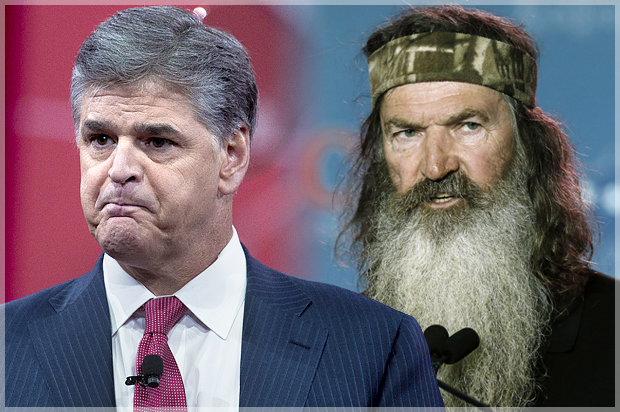
Dear White America: Your toxic masculinity is killing youSean Hannity, Phil Robertson (Credit: Jeff Malet, maletphoto.com/AP/Bill Haber/Salon)
Dear White America,
I am your friend. I have written several letters of this type to you before. It pains me to have to do so again. What I am going to share in this letter may be commonsense for many white brothers and sisters. Other White Americans may be surprised. Because our society is so segregated, people of color often do not have many opportunities to talk with white people in a direct way regarding our sincere worries about the problems in your community. I hope that this open letter can be part of a broader conversation in that regard.
When a person suffers from chronic pain they often find ways to compensate for it. Some people self-medicate with drugs or alcohol. Others develop the mental discipline necessary to compartmentalize their physical suffering. Others cocoon themselves in a bubble of denial. Because I am your friend, I am going to be honest with you. White America is suffering from a type of cancer. It is hurting you; it is killing your children; it is damaging families; it hurls shrapnel in many directions, maiming and otherwise bringing an end to the lives of those people who are unfortunate enough to be in its blast radius. If you want the truth, this is it: toxic white masculinity, and the backward right-wing politics which nurture and protect it, are hurting millions of you every year.
I know that is hard to digest. But, because I care about you White America, I am obligated to tell you the truth, even at the risk of your discomfort.
For many of you, the very idea that there is such a thing as toxic white masculinity is both surprising and enraging. Denial and anger are a very normal reaction when an uncomfortable truth is called to account. But it is the truth. Toxic white masculinity is a fear of the world changing to the disadvantage of white men, and where what too many white men take as natural rights are actually going to be exposed as unfair advantages, advantages which were gifted by a lottery of genetics and fortune of birth, as opposed to earned merit.
Toxic white masculinity defaults to violence as a means of maintaining social and political control. It clings to guns as a symbol of “real” male identity. It fears women as equals; it lashes out at non-whites who are somehow “stealing” white men’s jobs and power. Toxic white masculinity sees “liberals,” “progressives,” “social justice,” and “feminism” as enemies — out of a fear that “white masculinity” will somehow be made obsolete or extinct. The dream worlds and paranoid fantasies of angry white men are distractions that look to some type of Other as the preeminent threat to America’s safety and security. The reality is of course, very different.
In reality, right-wing domestic terrorists and mass shooters are the number one threat to America’s safety and security since September 11, 2001.
White men are approximately 31 percent of the United States population. And yet, white men are nearly 63 percent of those people who commit mass shootings. Such behavior, among any other group, would be considered pathological and a public health crisis.
Dylann Roof turned his toxic white racist masculinity on a black church in Charleston. And John Houser — a white, right-wing, conservative, Christian fundamentalist, an anti-feminist, woman-hating Nazi sympathizer — directed his rage towards a movie theater in Lafayette last month, where he killed three people and wounded eight others.
Because I am your friend White America, I will share another truth with you: While the mainstream news media will run away from subjects that make you uncomfortable, it is no coincidence that “Trainwreck,” a movie written by a white Jewish feminist comedian, was the target of John Houser’s lethal actions. It was not“mental illness” which made John Houser shoot those people in Lafayette, although such a claim is a common deflection that prevents a serious discussion of white masculinity and mass shootings. One can be “mentally ill” separate and apart from their violent impulses. No, it was extreme right-wing politics and toxic white masculinity that drove Houser to kill.
This is just the tip of the iceberg. The killing and abuse of women by men in the United States — the vast majority of it committed within the same “racial” group — is so common that it is rarely deemed to be newsworthy by the mainstream news media. This is a disgusting national embarrassment.
Toxic white masculinity is a complex problem. And you cannot fix it unless you also confront how toxic white masculinity is nurtured and encouraged by your news media and political representatives. While I do not think that you are a victim of your news media and political parties, you have nonetheless been done a disservice by them.
Fox News is your mouthpiece: 92 percent of its prime time viewing audience is white. Fox is the most popular cable news network in the United States. Millions of people watch it on a daily basis. Fox News is part of a propaganda machine that consists of the Internet, radio, and social media. This has created an alternate reality for many White Americans where down is up and up is down, so to speak. Researchers have shown that the right-wing media actually makes its public less knowledgeable about empirical reality and current events than those people who do not watch or listen to it.
The white identity politics, grievance mongering, conspiracies, paranoid thinking, eliminationist rhetoric about liberals and progressives, hostility to women, rage against immigrants, anxiety about those who are not “Christian”, and mainstreaming of white supremacy and white racial resentment, are the fuel for toxic white masculinity. The right-wing media gins up and encourages such sentiments because it is dependent on them for viewers and ad revenue.
The Republican Party, meanwhile, is America’s most prominent white identity organization. Since the end of the civil rights movement, the modern GOP has fused together conservatism and racism as its name brand. In the Age of Obama, the Republican Party has found itself increasingly dysfunctional as its politics are seemingly unable to evolve beyond “hate the black guy in the White House and anything that he proposes,” however reasonable. In many ways — the fetishistic embrace of guns, hostility to women’s rights, Islamophobia, symbolic and overt racism against black people — the policies and talking points of the contemporary Republican Party are toxic white masculinity as a campaign platform. Together with the alternate reality created by the right-wing media, the Republican Party has become so radicalized, breaking many of the standing norms of consensus politics in modern American politics, that it no longer functions as a responsible political organization.
White America, you have been confused, misled, and lied to by your primary political party and media. This is hurting you in many ways.
The American economy is broken. Wealth and income inequality are severe. The psychological wages of being White in America may still exist, but they are not translating into the material wealth they once did in the not so recent past. For example, there are more White Americans on welfare and other types of public aid than any other group. White Americans also receive a disproportionate percentageof public assistance dollars. As Robert Putnam details in his new book “Our Kids: The American Dream in Crisis,” the life opportunities and upward mobility of White America are increasingly imperiled. The abuse of prescription drugs, as well as illegal narcotics such as heroine and methamphetamines, is a severe problem for White America. The sum total of these and other troubles have left white folks — white men especially — less hopeful and feeling more insecure and angry about their future.
It is en vogue as of late to talk about the concept known as “white privilege.” I believe that such language often does more to distract than it reveals. I will not use it here. Given the many problems you are facing in these times of trouble, tumult, and economic peril, you are likely not feeling very privileged at all. I still have great hope for the possibilities that folks can come together to find shared and common concerns across barriers of race and class. But as much as I find inspiration in such dreams — and the examples history has provided us of such alliances in the United States and elsewhere — I will restrain myself.
Instead, I will appeal to your most basic self-interest.
White America, your media and political leadership have created a broken politics and economy that have left you less secure, less safe, and less upwardly mobile than generations past. But hostility and anxiety towards people who may have a different skin color than you is fool’s gold. White America’s leaders, and the plutocrats to whom they owe their allegiance, have been using that fake money to hustle and manipulate you for centuries.
White America, toxic white masculinity has provided a type of succor and protective blanket for many of your men. But this toxic white masculinity is killing your women and children — and even hurting and killing your men as well, both in the literal physical sense, and the figurative one, damaging their capacity to live full and emotionally healthy and satisfying lives.
White America, I end this open letter as I began it. I am your friend. I care deeply about your health and well-being. You can make a better way. But first, you must choose to do so.
Chauncey DeVega is editor and founder of the blog We Are Respectable Negroes, whose work has been featured by the NY Times, Alternet, the BBC, the New York Daily News, the Utne Reader, the Week, and The Atlantic Monthly. Chauncey DeVega is also a regular guest on Ring of Fire Radio and TV. He can be followed on Twitter and Facebook.

Saturday, May 16, 2015

The Myth of American Exceptionalism


FP


Voice

The Myth of American Exceptionalism


The idea that the United States is uniquely virtuous may be comforting to Americans. Too bad it's not true.


The Myth of American Exceptionalism


Over the last two centuries, prominent Americans have described the United States as an "empire of liberty," a "shining city on a hill," the "last best hope of Earth," the "leader of the free world," and the "indispensable nation." These enduring tropes explain why all presidential candidates feel compelled to offer ritualistic paeans to America’s greatness and why President Barack Obama landed in hot water — most recently, from Mitt Romney — for saying that while he believed in "American exceptionalism," it was no different from "British exceptionalism," "Greek exceptionalism," or any other country’s brand of patriotic chest-thumping.


Most statements of "American exceptionalism" presume that America’s values, political system, and history are unique and worthy of universal admiration. They also imply that the United States is both destined and entitled to play a distinct and positive role on the world stage.

The only thing wrong with this self-congratulatory portrait of America’s global role is that it is mostly a myth. Although the United States possesses certain unique qualities — from high levels of religiosity to a political culture that privileges individual freedom — the conduct of U.S. foreign policy has been determined primarily by its relative power and by the inherently competitive nature of international politics. By focusing on their supposedly exceptional qualities, Americans blind themselves to the ways that they are a lot like everyone else.

This unchallenged faith in American exceptionalism makes it harder for Americans to understand why others are less enthusiastic about U.S. dominance, often alarmed by U.S. policies, and frequently irritated by what they see as U.S. hypocrisy, whether the subject is possession of nuclear weapons, conformity with international law, or America’s tendency to condemn the conduct of others while ignoring its own failings. Ironically, U.S. foreign policy would probably be more effective if Americans were less convinced of their own unique virtues and less eager to proclaim them.

What we need, in short, is a more realistic and critical assessment of America’s true character and contributions. In that spirit, I offer here the Top 5 Myths about American Exceptionalism.


Myth 1

There Is Something Exceptional About American Exceptionalism.

 
Whenever American leaders refer to the "unique" responsibilities of the United States, they are saying that it is different from other powers and that these differences require them to take on special burdens.

Yet there is nothing unusual about such lofty declarations; indeed, those who make them are treading a well-worn path. Most great powers have considered themselves superior to their rivals and have believed that they were advancing some greater good when they imposed their preferences on others. The British thought they were bearing the "white man’s burden," while French colonialists invoked la mission civilisatrice to justify their empire. Portugal, whose imperial activities were hardly distinguished, believed it was promoting a certain missão civilizadora. Even many of the officials of the former Soviet Union genuinely believed they were leading the world toward a socialist utopia despite the many cruelties that communist rule inflicted. Of course, the United States has by far the better claim to virtue than Stalin or his successors, but Obama was right to remind us that all countries prize their own particular qualities.

So when Americans proclaim they are exceptional and indispensable, they are simply the latest nation to sing a familiar old song. Among great powers, thinking you’re special is the norm, not the exception.


Myth 2

The United States Behaves Better Than Other Nations Do.

 
Declarations of American exceptionalism rest on the belief that the United States is a uniquely virtuous nation, one that loves peace, nurtures liberty, respects human rights, and embraces the rule of law. Americans like to think their country behaves much better than other states do, and certainly better than other great powers.

If only it were true. The United States may not have been as brutal as the worst states in world history, but a dispassionate look at the historical record belies most claims about America’s moral superiority.

For starters, the United States has been one of the most expansionist powers in modern history. It began as 13 small colonies clinging to the Eastern Seaboard, but eventually expanded across North America, seizing Texas, Arizona, New Mexico, and California from Mexico in 1846. Along the way, it eliminated most of the native population and confined the survivors to impoverished reservations. By the mid-19th century, it had pushed Britain out of the Pacific Northwest and consolidated its hegemony over the Western Hemisphere.

The United States has fought numerous wars since then — starting several of them — and its wartime conduct has hardly been a model of restraint. The 1899-1902 conquest of the Philippines killed some 200,000 to 400,000 Filipinos, most of them civilians, and the United States and its allies did not hesitate to dispatch some 305,000 German and 330,000 Japanese civilians through aerial bombing during World War II, mostly through deliberate campaigns against enemy cities. No wonder Gen. Curtis LeMay, who directed the bombing campaign against Japan, told an aide, "If the U.S. lost the war, we would be prosecuted as war criminals." The United States dropped more than 6 million tons of bombs during the Indochina war, including tons of napalm and lethal defoliants like Agent Orange, and it is directly responsible for the deaths of many of the roughly 1 million civilians who died in that war.

More recently, the U.S.-backed Contra war in Nicaragua killed some 30,000 Nicaraguans, a percentage of their population equivalent to 2 million dead Americans. U.S. military action has led directly or indirectly to the deaths of 250,000 Muslims over the past three decades (and that’s a low-end estimate, not counting the deaths resulting from the sanctions against Iraq in the 1990s), including the more than 100,000 people who died following the invasion and occupation of Iraq in 2003. U.S. drones and Special Forces are going after suspected terrorists in at least five countries at present and have killed an unknown number of innocent civilians in the process. Some of these actions may have been necessary to make Americans more prosperous and secure. But while Americans would undoubtedly regard such acts as indefensible if some foreign country were doing them to us, hardly any U.S. politicians have questioned these policies. Instead, Americans still wonder, "Why do they hate us?"

The United States talks a good game on human rights and international law, but it has refused to sign most human rights treaties, is not a party to the International Criminal Court, and has been all too willing to cozy up to dictators — remember our friend Hosni Mubarak? — with abysmal human rights records. If that were not enough, the abuses at Abu Ghraib and the George W. Bush administration’s reliance on waterboarding, extraordinary rendition, and preventive detention should shake America’s belief that it consistently acts in a morally superior fashion. Obama’s decision to retain many of these policies suggests they were not a temporary aberration.

The United States never conquered a vast overseas empire or caused millions to die through tyrannical blunders like China’s Great Leap Forward or Stalin’s forced collectivization. And given the vast power at its disposal for much of the past century, Washington could certainly have done much worse. But the record is clear: U.S. leaders have done what they thought they had to do when confronted by external dangers, and they paid scant attention to moral principles along the way. The idea that the United States is uniquely virtuous may be comforting to Americans; too bad it’s not true. 


Myth 3

America’s Success Is Due to Its Special Genius.

 
The United States has enjoyed remarkable success, and Americans tend to portray their rise to world power as a direct result of the political foresight of the Founding Fathers, the virtues of the U.S. Constitution, the priority placed on individual liberty, and the creativity and hard work of the American people. In this narrative, the United States enjoys an exceptional global position today because it is, well, exceptional.

There is more than a grain of truth to this version of American history. It’s not an accident that immigrants came to America in droves in search of economic opportunity, and the "melting pot" myth facilitated the assimilation of each wave of new Americans. America’s scientific and technological achievements are fully deserving of praise and owe something to the openness and vitality of the American political order.

But America’s past success is due as much to good luck as to any uniquely American virtues. The new nation was lucky that the continent was lavishly endowed with natural resources and traversed by navigable rivers. It was lucky to have been founded far from the other great powers and even luckier that the native population was less advanced and highly susceptible to European diseases. Americans were fortunate that the European great powers were at war for much of the republic’s early history, which greatly facilitated its expansion across the continent, and its global primacy was ensured after the other great powers fought two devastating world wars. This account of America’s rise does not deny that the United States did many things right, but it also acknowledges that America’s present position owes as much to good fortune as to any special genius or "manifest destiny."


Myth 4

The United States Is Responsible for Most of the Good in the World.

 
Americans are fond of giving themselves credit for positive international developments. President Bill Clinton believed the United States was "indispensable to the forging of stable political relations," and the late Harvard University political scientist Samuel P. Huntington thought U.S. primacy was central "to the future of freedom, democracy, open economies, and international order in the world." Journalist Michael Hirsh has gone even further, writing in his book At War With Ourselves that America’s global role is "the greatest gift the world has received in many, many centuries, possibly all of recorded history." Scholarly works such as Tony Smith’s America’s Mission and G. John Ikenberry’s Liberal Leviathan emphasize America’s contribution to the spread of democracy and its promotion of a supposedly liberal world order. Given all the high-fives American leaders have given themselves, it is hardly surprising that most Americans see their country as an overwhelmingly positive force in world affairs.

Once again, there is something to this line of argument, just not enough to make it entirely accurate. The United States has made undeniable contributions to peace and stability in the world over the past century, including the Marshall Plan, the creation and management of the Bretton Woods system, its rhetorical support for the core principles of democracy and human rights, and its mostly stabilizing military presence in Europe and the Far East. But the belief that all good things flow from Washington’s wisdom overstates the U.S. contribution by a wide margin.

For starters, though Americans watching Saving Private Ryan or Patton may conclude that the United States played the central role in vanquishing Nazi Germany, most of the fighting was in Eastern Europe and the main burden of defeating Hitler’s war machine was borne by the Soviet Union. Similarly, though the Marshall Plan and NATO played important roles in Europe’s post-World War II success, Europeans deserve at least as much credit for rebuilding their economies, constructing a novel economic and political union, and moving beyond four centuries of sometimes bitter rivalry. Americans also tend to think they won the Cold War all by themselves, a view that ignores the contributions of other anti-Soviet adversaries and the courageous dissidents whose resistance to communist rule produced the "velvet revolutions" of 1989.

Moreover, as Godfrey Hodgson recently noted in his sympathetic but clear-eyed book, The Myth of American Exceptionalism, the spread of liberal ideals is a global phenomenon with roots in the Enlightenment, and European philosophers and political leaders did much to advance the democratic ideal. Similarly, the abolition of slavery and the long effort to improve the status of women owe more to Britain and other democracies than to the United States, where progress in both areas trailed many other countries. Nor can the United States claim a global leadership role today on gay rights, criminal justice, or economic equality — Europe’s got those areas covered.

Finally, any honest accounting of the past half-century must acknowledge the downside of American primacy. The United States has been the major producer of greenhouse gases for most of the last hundred years and thus a principal cause of the adverse changes that are altering the global environment. The United States stood on the wrong side of the long struggle against apartheid in South Africa and backed plenty of unsavory dictatorships — including Saddam Hussein’s — when short-term strategic interests dictated. Americans may be justly proud of their role in creating and defending Israel and in combating global anti-Semitism, but its one-sided policies have also prolonged Palestinian statelessness and sustained Israel’s brutal occupation.

Bottom line: Americans take too much credit for global progress and accept too little blame for areas where U.S. policy has in fact been counterproductive. Americans are blind to their weak spots, and in ways that have real-world consequences. Remember when Pentagon planners thought U.S. troops would be greeted in Baghdad with flowers and parades? They mostly got RPGs and IEDs instead.

Myth 5

God Is on Our Side.

 
A crucial component of American exceptionalism is the belief that the United States has a divinely ordained mission to lead the rest of the world. Ronald Reagan told audiences that there was "some divine plan" that had placed America here, and once quoted Pope Pius XII saying, "Into the hands of America God has placed the destinies of an afflicted mankind." Bush offered a similar view in 2004, saying, "We have a calling from beyond the stars to stand for freedom." The same idea was expressed, albeit less nobly, in Otto von Bismarck’s alleged quip that "God has a special providence for fools, drunks, and the United States."

Confidence is a valuable commodity for any country. But when a nation starts to think it enjoys the mandate of heaven and becomes convinced that it cannot fail or be led astray by scoundrels or incompetents, then reality is likely to deliver a swift rebuke. Ancient Athens, Napoleonic France, imperial Japan, and countless other countries have succumbed to this sort of hubris, and nearly always with catastrophic results.

Despite America’s many successes, the country is hardly immune from setbacks, follies, and boneheaded blunders. If you have any doubts about that, just reflect on how a decade of ill-advised tax cuts, two costly and unsuccessful wars, and a financial meltdown driven mostly by greed and corruption have managed to squander the privileged position the United States enjoyed at the end of the 20th century. Instead of assuming that God is on their side, perhaps Americans should heed Abraham Lincoln’s admonition that our greatest concern should be "whether we are on God’s side."

Given the many challenges Americans now face, from persistent unemployment to the burden of winding down two deadly wars, it’s unsurprising that they find the idea of their own exceptionalism comforting — and that their aspiring political leaders have been proclaiming it with increasing fervor. Such patriotism has its benefits, but not when it leads to a basic misunderstanding of America’s role in the world. This is exactly how bad decisions get made.

America has its own special qualities, as all countries do, but it is still a state embedded in a competitive global system. It is far stronger and richer than most, and its geopolitical position is remarkably favorable. These advantages give the United States a wider range of choice in its conduct of foreign affairs, but they don’t ensure that its choices will be good ones. Far from being a unique state whose behavior is radically different from that of other great powers, the United States has behaved like all the rest, pursuing its own self-interest first and foremost, seeking to improve its relative position over time, and devoting relatively little blood or treasure to purely idealistic pursuits. Yet, just like past great powers, it has convinced itself that it is different, and better, than everyone else. 

International politics is a contact sport, and even powerful states must compromise their political principles for the sake of security and prosperity. Nationalism is also a powerful force, and it inevitably highlights the country’s virtues and sugarcoats its less savory aspects. But if Americans want to be truly exceptional, they might start by viewing the whole idea of "American exceptionalism" with a much more skeptical eye.