Fair Use Notice

FAIR USE NOTICE

A BEAR MARKET ECONOMICS BLOG

OCCUPY MADNESS AND DYSFUNCTION

This site may contain copyrighted material the use of which has not always been specifically authorized by the copyright owner. We are making such material available in an effort to advance understanding of environmental, political, human rights, economic, democracy, scientific, and social justice issues, etc. we believe this constitutes a ‘fair use’ of any such copyrighted material as provided for in section 107 of the US Copyright Law.

In accordance with Title 17 U.S.C. Section 107, the material on this site is distributed without profit to those who have expressed a prior interest in receiving the included information for research and educational purposes. For more information go to: http://www.law.cornell.edu/uscode/17/107.shtml

If you wish to use copyrighted material from this site for purposes of your own that go beyond ‘fair use’, you must obtain permission from the copyright owner.

FAIR USE NOTICE FAIR USE NOTICE: This page may contain copyrighted material the use of which has not been specifically authorized by the copyright owner. This website distributes this material without profit to those who have expressed a prior interest in receiving the included information for scientific, research and educational purposes. We believe this constitutes a fair use of any such copyrighted material as provided for in 17 U.S.C § 107.

Read more at: http://www.etupdates.com/fair-use-notice/#.UpzWQRL3l5M | ET. Updates
FAIR USE NOTICE FAIR USE NOTICE: This page may contain copyrighted material the use of which has not been specifically authorized by the copyright owner. This website distributes this material without profit to those who have expressed a prior interest in receiving the included information for scientific, research and educational purposes. We believe this constitutes a fair use of any such copyrighted material as provided for in 17 U.S.C § 107.

Read more at: http://www.etupdates.com/fair-use-notice/#.UpzWQRL3l5M | ET. Updates

All Blogs licensed under Creative Commons Attribution 3.0

Friday, May 15, 2015

American Exceptionalism Is No Shining City On a Hill: It Never Was.


US Empire

American Exceptionalism Is No Shining City On a Hill

by GILBERT MERCIER


The concept of American exceptionalism is as old as the United States, and it implies that the country has a qualitative difference from other nations. This notion of being special gives Americans the sense that playing a lead role in world affair is part of their natural historic calling. However there is nothing historically exceptional about this: the Roman empire also viewed itself as a system superior to other nations and, more recently, so did the British and the French empires.

On the topic of American exceptionalism, which he often called “Americanism”, Seymour Martin Lipset noted that “America’s ideology can be described in five words: liberty, egalitarism, individualism, populism and laissez-faire. The revolutionary ideology, which became American creed, is liberalism in its eighteenth and nineteenth-century meaning. It departed from conservatism Toryism, statist communitarianism, mercantilism and noblesse-oblige dominant in monarchical state-church formed cultures.” Naturally identifying America’s system as a unique ideology, just like calling its successful colonial war against Britain a revolution, is a fallacy. For one, America was never based on social equality, as rigid class distinctions always remained through US history.

In reality, the US has never broken from European social models. American exceptionalism implies a sense of superiority, just like in the case of the British empire, the French empire and the Roman empire. In such imperialist systems, class inequality was never challenged and, as matter of fact, served as cornerstone of the imperial structure. In American history, the only exception to this system based on social inequality was during the post World War II era of the economic “miracle”. The period from 1945 to the mid 1970s was characterized by major economic growth, an absence of big economic downturns, and a much higher level of social mobility on a massive scale. This time frame saw a tremendous expansion of higher education: from 2.5 million people to 12 million going to colleges and universities, and this education explosion, naturally, fostered this upward mobility where the American dream became possible for the middle class.

Regardless of  real domestic social progress made in the United States after the birth of the empire in 1945, for the proponents of American exceptionalism — this includes the entire political class — the myth of the US being defined as a “shining city on a hill” has always been a rationale to justify the pursuit of imperialism. For example, when President Barack Obama addressed the nation to justify the US military intervention in Libya, he said that “America is different”, as if the US has a special role in history as a force for good. In a speech on US foreign policy, at West Point on May 28, 2014, Obama bluntly stated: “In fact, by most measures, America has rarely been stronger relative to the rest of the world. Those who argue otherwise — who suggest that America is in decline or has seen its global leadership slip away are misreading history. Our military has no peer….  I believe in American exceptionalism with every fiber of my being.”

In his book, Democracy In America, Frenchman Alexis de Tocqueville was lyrical in his propaganda-like adulation of American exceptionalism, defining it almost as divine providence. “When the earth was given to men by the Creator, the earth was inexhaustible. But men were weak and ignorant, and when they had learned to take advantage of the treasures which it contained, they already covered its surface and were soon obliged to earn by the sword an asylum for repose and freedom. Just then North America was discovered, as if it had been kept in reserve by the Deity and had risen from beneath the waters of the deluge”, wrote de Tocqueville.

This notion, originated by the French author, and amplified ever since, which defined the US as the “divine gift” of a moral and virtuous land, is a cruel fairy tale. It is mainly convenient to ease up America’s profound guilt. After all, the brutal birth of this nation took place under the curse of two cardinal sins: the theft of Native American lands after committing a genocide of their population; and the hideous crime of slavery, with slaves building an immense wealth for the few, in a new feudal system, with their sweat, tears and blood.


Gilbert Mercier is the Editor in Chief of News Junkie Post.

Sunday, May 3, 2015

Institutional Racism and Poverty


Meryl Mohan


Institutional Racism and Poverty


Social Inequality and Public Policy - Professor Isaac Martin - March 2009

Institutional racism is a form of racism that exists subtly and beneath the conspicuous actions and policies of structures and institutions. For the purposes of this paper, “institution” refers to an establishment or governing body that creates or sets rules, policies, or standards in society. These institutions produce a societal order and hierarchy, impacting human behavior with its power to overshadow individuals’ own potential and intentions. “Racism” refers to the belief, and acts in conjunction with this belief, that particular races are innately different and inferior to others. Yet, beyond this compound definition, this research paper regards institutional racism as not only the deliberate actions of institutions, but also the ignorant and apathetic actions of institutions in perpetuating racism.


In this paper, I plan to discuss this particular form of racism, debating its contributions to the issue of poverty. I argue the way in which institutions can keep people in poverty or even force people into poverty in the United States. I believe this research is important, as institutional racism often goes under the radar. Often, only field research or investigation reveals the subversive tactics of institutional racism. In addition, it normatively goes unrecognized by the public and even those who are directly affected by it. As a result, this form of discrimination, whether deliberate or incognizant, is more difficult to curtail. These methods are safeguarded by the institutions themselves, falling under an umbrella of legitimate policies and actions. With relation to poverty, institutional racism can keep certain races in a perpetual condition of poverty, denying them the opportunities and capabilities to rise above their poor status.

This research is potentially important for policy makers, as information on this topic can provide greater resources and different angles for policy makers to approach the issue of poverty. Even as race itself is a “taboo” subject, conclusive research has the potential to present evidence pointing to institutional racism and the prevalence of poverty among those races. As policy makers have the possibility to influence, curb, or promote the institutional decisions regarding access to jobs, education, or a good quality of life, this research will be potentially important for them. With more strict policies regarding institutions and racism, policy makers can begin to tackle an issue that is still prevalent in society today.

One can examine this issue in a variety of methods, yet I intend to address institutional racism through particular categories of structures and their adverse effect on poverty. Specifically, I will focus on the institutions within the sectors of criminal justice, education, and urban planning. The structures of criminal justice include the prisons and courts of the criminal justice system. Within education, the school boards and test-maker organizations both execute institutionally racist practices. Finally, in the field of urban planning, the city government further maintains and increases poverty among minorities. All of these three spheres connect along the overarching importance of geographic mismatch. The spatial relations of the prisons, the inner city schools, and the industrial urban centers all reflect the setbacks and opportunities minorities face in the United States.

In the sphere of criminal justice, the institutions of prisons and courts create a system that purports racism and contributes to poverty in the United States. In this system, institutional racism takes root in the factors that generate the overwhelming majority of minorities in prison. In Katherine Pettus’s book Felony Disenfranchisement in America, she argues that the institution of prisons and the criminal justice system are a product of the racist roots upon which America was built (Pettus 151). She discusses the United States’s criminal justice policy as one that accentuates and breeds groups of domination and subordination. The same laws broken by white people are not handled through the criminal justice system, affirming that the law and the prisons were not created for white people in mind, but for minorities (151). In conjunction with this structure and composition of prisons, the geographic location of the prison creates and sustains disparate groups that institutionalize segregation. In society, prisons “perform a kind of social, economic, and political ‘magic’ by ‘disappearing’ large number of poor and minority people” (Rhodes 67). Statistics of the racial makeup in prisons further confirm these statements, as in the United States, more than 50 percent of the prisoners are African American, and 75 percent of the prisoners are people of color (67). Prisons remain on the periphery of white counties, isolated from the metropolis but still set in stark contrast to white suburbia and the cosmopolitan lifestyle (Pettus 20). The disenfranchised felons and ex-felons remain on the periphery of society, isolated from the opportunities within the metropolis.

Institutionally, the courts implement additional racist practices that contribute to this pervading disparity in prison demographic. The jury selection process, for example, results in primarily white juries. Customarily, this process relies on the exclusion of those with minimal educational credentials, hourly wage earners, and low-income individuals (Feagin and Feagin 141). As the courts themselves provide poor compensation, many low-income minorities cannot afford to leave their jobs to attend jury duty (142). Due to this condition, juries remain disproportionately white. Consequently, there exists an unequal representation of race and class in the courtroom, potentially increasing the number of minorities institutionalized in prisons.

The institution of prisons and the practices of courts harbor an environment in which the criminal justice system fails to provide a smooth re-integration of ex-felons into society. The lack of white populations in the prisons aid the legislation of restrictive laws that keep minorities barred from social integration after prison (Behrens et al. 599). Specifically, racial differences in punishment reflect restrictions on voting rights that “dilute the voting strength of minority groups” (599). Considering the racial makeup of prisons, its locality, and the lack of attention paid to minority disadvantages, disenfranchisement severely handicaps ex-felons and their re-entry into society. The stamp of a criminal record already hinders employment opportunities and earnings potential. With ex-felons representing about eight percent of the working-age population (Pager 938), the restrictions ex-felons face in obtaining housing or government benefits perpetuate poverty in society (Manza and Uggens 502). Denying them voting rights “undermines their capacity to connect with the political system, and [thereby] increase[s] their risk of recidivism” (Manza and Uggens 502). These factors continue a cycle in which minorities face greater risk of entering prison and greater difficulty in transitioning back into society once released. 

Institutional racism within the criminal justice sphere fosters the likelihood of minorities entering prison. Moreover, it further cultivates lingering effects upon ex-felons, making it atypical for them to rise above their peripheral status in society.

In addition to the institutional racism prevalent in the criminal justice system, education institutions like the school board and test-maker organizations also establish racist policies that perpetuate poverty in society. Through modes of cultural and linguistic ignorance, institutions pay inadequate attention to the respective needs of minorities in the education system. This mode continues from basic to college education, as institutions continue to tailor their best educational resources and opportunities to those of the white middle class. In “Institutionalized Racism and the Education of Blacks,” Spears discusses the educational performance of black students. He argues that the poor academic achievement by black students is partially due to educational systems’ ignorance of their various linguistic and cultural differences (Spears 128). Spears states that the same criteria and practices applied to white students cannot simply be applied to black students. For each individual, one must take into consideration the background and manner in which they are best suited to learn and grasp material. The decision makers of school curriculums in the inner city do not understand the ways in which discrimination and deprivation alter how students learn and mature. Black students are victimized by the institutions that disregard their educational needs, and comparing their performance to white students who lack this victimization by institutionalized racism is a false evaluation. Specifically in regard to African Americans, this racism denies the same opportunities and services by which they can achieve a good life.

Test-maker organizations also perpetuate racism by ignoring the cultural differences of low-income and minority students. These organizations create tests that do not take into consideration the cultural, linguistic, geographic, social, and economic differences of black students, for example. The inferior education provided in these inner city schools creates difficulties in passing written or standardized tests for minority students (Knowles and Prewitt 61). In continuing education, university admission offices provide entrance to students who score high on a test that is geared towards white middle class high schools, not the inner city schools in which minority population is high (5). Even if these universities do not purposely implement racist practices, they unwittingly grant the white, middle, and affluent classes a higher education and a more financially secure future. The structures of education fail to prepare all students through methods of racial and class segregation, and minorities themselves lack the power to make these structural changes.

In the education system, school boards also exhibit forms of institutional racism by placing students in academic tracks based on ability. In “Tracking: From Theory to Practice,” Maureen T. Hallinan discusses the negative effects of placing children in these different tracks. She argues that this process fosters segregation, and the schools and school boards fail to take action to instate measures that prevent this segregation based on race, social status, and class (Hallinan 84). The racism prevalent in these tracking systems is evident through the overrepresentation of African Americans and Latinos in the lower tracks. Many schools in predominantly poor and minority neighborhoods offer a fewer percentage of higher track classes, in comparison to those in affluent white and Asian populated areas (Oakes 229). In addition, higher tracks vary across racial and economic lines. In schools with more minority and lower-income populations, evidence shows a disparity in the quality of resources and opportunities offered. For example, an Algebra 2 class in a minority-rich neighborhood might be taught by a less qualified teacher with a less rigorous curriculum than the same class in a predominantly white, prosperous neighborhood (229). Teachers themselves gravitate towards the white, affluent communities that offer higher pay and esteem, leaving the less wealthy communities with less-qualified teachers. Furthermore, high competition in the wealthier schools results in minority students having greater chances of college-track enrollment at all-minority schools. As a consequence, minority students receive an inferior quality of education in comparison, hindering the acquisition of human capital with which to compete in the labor market.  

Repeatedly, spatial and geographic orientation is seen to either harm or foster a good quality of life, whether it concerns prisons and their peripheral location, or the inferior education prevalent in the inner city schools. Institutions within the urban planning sector, such as the city government, also influence the geographic location of individuals, defining zones and setting ordinances. 

Proximity to certain areas impacts one’s capability to obtain a job and remain in healthy living and working conditions. Primarily, the lack of consideration and recognition of the effects of zoning and urban planning reflects in the continuing poverty of minorities. The polarization of jobs and housing, for example, negatively affects the minorities who live in the metropolitan centers. According to Knowles and Prewitt in Institutional Racism in America, the “ghetto resident is left without the means to reach most jobs,” as city governments fail to provide low-cost, adequate transportation to the outlying areas where income potential is higher (Knowles and Prewitt 21). The majority of well-paying jobs follow the white middle class into the areas in which they live. This geographic mismatch leaves them outside the “major web of recruitment,” which occurs in the suburban spheres of economic development (Feagin and Feagin 47). As a result, those in the inner city are left with the low paying jobs that cannot suffice for a good quality of life.

In addition to this, minority families are often susceptible, through projects like urban renewal, to the dangers of noise, pollution, and other ills that only perpetuate a status of poverty and deprivation. These plans look to eliminate slum housing and replace it with private businesses that expand profit, forcing minorities in these locations out of their homes (Feagin and Feagin 107). With projects like highway construction to connect white suburbs, minority families are further displaced. White middle-class individuals can leave these locations with ease, whereas “the black people [evicted] by the bulldozers” find it extremely difficult (Knowles and Prewitt 28). Institutional racism lives within the city governments of the United States whose inaction and lack of recognition reproduces the adverse effects of decisions like urban renewal.

In addition to urban renewal, the city government also practices institutional racism as it relates to environmental racism. Specifically, environmental racism addresses environmental hazards and demographics, arguing the existence of “white privilege.” White privilege in this instance refers to the way in which white society has utilized their race to engender environmental racism, allowing people of color to inherit the hazards of urban development (Pulido 12). In many cities, whites have managed to move away from the industrial centers through suburbanization. In Los Angeles, however, many nonwhites have started moving into the suburbs neighboring the industrial core. As a result, these suburbs have now become an extension of the inner city, and central Los Angeles remains a largely nonwhite area (12). Yet, these same areas are also where the concentration of environmental hazards exists. Minorities are forced into the hazardous city center, and the city government allows these people to live in dangerous health zones. The government controls land uses and ordinances, and permits noxious land uses around areas such as central Los Angeles. This heightens poverty, creating an undesirable environment in which businesses cannot grow, job opportunities diminish, health conditions worsen, and the quality of life disintegrates.

Institutional racism rests within the structures of America’s society. Through the seemingly legitimate actions of these institutions, the effects of this form of racism continue to act as a pervading cause of poverty. Spatial relations, one of the most significant criteria in the status of poverty among individuals, often determines the wealth of opportunities and resources available to people. Whether this locality relates to one’s job, housing, or other aspects, geographic mismatch decidedly contributes to the perpetuation of poverty. In the sectors of criminal justice, education, and urban planning, the location of the prisons, the inner city schools, and the layout of homes and jobs create a web of disparity between minorities and the white, affluent class. The overt, subtle, and even ignorant actions of institutions in these sectors further reproduce poverty along racial lines, establishing conditions in which minorities are set at a considerable disadvantage in society.

Works Cited
  1. Behrens, Angela, and Christopher Uggen and Jeff Manza. “Ballot Manipulation and the ‘Menace of Negro Domination’: Racial Threat and Felon Disenfranchisement in the United States.” The American Journal of Sociology. 109.3 (2003): 559-6065. JSTOR. 2 March 2009. <http://links.jstor.org/search>.
  2. Feagin, Joe R. and Clairece Booher Feagin. Discrimination American Style. Englewood Cliffs: Prentice-Hall, Inc., 1978.
  3. Frymer, Paul. “Courts, Labor Law, and the Institutional Construction of Racial Animus.” The American Political Science Review. 99.3 (2005): 373-387. JSTOR. 9 Feb. 2009. <http://links.jstor.org/search>.
  4. Hallinan, Maureen T. “Tracking: From Theory to Practice.” Sociology of Education. 67.2 (1994): 79-84. JSTOR. 2 March 2009. <http://links.jstor.org/search>.
  5. Knowles, Louis L. and Kenneth Prewitt. Institutional Racism in America. Englewood Cliffs: Prentice-Hall, Inc., 1969.
  6. Manza, Jeff and Christopher Uggen. “Punishment and Democracy: Disenfranchisement of Nonincarcerated Felons in the United States.” Perspectives on Politics. 2.3 (2004): 491-505.  JSTOR. 18 March 2009. <http://links.jstor.org/search>.
  7. Oakes, Jeannie. Keeping Track: How Schools Structure Inequality. New Haven: Yale University Press, 1985.
  8. Pager, Devah. “The Mark of a Criminal Record.” The American Journal of Sociology. 108.5 (2003): 937-975. JSTOR. 17 March 2009. <http://links.jstor.org/search>.
  9. Pettus, Katherine Irene. Felony Disenfranchisement in America. New York: LFB Scholarly Publishing LLC, 2005.
  10. Pulido, Laura. “Rethinking Environmental Racism: White Privilege and Urban Development in Southern California.” Annals of the Association of American Geographers. 90.1 (2000): 12-40. JSTOR. 9 Feb. 2009. <http://links.jstor.org/search>.
  11. Rhodes, Lorna A. “Toward an Anthropology of Prisons.” Annual Review of Anthropology. 30 (2001): 65-83. JSTOR. 17 March 2009. <http://links.jstor.org/search>.
  12. Spears, Arthur K. “Institutionalized Racism and the Education of Blacks.” Anthropology & Education Quarterly. 90.2 (1978): 127-136. JSTOR. 9 Feb. 2009. <http://links.jstor.org/search>.

Saturday, April 25, 2015

2 political scientists have found the secret to partisanship, and it’s deeply depressing

VOX


2 political scientists have found the secret to partisanship, and it’s deeply depressing


Politics isn't about who you love. It's about who you fear.
That's the upshot of a draft paper by political scientists Alan Abramowitz and Steven Webster that attempts to untangle a mystery about modern American politics: how can there be record levels of party loyalty and straight-ticket voting at the same time that fewer Americans than ever before are identifying as Republicans and Democrats?
To answer the question, Abramowitz and Webster test a host of political characteristics to see what best predicts party loyalty. The real key, they found, was fear of the other party: "Regardless of the strength of their attachment to their own party, the more voters dislike the opposing party, the greater the probability that they will vote consistently for their own party’s candidates."
It's worth saying that a bit more clearly: you're more likely to vote Democratic if you hate Republicans than if you love Democrats, and vice versa. What parties need to do to keep you loyal isn't make you inspired. Rather, they need to make you scared.

Partisans like their own party less, but they like the other party a lot less

You don't actually need a regression analysis to see that hate, not love, is driving the changes in American politics. Abramowitz and Webster include this graph of people's attitudes toward their party, and toward the opposing party, and it gets more disturbing the longer you look at it:
party thermometer chart
What's changed isn't how much we like our own party. It's how much we hate the other party. (Chart: Abramowitz/Webster)
The thick line atop the chart shows people's attitudes toward their own party since 1980. The change there isn't dramatic, but it's noticeable: on net, people like their own party a bit less than they did in '80s and '90s.
Consider that for a minute: even as people have become more loyal to their political party, they actually like their party less. That's a very strange finding. But it's more than explained by the line at the bottom of the chart. That line shows people's attitudes toward the other party — and there, you see a sharp, sustained drop in favorability.
This, then, is the last 30 years of American party politics in a sentence: we like the party we belong to a bit less, but we hate the other party much more.

Parties thrive on their members' fears

This chart from Pew's massive survey around partisan polarization is a powerful companion to Abramowitz and Webster's work:
partisan animosity
People often compare politics to sports. Both have teams, and winners and losers, and the different sides often hate each other. But here's where the analogy falls apart: in politics, many believe — often correctly — that if the wrong side wins, the consequences will be grievous. The other side isn't just disliked. It's feared.
What's more, politicians from both parties have an incentive to keep it that way. This chart also comes from Pew, and it's powerful: it shows that the more you hate the other party, the likelier you are to vote, and the likelier you are to donate money to candidates from your party:

How demographics drive partisan animosity

The question all this raises is why voters are coming to fear the other party more with each passing decade. The answer Abramowitz and Webster offer is that it comes down to changing composition: the two parties are becoming more demographically dissimilar from each other, and that's making it easier for them to hate each other.
Abramowitz and Webster note, for instance, "In 2012, according to the national exit poll, nonwhites made up 45 percent of Democratic congressional and presidential voters but only 11 percent of Republican congressional and presidential voters." Meanwhile, the Republican Party has become much more religious: in 1980, 48 percent of observant white voters were Republicans; by 2012, that had risen to 78 percent.
This is leading to sharper polarization on major cultural issues like abortion. "Between 1980 and 2012 the proportion of Democratic voters taking a strongly pro-choice position on abortion rose from 38 percent to 61 percent," write Abramowitz and Webster, while the proportion of Republicans "favoring a ban or stricter limits on abortion rose from 42 percent to 51 percent."
In other words, as the parties become more distant demographically and culturally, they become more distant on policy, too. And so voters of each party are being at least somewhat rational in their increased fear of the other party: a liberal Democrat actually has more to fear from the Republican Party of 2012 than she did from the Republican Party of 1980, and vice versa.

Why Republicans will dominate Congress and Democrats will turn out for Hillary

This theory leads to at least a few major conclusions about American politics. The one Abramowitz and Webster emphasize is that it gives Republicans an enduring advantage in congressional elections. Republicans have long had a geographical advantage in both House and Senate elections because their voters are more spread out than Democratic voters. In the past, Democratic candidate could compete by distancing themselves from the national party and making the election about local issues. But as the country grows more partisan, that's becoming harder, and the result is that Republicans are likely to be dominant at the congressional level for some time.
Jonathan Chait, meanwhile, pulls some good news for Democrats out of the data. Just as Republicans have a natural advantage at the congressional level, Chait believes Democrats have a natural advantage at the presidential level, where the voters skew younger and less white. And if fear of a Republican president means the Obama coalition persists after Obama, then it's going to be a long time before Republicans win back the White House.
Both of these lessons speak to the same underlying reality: as American politics becomes more partisan, and more based on fear of the opposing party, individual candidates matter less. So for all the talk of how much less enthusiastic Democrats are for Hillary Clinton than they were for Barack Obama, it's not likely to matter all that much because Democrats are going to be extremely enthusiastic about beating the Republicans, and vice versa.

Friday, April 3, 2015

Creationism as a mental illness


Psychology Today


Creationism as a mental illness

In Cockney rhyming slang, the word ‘believe' is represented by ‘Adam and Eve'. When faced with something baffling, shocking or plain peculiar, you might use the rhetorical expression, ‘Would you Adam and Eve it?' It's ironic, then, that one of the great debates of the day is about the literal truth of the bible story; or in other words, the extent to which we should Adam and Eve in Adam and Eve.
It's a question not just of belief but of denial. The phrase ‘in denial' has become so commonplace it's hard to still hear its power. In common with the ostrich which, as danger approaches, buries its head in the sand, those who are ‘in denial' prefer a false but subjective sense of security to a true but objectively scary reality. Denial brings short term, if illusory, comfort.

Hence creationism, the theory/superstition that, contrary to massive scientific evidence, the world began exactly as described in the Book of Genesis. Instead of deriving from millions of years of patient evolution, Adam and Eve popped out, fully formed, like characters from a Swiss cuckoo clock. Would you Adam and Eve it? Of course not. It's a myth, but like many myths it serves a psychological purpose which is to provide a storybook sense of simple origins, which allays people's fears. Those who believe this myth to be the truth are in a state of denial.


Along with denial, two other factors connect creationism with mental illness. The first is psychosis, which is an extension of denial. If psychosis is marked by the discrepancy between one's personal view of the world and the consensual view, creationism holds onto the personal view at all costs, refusing to accept what is abundantly clear. True, if creationism became the majority view, its psychotic character might be mitigated. Except that this majority view would have no more valence than the belief so widely held about the relationship between the sun and the earth before Copernicus proved how the latter orbits the former, and not vice versa.

Finally, creationism shares with autism an alleged lack of ability for irony. Creationists take the bible story as literally true, unable to recognise that it might be working on those other, mythic levels.

If tests for madness include talking to yourself and looking for hairs on the palm of your hand, then here's another: do you Adam and Eve in Adam and Eve?


Robert Rowland Smith is the author of 'Breakfast with Socrates: an Extraordinary (Philosophical) Journey Through your Ordinary Day' (Free Press).

Conservatism as a Mental Illness


Psychology Today


This post is in response to Creationism as a mental illness by Robert Rowland Smith
 
 
In Creationism as a Mental Illness, Robert Rowland Smith argues that creationists exhibit several signs of mental illness including denial, psychosis, and inability to grasp irony.


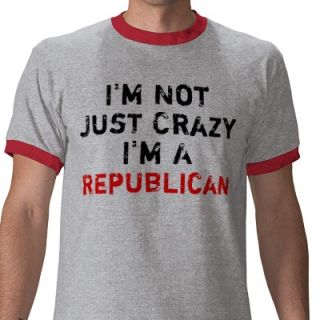
The specter of mental illness does indeed loom large over creationists, but they are not alone. Signs of psychopathology can also be seen among their political bedfellows, conservative politicians, especially when you consider a wide range of illness indicators. In his award-winning 2005 book, Dr. James Whitney Hicks discusses 50 signs of mental illness (link is external) including denial, delusion, hallucination, disordered thinking, anger, anti-social behavior, sexual preoccupation, grandiosity, general oddness, and paranoia. Now I'm no clinician, but in my (admittedly biased brown) eyes it seems that prominent Republicans have evidenced each of these ten telltale signs of mental illness over the past year:

1) Denial: humans did not evolve (link is external);  Obama is not a native-born American Christian (link is external)

2) Delusion: climate is not changing (link is external)

3) Hallucination: God ordained me to be President (link is external)

4) Disordered Thinking: being for small government that's huge in the bedroom (link is external);  being anti-contraception and anti-abortion (link is external)

5) Anger: Newt Gingrich’s perpetual scowl (link is external)

6) Anti-social Behaviortoward women (link is external), gays (link is external), minorities, anyone without an umbilical cord or trust fund

7) Sexual Preoccupation: a fervent compulsion to control when we can mate, with whom we can mate, and precisely how we are allowed to mate (which I lampoon in Why Do Politicians Want to Police Dick and Jane's Private Parts?)

8) Grandiosity: even Rick Santorum recognizes (link is external) Gingrich’s “over the moon” grandiosity (link is external)

9) General Oddness: Ron Paul (link is external)

10) Paranoiapretty much all of them, all of the time (link is external)
Even (the not necessarily dumb (link is external)) Pope Francis appears to recognize (link is external) that “it is a serious illness, this of ideological [conservative] Christians. It is an illness, but it is not new, eh?”

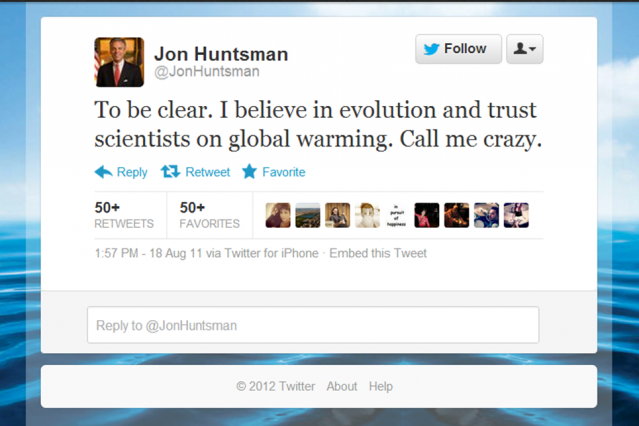
Regrettably, the Republican who least exhibits anti-science stances is the only one who (tongue-in-cheek) acknowledges his mental illness:


Until Jon Huntsman becomes the sane voice of his insane party, maybe "Republican Syndrome" should be added to the DSM-V (link is external) so that crazy conservative pols can receive the mental health treatment they need. I bet "Obamacare" would even cover it.
Follow me on Facebook  (link is external)and Twitter (link is external).  
Copyright © 2012 Barry X. Kuhle (link is external). All rights reserved.
Disclaimer: The views expressed in this blog do not necessarily reflect the views of Psychology Today and the University of Scranton, or me, or my friends, family, probation officer, gut bacteria, darkest thoughts, and personal mohel (link is external).

Tuesday, December 23, 2014

Our Broken Social Contract


The New York Times


Opinionator - A Gathering of Opinion From Around the Web

Our Broken Social Contract


Many Americans think that their country has lost its way. But when they try to make sense of what’s happening, they disagree about whether the problem is essentially economic or whether it stems from cultural and moral decay.
Charles Murray, the provocative author of “Coming Apart” and “The Bell Curve,” argues that the cultural insurgencies of the 1960s yanked crucial underpinnings out from the social order and undermined traditional norms of self-restraint, responsibility, family, faith and country. Murray’s latest portrayal of America’s social deterioration focuses on the long-term impact of these insurgencies, notably on a typical, though fictional, working-class community he calls Fishtown. Fishtown is made up of whites who “have no academic degree higher than a high school diploma. If they work, their job must be in a blue-collar, service, or low-level white-collar occupation.”
Murray continues:
Now let us return to the relationship of Fishtown’s decline with America’s civic culture. The decline of industriousness among Fishtown males strikes at the heart of the signature of America’s civic culture — the spirit of enterprise, stick-to-it-iveness, and hard work to make a better life for oneself and one’s children. The divergence in marriage and the rise of single-parent homes has cascading effects. The webs of civic engagement in an ordinary community are spun largely by parents who are trying to foster the right environment for their children — lobbying the city council to install four-way stop signs at an intersection where children play, coaching the Little League teams, using the P.T.A. to improve the neighborhood school. For that matter, many of the broader political issues in a town or small city are fought out because of their direct and indirect effects on the environment for raising children. Married fathers are a good source of labor for these tasks. Unmarried fathers are not. Nor can the void be filled by the moms. Single mothers who want to foster the right environment for their children are usually doing double duty already, trying to be the breadwinner and an attentive parent at the same time. Few single mothers have much time or energy to spare for community activities.

An eloquent description of American social dysfunction comes from my colleague David Brooks, writing about Edward Snowden, who leaked information on domestic surveillance. Brooks argues that Snowden is the product of an upbringing lacking “gently gradated authoritative structures: family, neighborhood, religious group, state, nation and world,” who thus became party to a
rising tide of distrust, the corrosive spread of cynicism, the fraying of the social fabric and the rise of people who are so individualistic in their outlook that they have no real understanding of how to knit others together and look after the common good.
A very different assessment of where and how America has lost its ethical and moral moorings comes from Alan Krueger, the chairman of President Obama’s Council of Economic Advisers. Krueger has argued in two recent appearances, at Oberlin College and more recently at the Rock and Roll Hall of Fame (of all places) that the uncritical worship of the free market in the 1980s allowed the nation’s corporate elite to abandon longstanding constraints in its treatment of labor, especially in shifting the rewards of rising productivity from employees to the owners of capital.
With the blessing of the new right, Krueger argues, corporate America has abandoned its commitment to the commonweal over the past three decades. It no longer honors norms of fairness and equality. To Krueger, it is in the economic sphere that American integrity has been eroded and its ideals corrupted.
At Oberlin, Krueger put it this way:
In considering reasons for the growing wage gap between the top and everyone else, economists have tended to shy away from considerations of fairness and instead focus on market forces, mainly technological change and globalization. But given the compelling evidence that considerations of fairness matter for wage setting, I would argue that we need to devote more attention to the erosion of the norms, institutions and practices that maintain fairness in the job market. We also need to focus on the policies that can lead to more widely shared – and stronger – economic growth. It is natural to expect that market forces such as globalization would weaken norms and institutions that support fairness in wage setting. Yet I would argue that the erosion of the institutions and practices that support fairness has gone beyond market forces.
As the point man for the Obama administration on economic policy, Krueger has become the leading opponent of those who believe that growing inequality and middle-class stagnation are the inevitable consequences of technological innovation and the disruptive force of globalization.
The approach Krueger disputes was succinctly expressed by Greg Mankiw, a Harvard economist who served as chairman of the Council of Economic Advisers in the George W. Bush administration.
In 2006, writing on his blog, Mankiw tackled the factors behind the decline of unions, which once exerted countervailing pressures on corporate giants:
One is globalization. As the economy becomes more open, firms are increasingly operating in competitive markets. This means they have less economic profit that could be a target for unions.
In a 2013 paper, “Defending the One Percent,” Mankiw argues that
changes in technology have allowed a small number of highly educated and exceptionally talented individuals to command superstar incomes in ways that were not possible a generation ago.
Krueger agrees that globalization and technology have been powerful factors in shaping both the job market and the distribution of income. But he makes two points that directly undermine the economic inevitability argument, which is often used to justify the declining share of income going to labor and the sharp rise in income inequality that followed this decline.
First, if corporations are coerced by competition to slash spending, including labor costs, Krueger asks why “corporate profits as a share of the economy are near their all-time high.” Such profits make it particularly “hard to argue that companies do not have the ability to support higher wages.”
Figure 1 from the St. Louis Federal Reserve, hardly a bastion of radicalism, shows that corporate profits as a share of Gross Domestic Product have reached record levels:
Photo
Fig. 1 CreditSt. Louis Federal Reserve
Krueger suggests that the recent surge in corporate profits gives businesses wide leeway – what he terms a large “zone of indeterminacy”— to raise wages and remain solidly in the black.
Krueger’s second point is that rising inequality has not achieved improved productivity:
Productivity growth has not accelerated over the past 30 years; in fact, except for the late 1990s (when inequality narrowed) productivity growth has slowed. If the rise in inequality had improved incentives, one would have expected productivity growth to rise even more quickly, not slow down. Indeed, it is hard to see what the macroeconomy has gained from the enormous shift in the income distribution.
Before the 1980s, C.E.O. pay, according to Krueger, was set with close attention to norms of fairness, so that the range of compensation between janitors and top executives was kept within limits. This “social compact began to fray in the 1980s,” Krueger argued in his Cleveland speech. He provides a chart, Figure 2, showing “how labor compensation has failed to keep pace with productivity growth.”
Photo
Fig. 2 CreditWhitehouse.gov
To further buttress his case, Krueger points out (see Figure 3) that other wealthy countries have experienced the same economic pressures as the United States, but have not seen such sharp rises in inequality.
Photo
Fig. 3 CreditWhitehouse.gov
“The level of inequality varies considerably across these countries,” Krueger said. “The widely differing responses to globalization and technological change suggest that other factors mediate these forces.”
While Krueger’s analysis is very different from Charles Murray’s or from David Brooks’s, all three share an interest in what they see as disintegrating moral norms. And there is something else that binds them: the trends that Murray, Brooks and Krueger deplore continue with unrelenting force. From Murray’s perspective, social decay and irresponsible behavior have spread into the broad working and lower middle class.
Social indicators of conventionally defined moral standards are discouraging: The percentage of children born to unwed mothers has grown from 20 percent in 1984, when Murray published his seminal work, “Losing Ground”, to 41 percent in 2011; the rate among black women has gone from 59 percent to 72 percent, among white women from 12 percent to 29 percent and among Hispanic women 25 percent to 53 percent.
According to the Bureau of Labor Statistics, the work force participation rate among men without high school diplomas has fallen from 77.9 percent in 1983 to 57.9 percent in 2012, and for men with high school diplomas from 90.5 percent in 1983 to 69.6 percent in 2012.
Regarding David Brooks’s lament concerning the “rise of people who are so individualistic in their outlook that they have no real understanding of how to knit others together and look after the common good,” the American Psychological Association has published a paper containing this pithy observation:
“You can look at individual scores of narcissism, you can look at data on lifetime prevalence of Narcissistic Personality Disorder, you can look at related cultural trends, and they all point to one thing,” says W. Keith Campbell, Ph.D., head of the University of Georgia psychology department. “Narcissism is on the rise.”
Or look at the problem from Krueger’s perspective as an economist: since Jan. 20, 2009, the day Obama took office, the Gini index, a standard measure of income inequality, has risen steadily (Figure 4).
Photo
Fig. 4 CreditSt. Louis Federal Reserve
Krueger’s goal of bringing norms of fairness back into the business culture appears not to be taking hold. Emmanuel Saez, the Berkeley economist whose work on inequality is often cited by the Obama administration,released a study in January showing that during the first two years of the current recovery, 2009 to 2011, average family income grew by a modest 1.7 percent, “but the gains were very uneven. Top 1 percent incomes grew by 11.2 percent while bottom 99 percent incomes shrunk by 0.4 percent.” Top 1 percent incomes grew by 11.2 percent while bottom 99 percent incomes shrunk by 0.4 percent.”
Earlier this month, Obama acknowledged America’s uphill struggle on this score.”Too many middle-class families still feel like they’re working harder and harder and can’t get ahead,” he said. “Inequality is still growing in our society.”
If these trends continue, and most evidence suggests they will, one of the central ironies of the Obama years will be that a Democratic administration committed to pushing back against the unjust distribution of resources and to the promotion of morally cohesive communities will in fact have overseen an eight-year period of social disintegration, inequality and rising self-preoccupation.
This is not the legacy the Obama administration wants to leave.

Tuesday, April 15, 2014

Liberalism has won, which is why conservatives do what they do

Rally, person holding sign.
Kevin Drum riffs on a theme that has truly interested me of late:

Over the last half century, various branches of government have also taken plenty of proactive steps to marginalize religion. Prayer in public school has been banned. Creches can no longer be set up in front of city hall. Parochial schools are forbidden from receiving public funds. The Ten Commandments can't be displayed in courtrooms. Catholic hospitals are required to cover contraceptives for their employees. Gay marriage is legal in more than a dozen states and the number is growing rapidly.
His point is that liberals have won the culture war, and we have. Conservatives are left trying to justify their cultural relevance by pathetically disassembling box office receipts like this. (Did you know that Tina Fey and Ricky Gervais are "two of the most divisive actors working today"?) 
And it goes deeper than what Drum writes. Liberal social values are deeply embedded in our culture, from pretty much everything on TV outside the Christian channels at the fringe of the channel lineup, to any movie of note. In that Breitbart link above, Nick Nolte waxes about God's Not Dead, an indie Christian film that has grossed $41 million on a production budget of $2 million. Good job! Then again, it's a blip. Captain America has grossed nearly half a billion in 10 days, with its overtly civil-libertarian and anti-neocon message. I mean, Captain America is saying that a fear-based (read: Republican) foreign policy is not the "American Way."

For a crowd that flinches at any notion of sex, it's gotta be impossible to escape sexual imagery, from advertising to media to Miley Cyrus' latest whatever-the-hell she is doing. And seriously, don't listen to song lyrics. I flinched hearing my six-year-old daughter sing along with Flo Rida's "Whistle." She was too little to understand what that song was really about, but at some point, she will. I'm not the kind of parent overly concerned with "protecting" her from that sort of thing, but if you are, it's a tough world out there.

On economic matters, the pendulum is swinging hard against the financial elite. There's a reason we get regular installments of "billionaire calls economic populists Nazis." They were used to being paragons of society. Now they are the enemy. And with populism on the rise, and with talk of income inequality routine, Reaganesque "trickle down" theories are decidedly out of favor. Why do you think Republicans are afraid to roll out their "solutions" to our problems? It's because they know their views, whether on health care or immigration or pretty much anything else, are out of touch with public opinion. Sure, there is infighting in their caucus, but it's a fight between those who think conservatism is popular and being loud-and-proud will be politically advantageous (e.g. Ted Cruz), and those who know how to read the polls.

That's not to say that we've WON won. We certainly have won the battle of ideas. But power isn't just about ideas. It's about wrestling the institutional levers of government from the retrogrades. Those entrenched economic and conservative interests wield power via the Supreme Court, through gross gerrymandering, through voter suppression efforts. So we've got a lot of work ahead of us.

But if you wonder why conservatives seem to carry perpetual grievances, it's because they know they have lost. The entire world around them has left them behind. Heck, they've created an entire alternate media world in which to cocoon themselves. But they know they've lost. They may still alternate between the "denial" (Ted Cruz) and "anger" (Bill Donohue) phases of acceptance, but the only question left is how long will it be before our government truly represents the public will. And when that happens, we'll be truly able to ignore the perpetual tempter tantrum from the Right.

Originally posted to kos on Mon Apr 14, 2014 at 11:24 AM PDT.

Also republished by Daily Kos.