The ethic of Wall Street is the ethic of celebrity. It is fused into one bizarre, perverted belief system and it has banished the possibility of the country returning to a reality-based world or avoiding internal collapse. A society that cannot distinguish reality from illusion dies.
This site may contain copyrighted material the use of which has not always been specifically authorized by the copyright owner. We are making such material available in an effort to advance understanding of environmental, political, human rights, economic, democracy, scientific, and social justice issues, etc. we believe this constitutes a ‘fair use’ of any such copyrighted material as provided for in section 107 of the US Copyright Law.
In accordance with Title 17 U.S.C. Section 107, the material on this site is distributed without profit to those who have expressed a prior interest in receiving the included information for research and educational purposes. For more information go to: http://www.law.cornell.edu/uscode/17/107.shtml
If you wish to use copyrighted material from this site for purposes of your own that go beyond ‘fair use’, you must obtain permission from the copyright owner.
FAIR USE NOTICE FAIR USE NOTICE: This page may contain copyrighted material the use of which has not been specifically authorized by the copyright owner. This website distributes this material without profit to those who have expressed a prior interest in receiving the included information for scientific, research and educational purposes. We believe this constitutes a fair use of any such copyrighted material as provided for in 17 U.S.C § 107.
FAIR USE NOTICE FAIR USE NOTICE: This page may contain copyrighted material the use of which has not been specifically authorized by the copyright owner. This website distributes this material without profit to those who have expressed a prior interest in receiving the included information for scientific, research and educational purposes. We believe this constitutes a fair use of any such copyrighted material as provided for in 17 U.S.C § 107.
In Cockney rhyming slang, the word ‘believe' is represented by ‘Adam
and Eve'. When faced with something baffling, shocking or plain
peculiar, you might use the rhetorical expression, ‘Would you Adam and
Eve it?' It's ironic, then, that one of the great debates of the day is
about the literal truth of the bible story; or in other words, the
extent to which we should Adam and Eve in Adam and Eve.
It's a question not just of belief but of denial. The phrase ‘in
denial' has become so commonplace it's hard to still hear its power. In
common with the ostrich which, as danger approaches, buries its head in
the sand, those who are ‘in denial' prefer a false but subjective sense
of security to a true but objectively scary reality. Denial brings short
term, if illusory, comfort.
Hence creationism, the theory/superstition
that, contrary to massive scientific evidence, the world began exactly
as described in the Book of Genesis. Instead of deriving from millions
of years of patient evolution, Adam and Eve popped out, fully formed,
like characters from a Swiss cuckoo clock. Would you Adam and Eve it? Of
course not. It's a myth, but like many myths it serves a psychological
purpose which is to provide a storybook sense of simple origins, which
allays people's fears. Those who believe this myth to be the truth are
in a state of denial.
Along with denial, two other factors connect creationism with mental
illness. The first is psychosis, which is an extension of denial. If
psychosis is marked by the discrepancy between one's personal view of
the world and the consensual view, creationism holds onto the personal
view at all costs, refusing to accept what is abundantly clear. True, if
creationism became the majority view, its psychotic character might be
mitigated. Except that this majority view would have no more valence
than the belief so widely held about the relationship between the sun
and the earth before Copernicus proved how the latter orbits the former,
and not vice versa.
Finally, creationism shares with autism
an alleged lack of ability for irony. Creationists take the bible story
as literally true, unable to recognise that it might be working on
those other, mythic levels.
If tests for madness include talking to yourself and looking for
hairs on the palm of your hand, then here's another: do you Adam and Eve
in Adam and Eve?
Robert Rowland Smith is the author of 'Breakfast with Socrates: an
Extraordinary (Philosophical) Journey Through your Ordinary Day' (Free
Press).
In Creationism as a Mental Illness, Robert
Rowland Smith argues that creationists exhibit several signs of mental
illness including denial, psychosis, and inability to grasp irony.
The specter of mental illness does indeed loom large over
creationists, but they are not alone. Signs of psychopathology can also
be seen among their political bedfellows, conservative politicians,
especially when you consider a wide range of illness indicators. In his
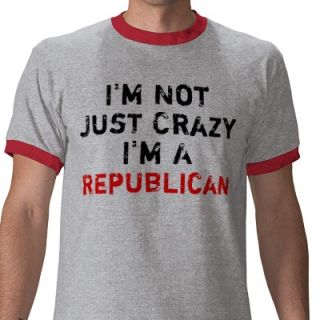
award-winning 2005 book, Dr. James Whitney Hicks discusses 50 signs of mental illness (link is external) including denial, delusion, hallucination, disordered thinking, anger, anti-social behavior, sexual preoccupation, grandiosity, general oddness, and paranoia. Now I'm no clinician, but in my (admittedly biased
brown) eyes it seems that prominent Republicans have evidenced each of
these ten telltale signs of mental illness over the past year:
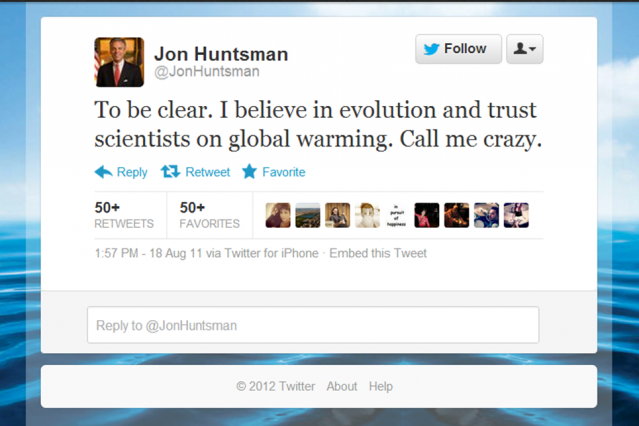
Regrettably, the Republican who least exhibits anti-science stances
is the only one who (tongue-in-cheek) acknowledges his mental illness:
Until Jon Huntsman becomes the sane voice of his insane party, maybe "Republican Syndrome" should be added to the DSM-V (link is external) so that crazy conservative pols can receive the mental health treatment they need. I bet "Obamacare" would even cover it.
Many Americans think that their country has lost its way. But when they try to make sense of what’s happening, they disagree about whether the problem is essentially economic or whether it stems from cultural and moral decay.
Charles Murray, the provocative author of “Coming Apart” and “The Bell Curve,” argues that the cultural insurgencies of the 1960s yanked crucial underpinnings out from the social order and undermined traditional norms of self-restraint, responsibility, family, faith and country. Murray’s latest portrayal of America’s social deterioration focuses on the long-term impact of these insurgencies, notably on a typical, though fictional, working-class community he calls Fishtown. Fishtown is made up of whites who “have no academic degree higher than a high school diploma. If they work, their job must be in a blue-collar, service, or low-level white-collar occupation.”
Murray continues:
Now let us return to the relationship of Fishtown’s decline with America’s civic culture. The decline of industriousness among Fishtown males strikes at the heart of the signature of America’s civic culture — the spirit of enterprise, stick-to-it-iveness, and hard work to make a better life for oneself and one’s children. The divergence in marriage and the rise of single-parent homes has cascading effects. The webs of civic engagement in an ordinary community are spun largely by parents who are trying to foster the right environment for their children — lobbying the city council to install four-way stop signs at an intersection where children play, coaching the Little League teams, using the P.T.A. to improve the neighborhood school. For that matter, many of the broader political issues in a town or small city are fought out because of their direct and indirect effects on the environment for raising children. Married fathers are a good source of labor for these tasks. Unmarried fathers are not. Nor can the void be filled by the moms. Single mothers who want to foster the right environment for their children are usually doing double duty already, trying to be the breadwinner and an attentive parent at the same time. Few single mothers have much time or energy to spare for community activities.
An eloquent description of American social dysfunction comes from my colleague David Brooks, writing about Edward Snowden, who leaked information on domestic surveillance. Brooks argues that Snowden is the product of an upbringing lacking “gently gradated authoritative structures: family, neighborhood, religious group, state, nation and world,” who thus became party to a
rising tide of distrust, the corrosive spread of cynicism, the fraying of the social fabric and the rise of people who are so individualistic in their outlook that they have no real understanding of how to knit others together and look after the common good.
A very different assessment of where and how America has lost its ethical and moral moorings comes from Alan Krueger, the chairman of President Obama’s Council of Economic Advisers. Krueger has argued in two recent appearances, at Oberlin College and more recently at the Rock and Roll Hall of Fame (of all places) that the uncritical worship of the free market in the 1980s allowed the nation’s corporate elite to abandon longstanding constraints in its treatment of labor, especially in shifting the rewards of rising productivity from employees to the owners of capital.
With the blessing of the new right, Krueger argues, corporate America has abandoned its commitment to the commonweal over the past three decades. It no longer honors norms of fairness and equality. To Krueger, it is in the economic sphere that American integrity has been eroded and its ideals corrupted.
At Oberlin, Krueger put it this way:
In considering reasons for the growing wage gap between the top and everyone else, economists have tended to shy away from considerations of fairness and instead focus on market forces, mainly technological change and globalization. But given the compelling evidence that considerations of fairness matter for wage setting, I would argue that we need to devote more attention to the erosion of the norms, institutions and practices that maintain fairness in the job market. We also need to focus on the policies that can lead to more widely shared – and stronger – economic growth. It is natural to expect that market forces such as globalization would weaken norms and institutions that support fairness in wage setting. Yet I would argue that the erosion of the institutions and practices that support fairness has gone beyond market forces.
As the point man for the Obama administration on economic policy, Krueger has become the leading opponent of those who believe that growing inequality and middle-class stagnation are the inevitable consequences of technological innovation and the disruptive force of globalization.
The approach Krueger disputes was succinctly expressed by Greg Mankiw, a Harvard economist who served as chairman of the Council of Economic Advisers in the George W. Bush administration.
In 2006, writing on his blog, Mankiw tackled the factors behind the decline of unions, which once exerted countervailing pressures on corporate giants:
One is globalization. As the economy becomes more open, firms are increasingly operating in competitive markets. This means they have less economic profit that could be a target for unions.
In a 2013 paper, “Defending the One Percent,” Mankiw argues that
changes in technology have allowed a small number of highly educated and exceptionally talented individuals to command superstar incomes in ways that were not possible a generation ago.
Krueger agrees that globalization and technology have been powerful factors in shaping both the job market and the distribution of income. But he makes two points that directly undermine the economic inevitability argument, which is often used to justify the declining share of income going to labor and the sharp rise in income inequality that followed this decline.
First, if corporations are coerced by competition to slash spending, including labor costs, Krueger asks why “corporate profits as a share of the economy are near their all-time high.” Such profits make it particularly “hard to argue that companies do not have the ability to support higher wages.”
Figure 1 from the St. Louis Federal Reserve, hardly a bastion of radicalism, shows that corporate profits as a share of Gross Domestic Product have reached record levels:
Photo
Fig. 1CreditSt. Louis Federal Reserve
Krueger suggests that the recent surge in corporate profits gives businesses wide leeway – what he terms a large “zone of indeterminacy”— to raise wages and remain solidly in the black.
Krueger’s second point is that rising inequality has not achieved improved productivity:
Productivity growth has not accelerated over the past 30 years; in fact, except for the late 1990s (when inequality narrowed) productivity growth has slowed. If the rise in inequality had improved incentives, one would have expected productivity growth to rise even more quickly, not slow down. Indeed, it is hard to see what the macroeconomy has gained from the enormous shift in the income distribution.
Before the 1980s, C.E.O. pay, according to Krueger, was set with close attention to norms of fairness, so that the range of compensation between janitors and top executives was kept within limits. This “social compact began to fray in the 1980s,” Krueger argued in his Cleveland speech. He provides a chart, Figure 2, showing “how labor compensation has failed to keep pace with productivity growth.”
Photo
Fig. 2CreditWhitehouse.gov
To further buttress his case, Krueger points out (see Figure 3) that other wealthy countries have experienced the same economic pressures as the United States, but have not seen such sharp rises in inequality.
Photo
Fig. 3CreditWhitehouse.gov
“The level of inequality varies considerably across these countries,” Krueger said. “The widely differing responses to globalization and technological change suggest that other factors mediate these forces.”
While Krueger’s analysis is very different from Charles Murray’s or from David Brooks’s, all three share an interest in what they see as disintegrating moral norms. And there is something else that binds them: the trends that Murray, Brooks and Krueger deplore continue with unrelenting force. From Murray’s perspective, social decay and irresponsible behavior have spread into the broad working and lower middle class.
Social indicators of conventionally defined moral standards are discouraging: The percentage of children born to unwed mothers has grown from 20 percent in 1984, when Murray published his seminal work, “Losing Ground”, to 41 percent in 2011; the rate among black women has gone from 59 percent to 72 percent, among white women from 12 percent to 29 percent and among Hispanic women 25 percent to 53 percent.
According to the Bureau of Labor Statistics, the work force participation rate among men without high school diplomas has fallen from 77.9 percent in 1983 to 57.9 percent in 2012, and for men with high school diplomas from 90.5 percent in 1983 to 69.6 percent in 2012.
Regarding David Brooks’s lament concerning the “rise of people who are so individualistic in their outlook that they have no real understanding of how to knit others together and look after the common good,” the American Psychological Association has published a paper containing this pithy observation:
“You can look at individual scores of narcissism, you can look at data on lifetime prevalence of Narcissistic Personality Disorder, you can look at related cultural trends, and they all point to one thing,” says W. Keith Campbell, Ph.D., head of the University of Georgia psychology department. “Narcissism is on the rise.”
Or look at the problem from Krueger’s perspective as an economist: since Jan. 20, 2009, the day Obama took office, the Gini index, a standard measure of income inequality, has risen steadily (Figure 4).
Photo
Fig. 4CreditSt. Louis Federal Reserve
Krueger’s goal of bringing norms of fairness back into the business culture appears not to be taking hold. Emmanuel Saez, the Berkeley economist whose work on inequality is often cited by the Obama administration,released a study in January showing that during the first two years of the current recovery, 2009 to 2011, average family income grew by a modest 1.7 percent, “but the gains were very uneven. Top 1 percent incomes grew by 11.2 percent while bottom 99 percent incomes shrunk by 0.4 percent.” Top 1 percent incomes grew by 11.2 percent while bottom 99 percent incomes shrunk by 0.4 percent.”
Earlier this month, Obama acknowledged America’s uphill struggle on this score.”Too many middle-class families still feel like they’re working harder and harder and can’t get ahead,” he said. “Inequality is still growing in our society.”
If these trends continue, and most evidence suggests they will, one of the central ironies of the Obama years will be that a Democratic administration committed to pushing back against the unjust distribution of resources and to the promotion of morally cohesive communities will in fact have overseen an eight-year period of social disintegration, inequality and rising self-preoccupation.
This is not the legacy the Obama administration wants to leave.
Kevin Drum riffs on a theme that has truly interested me of late:
Over the last half century, various branches of government
have also taken plenty of proactive steps to marginalize religion.
Prayer in public school has been banned. Creches can no longer be set up
in front of city hall. Parochial schools are forbidden from receiving
public funds. The Ten Commandments can't be displayed in courtrooms.
Catholic hospitals are required to cover contraceptives for their
employees. Gay marriage is legal in more than a dozen states and the
number is growing rapidly.
His point is that liberals have won the culture war, and we have.
Conservatives are left trying to justify their cultural relevance by
pathetically disassembling box office receipts like this. (Did you know that Tina Fey and Ricky Gervais are "two of the most divisive actors working today"?)
And it goes deeper than what Drum writes. Liberal social values are
deeply embedded in our culture, from pretty much everything on TV
outside the Christian channels at the fringe of the channel lineup, to
any movie of note. In that Breitbart link above, Nick Nolte waxes about God's Not Dead,
an indie Christian film that has grossed $41 million on a production
budget of $2 million. Good job! Then again, it's a blip. Captain America
has grossed nearly half a billion in 10 days, with its overtly civil-libertarian and anti-neocon message. I mean, Captain America is saying that a fear-based (read: Republican) foreign policy is not the "American Way."
For a crowd that flinches at any notion of sex, it's gotta be
impossible to escape sexual imagery, from advertising to media to Miley
Cyrus' latest whatever-the-hell she is doing. And seriously, don't
listen to song lyrics. I flinched hearing my six-year-old daughter sing
along with Flo Rida's "Whistle." She was too little to understand what
that song was really about, but at some point, she will. I'm not
the kind of parent overly concerned with "protecting" her from that sort
of thing, but if you are, it's a tough world out there.
On economic matters, the pendulum is swinging hard against the
financial elite. There's a reason we get regular installments of
"billionaire calls economic populists Nazis." They were used to being
paragons of society. Now they are the enemy. And with populism on the
rise, and with talk of income inequality routine, Reaganesque "trickle
down" theories are decidedly out of favor. Why do you think Republicans
are afraid to roll out their "solutions" to our problems? It's because
they know their views, whether on health care or immigration or pretty
much anything else, are out of touch with public opinion. Sure, there is
infighting in their caucus, but it's a fight between those who think
conservatism is popular and being loud-and-proud will be politically
advantageous (e.g. Ted Cruz), and those who know how to read the polls.
That's not to say that we've WON won. We certainly have won the
battle of ideas. But power isn't just about ideas. It's about wrestling
the institutional levers of government from the retrogrades. Those
entrenched economic and conservative interests wield power via the
Supreme Court, through gross gerrymandering, through voter suppression
efforts. So we've got a lot of work ahead of us.
But if you wonder why conservatives seem to carry perpetual
grievances, it's because they know they have lost. The entire world
around them has left them behind. Heck, they've created an entire
alternate media world in which to cocoon themselves. But they know
they've lost. They may still alternate between the "denial" (Ted Cruz)
and "anger" (Bill Donohue) phases of acceptance, but the only question
left is how long will it be before our government truly represents the
public will. And when that happens, we'll be truly able to ignore the
perpetual tempter tantrum from the Right.
Originally posted to kos on Mon Apr 14, 2014 at 11:24 AM PDT.
Oh yeah, and the coal industry, for whose benefit this chemical was being stored. But those guys are being let off the hook, reports Al Jazeera America – even in places where people were already not drinking tap water because of the industry’s paste misdeeds:
“This
is just a freak accident with the water thing, in my opinion,” said
Timothy McKinney, 30, a laid-off coal miner in Prenter, W.Va. “I’ve been
in coal mining since I was out of high school, and I don’t think
there’s anything wrong with the coal industry in general.”
…Until a lawsuit against nearby coal mine companies two years ago, many
Prenter residents had either drawn sulfurous-smelling water from wells
or driven miles down the road to buy bottled water. The plaintiffs in
the case said coal processing waste pumped underground by coal companies
had seeped into their water supply, turning it a red or orange color
and making it smell like rotten eggs.
After the suit, residents
say, they received connections to the West Virginia American Water
system. Yet on Jan. 9 they found out they couldn’t temporarily drink
that either, due to the chemical spill.
Despite the accident, the
decline of the coal industry — which McKinney blames on political
factors — is what he believes is the region’s biggest long-term problem,
not the poisoning of the water supply. His main wish for his state is a
bigger, not smaller, coal industry, providing good jobs which are not
curtailed by environmental regulations.
“I’m speaking for a
thousand, fifteen hundred people that’s been laid off throughout West
Virginia. There’s a lot of families that’s lost homes, families that’s
been broken up over it,” McKinney said, speaking near a creek that
emitted a strong odor of sulfur as a steady stream of large dump trucks
from a nearby mine rumbled past.
To be sure, it’s a
complex issue, in which a declining number of mining jobs has led some
to take up cooking meth instead. But the picture Al Jazeera paints is of
communities unaware that there are any other options:
“I
call it Coalfield Stockholm syndrome, and it is on a mass scale,” said
Dustin White, an activist with the Ohio Valley Environmental Coalition,
who is from Boone County himself.
“We are programmed early on,”
said White, 30, who is also the son of a coal miner. “They (the
industry) have ingrained themselves in every aspect of our lives.”
Lindsay Abrams is an assistant editor at Salon, focusing on
all things sustainable. Follow her on Twitter @readingirl, email
labrams@salon.com.
by William Damon (Senior Fellow and member of the Virtues of a Free Society Task Force)
Young people in this country are failing civics, which is a crisis for the nation.
The New York Times headline from May could not have been more compelling: "Failing grades on civics exam called a 'crisis.'"
The accompanying story reported bleak news from the latest National
Assessment of Student Progress (widely known as the "nation's report
card"). Among our present crop of high school seniors, only one in four
scored at least "proficient" in knowledge of U. S. citizenship. Of all
the academic subjects tested, civics and the closely linked subject of
history came in last: "a smaller proportion of fourth and eighth graders
demonstrated proficiency in civics than in any other subject the
federal government has tested since 2005, except history, American
students' worst subject."
Illustration by Barbara Kelley
Not surprisingly, the story drew appalled reactions from public
figures such as Sandra Day O'Conner ("we have a crisis on our hands").
Charles Quigley, a civics educator, noted that "the results confirm an
alarming and continuing trend that civics in America is on the decline."
He declared that in the U.S. today, "civic education is facing a real
'civic recession.'" Yet within a week, despite the perception of crisis
among those who were paying attention, the story vanished from sight.
This may be the most alarming part of the crisis—our society's seeming
lack of awareness of the grave threat that civic ignorance among our
youth poses to the future of our democracy.
Perhaps this important story was largely ignored because it was not
really news. For the past ten years or more, virtually every glimpse
into American students' views on citizenship has revealed both a lack of
understanding and a lack of interest. An American Enterprise Institute
study earlier this year found that most social studies teachers doubted
that their students grasped core U.S. citizenship concepts such as the
Bill of Rights or the separation of powers. A recent Department of
Education study found that only nine percent of U.S. high school
students are able to cite reasons why it is important for citizens to
participate in a democracy, and only six percent are able to identify
reasons why having a constitution benefits a country. The Center for
Information and Research on Civic Learning and Engagement (CIRCLE) has
reported a decades-long, step-wise decline in interest in political
affairs among college freshmen—from over 60 percent of the population in
1966 to less than half that percentage in our current period.
A free society requires an informed and virtuous citizenry.
For the past ten years, our research team at Stanford has interviewed
broad cross-sections of American youth about what U. S. citizenship
means to them. Here is one high school student's reply, not atypical:
"We just had (American citizenship) the other day in history. I forget
what it was." Another student told us that "being American is not really
special….I don’t find being an American citizen very important."
Another replied, "I don’t want to belong to any country. It just feels
like you are obligated to this country. I don’t like the whole thing of
citizen...I don’t like that whole thing. It’s like, citizen, no citizen;
it doesn’t make sense to me. It’s like to be a good citizen—I don’t
know, I don’t want to be a citizen...it’s stupid to me."
Such statements reflect more than an ignorance of citizenship—though
they may provide us with clues about the source of students'
present-day lack of knowledge. Beyond not knowing what U.S. citizenship
entails, many young Americans today are not motivated to learn about
how to become a fully engaged citizen of their country. They simply do
not care about their status as American citizens. Notions such as civic
virtue, civic duty, or devotion to their country mean little to them.
This is not true of all young people today—there are exceptions in
virtually every community—but it accurately describes a growing trend
that encompasses a large portion of our younger generation.
This trend has not arisen in isolation. Indeed, the attitudes of many
young Americans are closely aligned with intellectual positions that
they likely have never encountered first-hand. In our leading
intellectual and educational circles, the entire notion of national
devotion is now in dispute. For example, in a book about the future of
citizenship, a law professor recently wrote: "Longstanding notions of
democratic citizenship are becoming obsolete …American identity is
unsustainable in the face of globalization." As a replacement for
commitment to a nation-state, the author wrote, "loyalties…are moving to
transnational communities defined by many different ways: by race,
ethnicity, gender, religion, age, and sexual orientation." In similar
fashion, many influential educators are turning to "cosmopolitanism" and
"global citizenship" as the proper aim of civics instruction,
de-emphasizing the attachment to any particular country such as the
United States. As global citizens, it is argued, our primary
identification should be with the humanity of the world, and our primary
obligation should be to the universal ideals of human rights and
justice. Devotion to one's own nation state, commonly referred to as
patriotism, is suspect because it may turn into a militant chauvinism or
a dangerous "my country right or wrong" perspective.
As one high school student put it, "...It’s like to
be a good citizen—I don’t know, I don’t want to be a citizen...it’s
stupid to me."
While the lofty ideals of cosmopolitanism and world citizenship are
understandable, they do not in themselves provide a realistic route to
civic education. For one thing, the serious tasks of citizenship that
students need to learn are all played out on a local or national level
rather than a global one. We do not pay taxes to the world; we do not
vote for a world president or senator; we do not serve in a world army
or peace corps; and we are not called to jury duty in any world
courtroom. When we write e-mails to our congressional representatives or
vote and campaign for candidates running for elected office, these
activities are part of our national civic life, not part of any global
event. As philosopher Michael Walzer wrote, "I am not a citizen of the
world…I am not even aware that there is a world such that one could be a
citizen of."
To conduct our U.S. citizenship activities intelligently and
responsibly, we must know how the American system operates; and we must
care enough to make the effort to get involved. More than this, in times
of national peril, we must care enough to sacrifice for the
common good if needed. This requires more than civic knowledge: it
demands devotion to a cause greater than ourselves. Over the course of
American history, love of country has been the foremost motivator of
such sacrifices for the greater good, in battles both against tyrannical
forces abroad and social injustices domestically.
Discouraging young Americans from identifying with their country—and,
indeed, from celebrating the traditional American quest for liberty and
equal rights—is a sure way to remove their most powerful source of
motivation to learn about U. S. citizenship. Why would a student exert
any effort to master the rules of a system that the student has no
respect for and no interest in being part of? To acquire civic knowledge
as well as civic virtue, students need to care about their country.
It is especially odd to see schools with large immigrant populations
neglect teaching students about American identity and the American
tradition. Educational critic Diane Ravitch observed this phenomenon
when visiting a New York City school whose principal proudly spoke of
the school's efforts to celebrate the cultures of all the immigrant
students. Ravitch writes, "I asked him whether the school did anything
to encourage students to appreciate American culture, and he admitted
with embarrassment that it did not."
These and other American students are being urged to identify with,
on the one hand, customs from the native lands they have departed and,
on the other hand, with the abstract ideals of an amorphous global
culture. Lost in between these romantic affiliations is an
identification with the nation where these students actually will
practice citizenship. Adding to the dysfunction of this educational
choice, as Ravitch writes, is the absurdity of teaching "a student whose
family fled to this country from a tyrannical regime or from dire
poverty to identify with that nation rather than with the one that gave
the family refuge."
We are not "citizens of the world." We do not pay taxes to the world; we do not vote for a world president or senator.
How can we do better? Of course we need to teach students the
Constitution, along with its essential underlying principles such as
separation of powers, representative government, and Federalism.
Excellent programs for such teaching now exist. But these programs are
not widely used amidst today's single-minded focus on basic skills.
Compounding this neglect, the school assessments that drive the
priorities of teachers infrequently test for civic knowledge. To
preserve the American heritage of liberty and democracy for future
generations, citizenship instruction must be placed front and center in
U. S. classrooms rather than relegated to the margins.
As for the essential matter of motivation, the only way to capture
students' interest is to inspire in them some justifiable pride in their
country's best traditions. Fortunately, U. S. success stories are not
hard to find. In our recent history, three 20th Century cases could be
taught to promote pride in the American tradition: 1) the civil rights
movement that extended rights to millions of citizens in the United
States; 2) victories over totalitarianism (especially fascism,
communism, and other militaristic tyrannies) that extended new freedoms
to millions of subjugated people in Europe and Asia; and 3) the building
of a middle class that offered economic freedom to millions of ordinary
citizens, and to immigrants coming to American in search of a better
life as well.
We live in a time marked by anxieties over many perceived threats to
our way of life—terrorism, economic collapse, and climate change, to
mention just a few of the widespread fears making our headlines these
days. But there is a looming crisis closer at hand that poses every bit
as grave a threat to the future of our way of life: the very real
possibility that our democracy will be left in the hands of a citizenry
unprepared to govern it and unwilling the make the sacrifices needed to
preserve it. A free society requires an informed and virtuous citizenry.
Failing this, as Ben Franklin long ago warned, despotism lies just
around the corner.
William Damon is a professor of education at Stanford
University, director of the Stanford Center on Adolescence, and a senior
fellow at the Hoover Institution. For the past twenty-five years, Damon
has written on character development at all stages of life. Damon's
recent books include Failing Liberty 101 (Hoover Press, 2011); The Path to Purpose: How Young People Find their Calling in Life (2008); and The Moral Advantage: How to Succeed in Business by Doing the Right Thing (2004). Damon was founding editor of New Direction for Child and Adolescent Development and is editor in chief of The Handbook of Child Psychology
(1998 and 2006 editions). He is an elected member of the National
Academy of Education and a fellow of the American Educational Research
Association.
I am
going to start with three beloved movies of my childhood, and end with a
suggestion of why liberals will probably never be able to come to grips
with what they winningly call “inequality.” The three movies I have in
mind—”National Lampoon’s Animal House,” “Caddyshack,” and
“Ghostbusters”–were all written or directed, in whole or in part, by the
great Harold Ramis, who died last week, and whose work was eulogized by President Obama as follows:
When
we watched his movies . . . we didn’t just laugh until it hurt. We
questioned authority. We identified with the outsider. We rooted for the
underdog. And, through it all, we never lost our faith in happy
endings.
That seems about right, doesn’t it? Each of
the films I mentioned features some prudish or strait-laced patriarch
who is spectacularly humiliated by a band of slobs or misfits or smart
alecks. With their dick jokes and cruel insults, these movies
represented, collectively, the righteous rising-up of a generation
determined to get justice for the little guy. That’s why a group of
prominent Democrats showed up at Ramis’ funeral. It’s why articles about Ramis’ movies routinely speak of their liberating power.
So,
the political equation is obvious, right? We of the left own the
imagery of subversion and outsiderness. It’s ours. Every time a stupid
old white guy gets humiliated in a TV commercial for choosing Brand X,
we know it’s because the people at Brand Y secretly support universal
health insurance and a nice little pop in the minimum wage. Right?
Well,
no. And with that acknowledgement, let me advance to my bold
hypothesis: The dick joke is not always what it seems to be. The dick
joke is not always your friend.
Start
with the first really great movie Ramis had a hand in writing,
“National Lampoon’s Animal House.” Watching it again today, I didn’t
think so much of righteous defiance, or underdogs and outsiders; I
thought of Wall Street. This particular iteration of Ramis’ martinet vs.
slob theme pits—as everyone knows—a prissy, militaristic college
fraternity against a fraternity where the boys like pleasure, which is
to say, where they drink beer and throw parties and actually enjoy
getting laid. If this basic formula doesn’t strike you as particularly
rebellious or even remarkable, that’s because it isn’t: in its simple
anarchic assertion of appetite, it’s the philosophy of the people who
rule us. Everyone is a fraud in this world; learning is a joke; sex
objects are easily conned; Kennedy-style idealism is strictly for
suckers; and in one telling moment, fratboy 1 remarks to fratboy 2, who
is crying over the trashing of his borrowed automobile by fratboy 1 and
company, “You fucked up. You trusted us.” What popped into my mind when I
heard that line was that other great triumph of the boomer generation:
the time-bomb investments of 2008; Goldman Sachs peddling its “shitty
deals” to the naive and the credulous.
Drink, take and lie:
translate it into Latin and it could be the motto of the One Percent. It
is no coincidence that P. J. O’Rourke, who was editor of National
Lampoon when “Animal House” was made and is currently a wisecracking
critic of liberalism at the Cato Institute, recently declared that the
release of the movie in 1978 marked the moment when his generation “took
over” and started to make the world “better.” (That O’Rourke chose to
write this for the American Association of Retired Persons
is a particularly poignant detail.) It is also no coincidence that the
fraternity at Dartmouth which served as one of the models for “Animal
House” has of late become a kind of pipelineinto the
investment-banking industry, nor should it surprise anyone that Wall
Street is home to a secret Animal House-style fraternity of its own, a
place where the anarchic captains of finance come together to slurp
likker and howl their admiration for their beau ideal: the self-maximizing asshole . . . who got bad grades in college.
The
second of the Ramis comedies eulogized by Obama was the 1980 cult
classic “Caddyshack,” which took on the great movie theme of the
Seventies—class antagonism—over a game of golf. The martinet this time
is a country-club grandee, depicted by veteran blowhard Ted Knight; the
slob confronting him is a real-estate developer of hilariously garish
taste played by Rodney Dangerfield; between them stands the American
worker in all his nobility—meaning, specifically, a teenaged caddy at
the country club who must decide whether to be true to his blue-collar
self or to kiss the grandee’s ass in order to go to college. The movie
unfolds as a series of set pieces in which WASP prigs blow gasket after
gasket upon beholding some infringement of their Prussian
sensibilities—absorbing one of Dangerfield’s jokes, or seeing caddies
frolicking in the pool, or hearing someone using the word “sucks,” or
finding a car parked on the lawn, or picking up the saucy strains of a
Journey song as it wafts across the greensward. Boom: Apoplexy! Watch
the patriarchs go berserk!
And that makes for a pretty liberal
film, right? I mean, who else makes fun of country club grandees except
for us lefty authority-questioners?
Well, free-market
conservatives do. Google the phrase “Country club Republican” and what
you will find, by and large, are right-wing types using it as a synonym
for “RINO”: fake Republicans who are in it for the snobbery—not out of
faith in the relentless, disruptive forces of capitalism.
These
same conservatives are also the most likely to understand class conflict
in the way “Caddyshack” does: as a rivalry between WASP old money and
differently pedigreed new money. In fact, this is one of the themes of
George Gilder’s 1981 book “Wealth and Poverty,” the manifesto of the
“supply-side” revolution, and of countless wealth-celebrating books that
followed. That’s why “Caddyshack” seems in retrospect like a piece of
crypto-Reaganite social commentary. Rodney Dangerfield’s character, for
example, is a clear symbol of the crude power of markets—proudly showing
off one of his tasteless billboards and announcing that he only cares
about the “snobatorium” country club because he wants to build condos
there. The choice before the white, working-class caddy boils down to
the Harvard-proud WASP snob and the earthy, joke-cracking businessman;
the side he eventually chooses is the same one that millions of
real-life blue-collar workers were also choosing in those confused days.
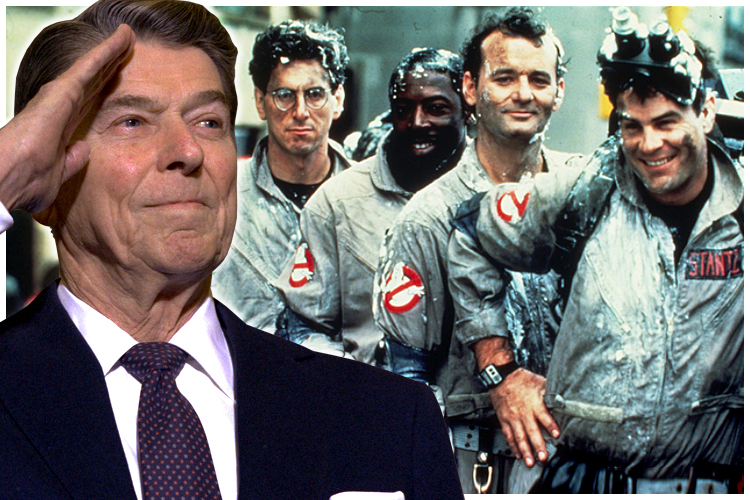
There is nothing “crypto” about Ramis’s 1984 hit, “Ghostbusters”: Its Reaganism is fully developed, as numerous critics have pointed out.
Here the martinet is none other than a troublemaking EPA bureaucrat;
the righteous, rule-breaking slobs are small businessmen—ghost-hunting
businessmen, that is, who have launched themselves deliriously into the
world of entrepreneurship. Eventually, after the buffoon from the EPA
gets needlessly into the businessmen’s mix and blunders the world into
catastrophe, the forces of order find they must outsource public safety
itself to the hired ghost-guns because government can’t do the job on
its own.
Both Reagan and his closest advisers were transfixed by the film, Sidney Blumenthal tells us;
“Ghostbusters” fit nicely into their idea of an America guided by
“fantasy and myth.” And while the film itself piled up its stupendous
box-office returns in that summer of ‘84, Jack Abramoff and his College
Republican pals got together a troupe of “Fritzbusters” to warm up the
crowds at Republican events, mocking Democratic presidential candidate
“Fritz” Mondale with an offensive take-off on the catchy “Ghostbusters”
theme song. And why not? What Mondale was promising—yes, promising—was to raise taxes, balance the budget, get responsible, and close down the party. What a Niedermeyer.
Harold
Ramis was a sort of poet of the rude gesture, of the symbolic
humiliation. Our reaction to his work, both now and when it was fresh,
is almost mechanical: We see the square on the screen get shamed, and
our mind shouts liberation. It is almost Pavlovian. Our culture-masters
have been gleefully triggering this kind of reaction for nearly fifty
years now—since the rude gesture first became a national pastime during
the 1960s—and in that time the affluent, middle-class society that
produced the Boomer generation has pretty much gone the way of the
family farmer.
These two developments are not unconnected. One small reason for the big economic change, I think, is the confusion engendered by the cultural
change. The kind of liberation the rude gesture brings has turned out
to be not that liberating after all, but along the way it has crowded
out previous ideas of what liberation meant—ideas that had to with
equality, with work, with ownership. And still our love of simple,
unadorned defiance expands. It is everywhere today. Everyone believes
that they’re standing up against unjust authority of some imaginary kind
or another—even those whose ultimate aim is obviously to establish an
unjust authority of their own. Their terms for it are slightly different
than the ones in “Animal House”—they talk about the liberal elite, the
statists, the social engineers, the “ruling class.” But they’re all
acting out the same old script. The Tea Party movement believes it’s
resisting the arrogant liberal know-it-alls. So did Andrew Breitbart, in
his brief career as a dealer in pranks and contumely. So do the people
who proposed that abominable gay marriage discrimination law in Arizona.
Hell, so do the pitiful billionaires of Wall Street—even they think they’re standing bravely for Ayn Rand’s downtrodden job creators.
Maybe
the day will come when we finally wake up and understand that insults
don’t always set us free. But until that happens, my liberal friends,
don’t ask for whom the bird flips: the bird flips for thee.
Thomas Frank's most recent book is "Pity the Billionaire."
He is also the author of "One Market Under God" and the founding editor
of "The Baffler" magazine.