Fair Use Notice

FAIR USE NOTICE

A BEAR MARKET ECONOMICS BLOG

OCCUPY MADNESS AND DYSFUNCTION

This site may contain copyrighted material the use of which has not always been specifically authorized by the copyright owner. We are making such material available in an effort to advance understanding of environmental, political, human rights, economic, democracy, scientific, and social justice issues, etc. we believe this constitutes a ‘fair use’ of any such copyrighted material as provided for in section 107 of the US Copyright Law.

In accordance with Title 17 U.S.C. Section 107, the material on this site is distributed without profit to those who have expressed a prior interest in receiving the included information for research and educational purposes. For more information go to: http://www.law.cornell.edu/uscode/17/107.shtml

If you wish to use copyrighted material from this site for purposes of your own that go beyond ‘fair use’, you must obtain permission from the copyright owner.

FAIR USE NOTICE FAIR USE NOTICE: This page may contain copyrighted material the use of which has not been specifically authorized by the copyright owner. This website distributes this material without profit to those who have expressed a prior interest in receiving the included information for scientific, research and educational purposes. We believe this constitutes a fair use of any such copyrighted material as provided for in 17 U.S.C § 107.

Read more at: http://www.etupdates.com/fair-use-notice/#.UpzWQRL3l5M | ET. Updates

All Blogs licensed under Creative Commons Attribution 3.0

Thursday, March 20, 2014

“Coalfield Stockholm syndrome”: West Virginians say they’re still loyal to the coal industry

SALON


“Coalfield Stockholm syndrome”: West Virginians say they’re still loyal to the coal industry


Some people affected by the water crisis don't blame "King Coal" for causing it


Mining operations, Charleston, WV (Credit: Amanda Haddox/Shutterstock)
 
 
There are plenty of people West Virginians can choose to be angry at following the chemical leak that left 300,000 of them without tap water. The folks at Freedom Industries who delayed reporting the leak until they were pretty much forced to, and who waited even longer to mention that a second chemical may have leaked as well. The state’s Department of Environmental Protection, which hadn’t inspected the facility in 20 years. The legislators behind the loophole-filled legislation that allowed them to get away with this (something that’s beginning to be remedied with today’s introduction of the Chemical Safety and Drinking Water Protection Act). The CDC for having no clue how dangerous the contaminated water actually was.

Oh yeah, and the coal industry, for whose benefit this chemical was being stored. But those guys are being let off the hook, reports Al Jazeera America – even in places where people were already not drinking tap water because of the industry’s paste misdeeds:
“This is just a freak accident with the water thing, in my opinion,” said Timothy McKinney, 30, a laid-off coal miner in Prenter, W.Va. “I’ve been in coal mining since I was out of high school, and I don’t think there’s anything wrong with the coal industry in general.”
…Until a lawsuit against nearby coal mine companies two years ago, many Prenter residents had either drawn sulfurous-smelling water from wells or driven miles down the road to buy bottled water. The plaintiffs in the case said coal processing waste pumped underground by coal companies had seeped into their water supply, turning it a red or orange color and making it smell like rotten eggs.
After the suit, residents say, they received connections to the West Virginia American Water system. Yet on Jan. 9 they found out they couldn’t temporarily drink that either, due to the chemical spill.
Despite the accident, the decline of the coal industry — which McKinney blames on political factors — is what he believes is the region’s biggest long-term problem, not the poisoning of the water supply. His main wish for his state is a bigger, not smaller, coal industry, providing good jobs which are not curtailed by environmental regulations.
“I’m speaking for a thousand, fifteen hundred people that’s been laid off throughout West Virginia. There’s a lot of families that’s lost homes, families that’s been broken up over it,” McKinney said, speaking near a creek that emitted a strong odor of sulfur as a steady stream of large dump trucks from a nearby mine rumbled past.
To be sure, it’s a complex issue, in which a declining number of mining jobs has led some to take up cooking meth instead. But the picture Al Jazeera paints is of communities unaware that there are any other options:
“I call it Coalfield Stockholm syndrome, and it is on a mass scale,” said Dustin White, an activist with the Ohio Valley Environmental Coalition, who is from Boone County himself.
“We are programmed early on,” said White, 30, who is also the son of a coal miner. “They (the industry) have ingrained themselves in every aspect of our lives.”
Lindsay Abrams Lindsay Abrams is an assistant editor at Salon, focusing on all things sustainable. Follow her on Twitter @readingirl, email labrams@salon.com.

Thursday, March 13, 2014

American Amnesia

Defining Ideas logo


July 1, 2011

American Amnesia

Young people in this country are failing civics, which is a crisis for the nation.


The New York Times headline from May could not have been more compelling: "Failing grades on civics exam called a 'crisis.'" The accompanying story reported bleak news from the latest National Assessment of Student Progress (widely known as the "nation's report card"). Among our present crop of high school seniors, only one in four scored at least "proficient" in knowledge of U. S. citizenship. Of all the academic subjects tested, civics and the closely linked subject of history came in last: "a smaller proportion of fourth and eighth graders demonstrated proficiency in civics than in any other subject the federal government has tested since 2005, except history, American students' worst subject."

Failing Liberty
Illustration by Barbara Kelley

Not surprisingly, the story drew appalled reactions from public figures such as Sandra Day O'Conner ("we have a crisis on our hands"). Charles Quigley, a civics educator, noted that "the results confirm an alarming and continuing trend that civics in America is on the decline." He declared that in the U.S. today, "civic education is facing a real 'civic recession.'" Yet within a week, despite the perception of crisis among those who were paying attention, the story vanished from sight. This may be the most alarming part of the crisis—our society's seeming lack of awareness of the grave threat that civic ignorance among our youth poses to the future of our democracy.

Perhaps this important story was largely ignored because it was not really news. For the past ten years or more, virtually every glimpse into American students' views on citizenship has revealed both a lack of understanding and a lack of interest. An American Enterprise Institute study earlier this year found that most social studies teachers doubted that their students grasped core U.S. citizenship concepts such as the Bill of Rights or the separation of powers. A recent Department of Education study found that only nine percent of U.S. high school students are able to cite reasons why it is important for citizens to participate in a democracy, and only six percent are able to identify reasons why having a constitution benefits a country. The Center for Information and Research on Civic Learning and Engagement (CIRCLE) has reported a decades-long, step-wise decline in interest in political affairs among college freshmen—from over 60 percent of the population in 1966 to less than half that percentage in our current period.

A free society requires an informed and virtuous citizenry.

For the past ten years, our research team at Stanford has interviewed broad cross-sections of American youth about what U. S. citizenship means to them. Here is one high school student's reply, not atypical: "We just had (American citizenship) the other day in history. I forget what it was." Another student told us that "being American is not really special….I don’t find being an American citizen very important." Another replied, "I don’t want to belong to any country. It just feels like you are obligated to this country. I don’t like the whole thing of citizen...I don’t like that whole thing. It’s like, citizen, no citizen; it doesn’t make sense to me. It’s like to be a good citizen—I don’t know, I don’t want to be a citizen...it’s stupid to me."

Such statements reflect more than an ignorance of citizenship—though they may provide us with clues about the source of students' present-day lack of knowledge. Beyond not knowing what U.S. citizenship entails, many young Americans today are not motivated to learn about how to become a fully engaged citizen of their country. They simply do not care about their status as American citizens. Notions such as civic virtue, civic duty, or devotion to their country mean little to them. This is not true of all young people today—there are exceptions in virtually every community—but it accurately describes a growing trend that encompasses a large portion of our younger generation.

This trend has not arisen in isolation. Indeed, the attitudes of many young Americans are closely aligned with intellectual positions that they likely have never encountered first-hand. In our leading intellectual and educational circles, the entire notion of national devotion is now in dispute. For example, in a book about the future of citizenship, a law professor recently wrote: "Longstanding notions of democratic citizenship are becoming obsolete …American identity is unsustainable in the face of globalization." As a replacement for commitment to a nation-state, the author wrote, "loyalties…are moving to transnational communities defined by many different ways: by race, ethnicity, gender, religion, age, and sexual orientation." In similar fashion, many influential educators are turning to "cosmopolitanism" and "global citizenship" as the proper aim of civics instruction, de-emphasizing the attachment to any particular country such as the United States. As global citizens, it is argued, our primary identification should be with the humanity of the world, and our primary obligation should be to the universal ideals of human rights and justice. Devotion to one's own nation state, commonly referred to as patriotism, is suspect because it may turn into a militant chauvinism or a dangerous "my country right or wrong" perspective.
As one high school student put it, "...It’s like to be a good citizen—I don’t know, I don’t want to be a citizen...it’s stupid to me."

While the lofty ideals of cosmopolitanism and world citizenship are understandable, they do not in themselves provide a realistic route to civic education. For one thing, the serious tasks of citizenship that students need to learn are all played out on a local or national level rather than a global one. We do not pay taxes to the world; we do not vote for a world president or senator; we do not serve in a world army or peace corps; and we are not called to jury duty in any world courtroom. When we write e-mails to our congressional representatives or vote and campaign for candidates running for elected office, these activities are part of our national civic life, not part of any global event. As philosopher Michael Walzer wrote, "I am not a citizen of the world…I am not even aware that there is a world such that one could be a citizen of."

To conduct our U.S. citizenship activities intelligently and responsibly, we must know how the American system operates; and we must care enough to make the effort to get involved. More than this, in times of national peril, we must care enough to sacrifice for the common good if needed. This requires more than civic knowledge: it demands devotion to a cause greater than ourselves. Over the course of American history, love of country has been the foremost motivator of such sacrifices for the greater good, in battles both against tyrannical forces abroad and social injustices domestically.

Discouraging young Americans from identifying with their country—and, indeed, from celebrating the traditional American quest for liberty and equal rights—is a sure way to remove their most powerful source of motivation to learn about U. S. citizenship. Why would a student exert any effort to master the rules of a system that the student has no respect for and no interest in being part of? To acquire civic knowledge as well as civic virtue, students need to care about their country.

It is especially odd to see schools with large immigrant populations neglect teaching students about American identity and the American tradition. Educational critic Diane Ravitch observed this phenomenon when visiting a New York City school whose principal proudly spoke of the school's efforts to celebrate the cultures of all the immigrant students. Ravitch writes, "I asked him whether the school did anything to encourage students to appreciate American culture, and he admitted with embarrassment that it did not."

These and other American students are being urged to identify with, on the one hand, customs from the native lands they have departed and, on the other hand, with the abstract ideals of an amorphous global culture. Lost in between these romantic affiliations is an identification with the nation where these students actually will practice citizenship. Adding to the dysfunction of this educational choice, as Ravitch writes, is the absurdity of teaching "a student whose family fled to this country from a tyrannical regime or from dire poverty to identify with that nation rather than with the one that gave the family refuge."

We are not "citizens of the world." We do not pay taxes to the world; we do not vote for a world president or senator.

How can we do better? Of course we need to teach students the Constitution, along with its essential underlying principles such as separation of powers, representative government, and Federalism. Excellent programs for such teaching now exist. But these programs are not widely used amidst today's single-minded focus on basic skills. Compounding this neglect, the school assessments that drive the priorities of teachers infrequently test for civic knowledge. To preserve the American heritage of liberty and democracy for future generations, citizenship instruction must be placed front and center in U. S. classrooms rather than relegated to the margins.

As for the essential matter of motivation, the only way to capture students' interest is to inspire in them some justifiable pride in their country's best traditions. Fortunately, U. S. success stories are not hard to find. In our recent history, three 20th Century cases could be taught to promote pride in the American tradition: 1) the civil rights movement that extended rights to millions of citizens in the United States; 2) victories over totalitarianism (especially fascism, communism, and other militaristic tyrannies) that extended new freedoms to millions of subjugated people in Europe and Asia; and 3) the building of a middle class that offered economic freedom to millions of ordinary citizens, and to immigrants coming to American in search of a better life as well.

We live in a time marked by anxieties over many perceived threats to our way of life—terrorism, economic collapse, and climate change, to mention just a few of the widespread fears making our headlines these days. But there is a looming crisis closer at hand that poses every bit as grave a threat to the future of our way of life: the very real possibility that our democracy will be left in the hands of a citizenry unprepared to govern it and unwilling the make the sacrifices needed to preserve it. A free society requires an informed and virtuous citizenry. Failing this, as Ben Franklin long ago warned, despotism lies just around the corner.


William Damon is a professor of education at Stanford University, director of the Stanford Center on Adolescence, and a senior fellow at the Hoover Institution. For the past twenty-five years, Damon has written on character development at all stages of life. Damon's recent books include Failing Liberty 101 (Hoover Press, 2011); The Path to Purpose: How Young People Find their Calling in Life (2008); and The Moral Advantage: How to Succeed in Business by Doing the Right Thing (2004). Damon was founding editor of New Direction for Child and Adolescent Development and is editor in chief of The Handbook of Child Psychology (1998 and 2006 editions). He is an elected member of the National Academy of Education and a fellow of the American Educational Research Association.

Sunday, March 2, 2014

Baby boomer humor’s big lie: “Ghostbusters” and “Caddyshack” really liberated Reagan and Wall Street

SALON


Baby boomer humor’s big lie: “Ghostbusters” and “Caddyshack” really liberated Reagan and Wall Street

Harold Ramis was a master of subversive comedy. But the politics of "Caddyshack" and rude gestures have backfired


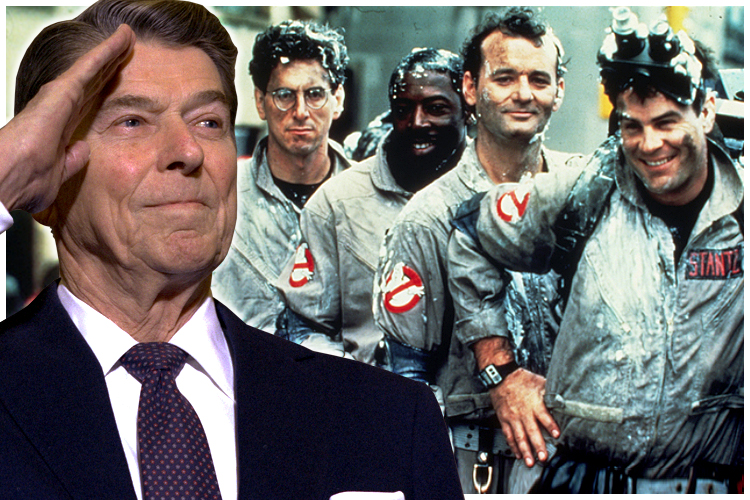
Baby boomer humor's big lie:  
Ronald Reagan, ghostbusters (Credit: AP)


I am going to start with three beloved movies of my childhood, and end with a suggestion of why liberals will probably never be able to come to grips with what they winningly call “inequality.” The three movies I have in mind—”National Lampoon’s Animal House,” “Caddyshack,” and “Ghostbusters”–were all written or directed, in whole or in part, by the great Harold Ramis, who died last week, and whose work was eulogized by President Obama as follows:
When we watched his movies . . . we didn’t just laugh until it hurt. We questioned authority. We identified with the outsider. We rooted for the underdog. And, through it all, we never lost our faith in happy endings.
That seems about right, doesn’t it? Each of the films I mentioned features some prudish or strait-laced patriarch who is spectacularly humiliated by a band of slobs or misfits or smart alecks. With their dick jokes and cruel insults, these movies represented, collectively, the righteous rising-up of a generation determined to get justice for the little guy. That’s why a group of prominent Democrats showed up at Ramis’ funeral. It’s why articles about Ramis’ movies routinely speak of their liberating power.

So, the political equation is obvious, right? We of the left own the imagery of subversion and outsiderness. It’s ours. Every time a stupid old white guy gets humiliated in a TV commercial for choosing Brand X, we know it’s because the people at Brand Y secretly support universal health insurance and a nice little pop in the minimum wage. Right?

Well, no. And with that acknowledgement, let me advance to my bold hypothesis: The dick joke is not always what it seems to be. The dick joke is not always your friend.

Start with the first really great movie Ramis had a hand in writing, “National Lampoon’s Animal House.” Watching it again today, I didn’t think so much of righteous defiance, or underdogs and outsiders; I thought of Wall Street. This particular iteration of Ramis’ martinet vs. slob theme pits—as everyone knows—a prissy, militaristic college fraternity against a fraternity where the boys like pleasure, which is to say, where they drink beer and throw parties and actually enjoy getting laid. If this basic formula doesn’t strike you as particularly rebellious or even remarkable, that’s because it isn’t: in its simple anarchic assertion of appetite, it’s the philosophy of the people who rule us. Everyone is a fraud in this world; learning is a joke; sex objects are easily conned; Kennedy-style idealism is strictly for suckers; and in one telling moment, fratboy 1 remarks to fratboy 2, who is crying over the trashing of his borrowed automobile by fratboy 1 and company, “You fucked up. You trusted us.” What popped into my mind when I heard that line was that other great triumph of the boomer generation: the time-bomb investments of 2008; Goldman Sachs peddling its “shitty deals” to the naive and the credulous.

Drink, take and lie: translate it into Latin and it could be the motto of the One Percent. It is no coincidence that P. J. O’Rourke, who was editor of National Lampoon when “Animal House” was made and is currently a wisecracking critic of liberalism at the Cato Institute, recently declared that the release of the movie in 1978 marked the moment when his generation “took over” and started to make the world “better.” (That O’Rourke chose to write this for the American Association of Retired Persons is a particularly poignant detail.) It is also no coincidence that the fraternity at Dartmouth which served as one of the models for “Animal House” has of late become a kind of pipeline into the investment-banking industry, nor should it surprise anyone that Wall Street is home to a secret Animal House-style fraternity of its own, a place where the anarchic captains of finance come together to slurp likker and howl their admiration for their beau ideal: the self-maximizing asshole . . . who got bad grades in college.

The second of the Ramis comedies eulogized by Obama was the 1980 cult classic “Caddyshack,” which took on the great movie theme of the Seventies—class antagonism—over a game of golf. The martinet this time is a country-club grandee, depicted by veteran blowhard Ted Knight; the slob confronting him is a real-estate developer of hilariously garish taste played by Rodney Dangerfield; between them stands the American worker in all his nobility—meaning, specifically, a teenaged caddy at the country club who must decide whether to be true to his blue-collar self or to kiss the grandee’s ass in order to go to college. The movie unfolds as a series of set pieces in which WASP prigs blow gasket after gasket upon beholding some infringement of their Prussian sensibilities—absorbing one of Dangerfield’s jokes, or seeing caddies frolicking in the pool, or hearing someone using the word “sucks,” or finding a car parked on the lawn, or picking up the saucy strains of a Journey song as it wafts across the greensward. Boom: Apoplexy! Watch the patriarchs go berserk!

And that makes for a pretty liberal film, right? I mean, who else makes fun of country club grandees except for us lefty authority-questioners?

Well, free-market conservatives do. Google the phrase “Country club Republican” and what you will find, by and large, are right-wing types using it as a synonym for “RINO”: fake Republicans who are in it for the snobbery—not out of faith in the relentless, disruptive forces of capitalism.

These same conservatives are also the most likely to understand class conflict in the way “Caddyshack” does: as a rivalry between WASP old money and differently pedigreed new money. In fact, this is one of the themes of George Gilder’s 1981 book “Wealth and Poverty,” the manifesto of the “supply-side” revolution, and of countless wealth-celebrating books that followed. That’s why “Caddyshack” seems in retrospect like a piece of crypto-Reaganite social commentary. Rodney Dangerfield’s character, for example, is a clear symbol of the crude power of markets—proudly showing off one of his tasteless billboards and announcing that he only cares about the “snobatorium” country club because he wants to build condos there. The choice before the white, working-class caddy boils down to the Harvard-proud WASP snob and the earthy, joke-cracking businessman; the side he eventually chooses is the same one that millions of real-life blue-collar workers were also choosing in those confused days.

There is nothing “crypto” about Ramis’s 1984 hit, “Ghostbusters”: Its Reaganism is fully developed, as numerous critics have pointed out. Here the martinet is none other than a troublemaking EPA bureaucrat; the righteous, rule-breaking slobs are small businessmen—ghost-hunting businessmen, that is, who have launched themselves deliriously into the world of entrepreneurship. Eventually, after the buffoon from the EPA gets needlessly into the businessmen’s mix and blunders the world into catastrophe, the forces of order find they must outsource public safety itself to the hired ghost-guns because government can’t do the job on its own.

Both Reagan and his closest advisers were transfixed by the film, Sidney Blumenthal tells us; “Ghostbusters” fit nicely into their idea of an America guided by “fantasy and myth.” And while the film itself piled up its stupendous box-office returns in that summer of ‘84, Jack Abramoff and his College Republican pals got together a troupe of “Fritzbusters” to warm up the crowds at Republican events, mocking Democratic presidential candidate “Fritz” Mondale with an offensive take-off on the catchy “Ghostbusters” theme song. And why not? What Mondale was promising—yes, promising—was to raise taxes, balance the budget, get responsible, and close down the party. What a Niedermeyer.

Harold Ramis was a sort of poet of the rude gesture, of the symbolic humiliation. Our reaction to his work, both now and when it was fresh, is almost mechanical: We see the square on the screen get shamed, and our mind shouts liberation. It is almost Pavlovian. Our culture-masters have been gleefully triggering this kind of reaction for nearly fifty years now—since the rude gesture first became a national pastime during the 1960s—and in that time the affluent, middle-class society that produced the Boomer generation has pretty much gone the way of the family farmer.

These two developments are not unconnected. One small reason for the big economic change, I think, is the confusion engendered by the cultural change. The kind of liberation the rude gesture brings has turned out to be not that liberating after all, but along the way it has crowded out previous ideas of what liberation meant—ideas that had to with equality, with work, with ownership. And still our love of simple, unadorned defiance expands. It is everywhere today. Everyone believes that they’re standing up against unjust authority of some imaginary kind or another—even those whose ultimate aim is obviously to establish an unjust authority of their own. Their terms for it are slightly different than the ones in “Animal House”—they talk about the liberal elite, the statists, the social engineers, the “ruling class.” But they’re all acting out the same old script. The Tea Party movement believes it’s resisting the arrogant liberal know-it-alls. So did Andrew Breitbart, in his brief career as a dealer in pranks and contumely. So do the people who proposed that abominable gay marriage discrimination law in Arizona. Hell, so do the pitiful billionaires of Wall Street—even they think they’re standing bravely for Ayn Rand’s downtrodden job creators.

Maybe the day will come when we finally wake up and understand that insults don’t always set us free. But until that happens, my liberal friends, don’t ask for whom the bird flips: the bird flips for thee.

Thomas Frank's most recent book is "Pity the Billionaire." He is also the author of "One Market Under God" and the founding editor of "The Baffler" magazine.

Tuesday, January 28, 2014

Bill Moyers on the Dark Money Assault on Democracy and How Racism Stills Drives Our Politics


  Media  


Moyers, "We should know who’s buying our government."


AMY GOODMAN: We turn now to Bill Moyers, the legendary broadcaster and host of Moyers & Company. Earlier this month, his program, Moyers & Company, aired the documentary report,State of Conflict: North Carolina. He is the former host of Bill Moyers Journal. He has won more than 30 Emmy Awards. He’s also a founding organizer of the Peace Corps, press secretary for President Lyndon Johnson, publisher of Newsday, senior correspondent for CBS News. His most recent book is Bill Moyers Journal: The Conversation Continues, as I hope it continues right here. Quite a report, and it isn’t even the whole thing. You go on in this report on the state of conflict in North Carolina to talk about the whole issue of voting rights. [Watch the documentary here, with full transcript published on AlterNet earlier this month].

BILL MOYERS: Yes, North Carolina now, because of this new far-right government—and these are not your father’s Republicans, they are really right-wing Republicans adhering to the fundamentalism of the right—they went after voting rights. It was one of the first objectives they fulfilled when they took power. And they now have the most restrictive voting rights in the country—a very complicated process of getting IDs that you have to have. They’ve redistricted in a way that packs African Americans into three districts, so that it’s hard to argue "one man, one vote" is happening down there. And the Justice Department has challenged the North Carolina state voting laws. But they are very restrictive, and they’re designed to perpetuate the Republican rule and to make it harder for the elderly, for the young, for minorities to vote.

AMY GOODMAN: One of the things they realized very quickly was that a lot of the voters who were voting early were voting Democrat, so they’re cracking down on the number of days that you can take—the number of days you can vote.

BILL MOYERS: Yes, there—for a while, it looked as if Mitt Romney had won in 2012, but when the early votes were finally counted, the margin went to—victory went to Obama. So, they don’t like that, and they’re doing away with early voting.

AMY GOODMAN: So, why did you focus on North Carolina, of all the states? Is it really so singular, so unique?

BILL MOYERS: Well, it’s very compact, what’s happening down there, and it’s very recent. This has happened to a considerable extent in Wisconsin. These are battleground states, where the right wing and the conservatives and the business and wealthy communities are collaborating to make sure they don’t lose again. North Carolina is an interesting state in and of itself. It’s a blue state, it’s a red state, it’s a purple state. Obama carried it by a whisker in 2008, Romney by a whisker in 2012. It goes back and forth. Jesse Helms, the, to use your term, legendary right-wing senator from North Carolina, was simultaneously in office with a progressive United States senator. It’s a purple state, really, that goes this way. So the Republicans, the right wing, are focusing on it. The Democrats ought to be focusing on it, but they’ve had their problems down there with corruption and scandals that played into Art Pope’s hands.

But there are three reasons for this story. One, it’s very clear what’s happening in North Carolina. Second, it’s a paradigm, a harbinger of what’s happening in other states. And then, most important, it really reveals what dark money is doing to American politics. So much of this money that has flowed into North Carolina comes from untraceable and unaccountable sources. They don’t know in North Carolina who’s funding the redistricting. They don’t know who’s funding these campaigns against their opponents. It’s coming from national sources, from Republican sources in Washington, from very wealthy people around the country. And that is, of course, flying in the face of the fundamental tenet of democracy, which is, we should know who’s buying our government.

AMY GOODMAN: And, of course, there is a North Carolinian in this, and it is Art Pope himself, also close to the Koch brothers.

BILL MOYERS: Yes, he is a—he’s been called a kingmaker as well as a king, because he has used his money—he’s a smart man, very shrewd, very intelligent, and very ruthless in how he uses his money. And as Jane Mayer, The New Yorker reporter, terrific reporter, as you and I both know, says at the end of the broadcast, this is more than North Carolina; this shows what a wealthy individual can do in any state where he or she is willing to put their money into politics in this way. So it’s a harbinger, as I say, of how our democracy—you know, organized money is the greatest threat to democracy because it unbalances the equilibrium. Democracy is supposed to check the excesses of private power and private greed. And if money disestablishes that equilibrium, we’re in trouble.

And the only answer—as we’ve seen in this film, the only answer to organized money is organized people. And that’s what really at first drew me to North Carolina. I’ve had a history there. I was on the board of Wake Forest University for years. I was in—I have good, close friends there who teach and who write and who work there. And I know something about North Carolina. And when I saw what was happening on these Moral Mondays, I knew nothing about them until the press stories began to come out. These people were gathering, not spontaneously, because Reverend Barber, who is himself a shrewd cat, a cool cat, as they say—I knew what he was doing in organizing these. The first arrest came in the summer, and then the news started—the news media started paying attention. It was obvious that people were becoming alarmed, agitated and organized in response to the buyout of North Carolina. And that remains the most hopeful—whether you’re a progressive conservative—a progressive Republican or a progressive liberal Democrat, you have to know that the only way we’re going to preserve our democracy is to fight this organized money. And that’s what the Moral Monday protesters are doing.

AMY GOODMAN: And they’re trying to plan the largest protest ever yet, and that will be February 8th. But there is a distinction sometimes between the progressives who are out there on the streets, who are getting arrested—more than a thousand got arrested in 2013—and the Democratic Party of North Carolina.

BILL MOYERS: That’s true. And this, of course, has played into the hands of the right wing. Progressives, of course, are more progressive than partisan. Democrats want Democrats to be re-elected, even if they’re centrists or center-right Democrats. So, there’s resentment in North Carolina among some traditional Democrats to Art—to Reverend Barber. He has now emerged as the progressive leader—not the Democratic leader, because he’s not a partisan in this respect. And so, there’s conflict between progressives and Democrats who are not progressives in North Carolina. This is an old—an old story, as you know.

The right wing solved it by this enormous confomity that they brought to their movement 25 and 30 years ago. The tea party was together enough to take over the Republican Party. Progressives are not together enough to take over, step by step, precinct by precinct, the Democratic Party. And that’s a source of conflict. And, of course, as I say in the documentary and said a moment ago, Democrats had some corruption and some scandals a few years ago when several went to jail. And that’s been a problem. That played right into the right’s hands, and it’s created a further rift between progressives and Democrats.

AMY GOODMAN: Reproductive rights also very much under attack. Fascinating to see Governor McCrory saying—you know, very simple answer when asked if he would be supporting more restrictions against abortion, in one of the debates, and his answer was "None," very clearly stated, but that hasn’t been the case.

BILL MOYERS: He read the tea leaves and saw that when he got into office—he was elected with the help of these conservatives, and of course he has to appease them in order to be re-elected, if he runs again. And one of the first changes in his agenda was to go against what he had said earlier and sign the most restrictive abortion bill, reproductive rights bill—anti-reproductive-rights bill in the country.

AMY GOODMAN: Last year, as you also clip, make an excerpt of in this documentary, The Daily Show’s Aasif Mandvi spoke to a North Carolina county precinct Republican chair named Don Yelton about North Carolina passing one of the most restrictive voter suppression bills in the nation.
DON YELTON: The bottom line is the law is not racist.
AASIF MANDVI: Of course the law is not racist, and you are not racist.
DON YELTON: Well, I have been called a bigot before. Let me tell you something. You don’t look like me, but I think I’ve treated you the same as I would anybody else.
AASIF MANDVI: Right.
DON YELTON: Matter of fact, one of my best friends is black.
AASIF MANDVI: So, one of your best friends—
DON YELTON: One of my best friends.
AASIF MANDVI: —is black.
DON YELTON: Yes.
AASIF MANDVI: And there’s more.
DON YELTON: When I was a young man, you didn’t call a black a black; you called him a Negro. I had a picture one time of Obama sitting on a stump as a witch doctor, and I posted that on Facebook. For your information, I was making fun of my white half of Obama, not the black half. And now, you have a black person using the term nigger this, nigger that, and it’s OK for them to do it.
AASIF MANDVI: You know that we can hear you, right?
DON YELTON: Yeah.
AASIF MANDVI: OK, you know that, that you—you know that we can hear you.
DON YELTON: Yeah.
AASIF MANDVI: OK, all right.
Then I found out the real reason for the law.
DON YELTON: The law is going to kick the Democrats in the butt.
AASIF MANDVI: Wow! An executive GOP committee member just admitted that this law isn’t designed to hurt black people; it’s designed to hurt Democrats.
DON YELTON: If it hurts a bunch of college kids that’s too lazy to get up off their bohunkus and go get a photo ID, so be it.
AASIF MANDVI: Right, right.
DON YELTON: If it hurts the whites, so be it. If it hurts a bunch of lazy blacks that wants the government to give them everything, so be it.
AASIF MANDVI: And it just so happens that a lot of those people vote Democrat.
DON YELTON: Gee.
AMY GOODMAN: That was from Comedy Central, The Daily Show. Almost immediately after the interview aired on The Daily Show, Don Yelton was forced to resign his position in the Republican Party. Bill Moyers?

BILL MOYERS: It’s sad that there are so many people in this country who cannot escape the prison of the past, and race is very much at the heart of this—particularly in the old Confederate states, this right-wing resurgence that we’re facing now. There are very few who speak as openly and as blatantly and as honestly as Don Yelton. He’s telling the interviewer, "Yeah, this is why I did what I did." Many do without revealing their motives. And if you track the voting patterns, if you track what’s happening in the country, you see that unspoken racism is still driving a large segment of our politics.

And fortunately, he outed himself and reminded us that the Republican Party in the South is the party that took over after the signing of the Civil Rights Act and the Voting Rights Act of 1965, when President Johnson said to me, "I think we’ve just handed the South to the Republicans for my lifetime and yours," because the racists who had been Democrats all those years until this transformation in American politics through the civil rights legislation and the civil rights movement—until this transformation brought them over, the Democrats had been the racist party in the South. I grew up in the South, and I remember all my Democratic friends were essentially racist. So, it’s changed, and Yelton was speaking a truth that dare not be heard. But he did say it, and we know it.

AMY GOODMAN: You know, Bill, we just came from Sundance Film Festival in Park City. Freedom Summer was one of the documentaries, from the remarkable filmmaker Stanley Nelson, and it’s about—this summer coming up is the 50th anniversary of the summer of 1964, when the three civil rights activists, James Chaney and Andrew Goodman and Mickey Schwerner, were killed. Of course, they were named; there were others who we don’t know who died. It was the summer of organizing in Mississippi, and it was the summer of the Freedom Democratic—the Mississippi Freedom Democratic Party. And you were the press secretary of Lyndon Johnson. What was it like to be there when Fannie Lou Hamer was taking Lyndon Johnson on at the 1964 Atlantic City Democratic convention? He did not want that voice, who wanted to integrate the Mississippi Democratic Party delegation to the convention, to be heard, and so he gave a speech at the same time, so the cameras would switch from her—as they did, reliably, giving voice to power—to President Johnson.

BILL MOYERS: What a dramatic and traumatic moment it was, a riveting moment. By the way, I didn’t become press secretary for two years. I was 30 that summer, and I was actually President Johnson’s domestic policy adviser, working on civil rights, voting rights and politics. And it was a—it was a dramatic moment. It was an unfortunate moment, too, because I wish, in retrospect, that we had embraced Fannie Lou Hamer and realized that’s where the future of the Democratic Party lay.

AMY GOODMAN: Could it kind of be like North Carolina Democrats today?

BILL MOYERS: Yes, exactly, exactly. But here was Johnson’s predicament. He wanted to carry as many Southern states as he could. He was from Texas. He wanted to bring progressive, moderate Democrats along with him in his campaign for ’64. And had he embraced Fannie Lou Hamer, the morally right thing to do, it would have been, he thought, politically costly. So he hammered out this compromise, which was not satisfactory to either side, in order to preserve his political prowess and his political opportunity to carry the South. And we did carry several states in the South in 1964 that I think probably he would have lost if he had not made this compromise. But in retrospect, of course—and not even in retrospect, at the time, the moral embrace would have been the right one to do, and that would have been to bring the Mississippi leadership, the Democratic—the black and civil rights leaders of Mississippi into the Democratic Party.

AMY GOODMAN: He almost resigned then, didn’t he? The pressure so enormous, at least that’s what comes out in Freedom Summer. He was saying—he was wondering if he would throw in the towel then.

BILL MOYERS: Yes, he was torn between winning and doing the right thing. Lyndon Johnson had never been an outstanding proponent of voting—of civil rights when he was a senator from Texas or the majority leader, but his heart was always in the right place, because as a young man he was a New Deal congressman from Texas, and that was trying to embrace a larger constituency.

AMY GOODMAN: He had just signed the Civil Rights Act earlier that summer.

BILL MOYERS: 1964, that’s right. And then suddenly he was faced with this moral-versus-political choice, and it really created a great tension in him. He was torn by what he had done at the same time. And he wasn’t sure that winning re-election was worth the moral price he had paid for it. But he got over that and ran a hearty campaign, and of course received the largest plurality in the country up until then in a presidential race.

AMY GOODMAN: Well, Bill, before we end the show, I wanted to ask about what your plans are. This year you turn 80.

BILL MOYERS: Yep.

AMY GOODMAN: You announced in October that Bill Moyers & Company, you’re going to be ending it. You got an avalanche of response. People—the force more powerful than any one person, the people spoke, and they said, "You can’t end this show." Bill Moyers—

BILL MOYERS: Well, enough people spoke to make me think that I was leaving—I was going AWOLin the middle of the battle. And, you know, when you’ve been at it 40-some-odd years—I’ve been a broadcaster for 41 years—you do have somewhat loyal constituents. Many of them are aging out, dying off. I mean, young journalists have no idea of what’s happened in broadcasting over the last 40 years. They’re into the web and so forth. But there were enough loyal fans, constituents around the country. They wrote—4,000 or 5,000 letters came to us, emails. And I had to face myself shaving in the morning and saying, "Are you abandoning these people?" So we came back for one more year.

AMY GOODMAN: Well, it’s great to see you coming back with documentaries like these. What’s your next?

BILL MOYERS: We’re working on a—we’re looking at Ayn Rand’s influence today. Ayn Rand was—is the libertarian, the famous writer, author of Atlas Shrugged and The Fountainhead, a libertarian who celebrates the virtue of money and says the—has had an enormous influence over American politics and is even popular today. I think Atlas Shrugged sells something like 150-200,000 copies. It’s being taught. Her philosophy is being taught in universities funded by Koch brother organizations and others. And so we’re looking at Rand Paul, for example, who’s a likely candidate for president in—I don’t know. They say not, but there’s some kind of a convergence there, because when he was 17, his father, Ron Paul, gave him a set of Ayn Rand’s novels. So we’re working on that.

AMY GOODMAN: Well, we look forward to the commentary. Bill, thanks so much for joining us, legendary broadcaster, host of Moyers & Company. Earlier this month, his program Moyers & Company aired a documentary called State of Conflict: North Carolina, and we’ll link to the full documentary at democracynow.org.
  
Bill Moyers has received 35 Emmy awards, nine Peabody Awards, the National Academy of Television’s Lifetime Achievement Award, and an honorary doctor of fine arts from the American Film Institute over his 40 years in broadcast journalism.  He is currently host of the weekly public television series Moyers & Company and president of the Schumann Media Center, a non-profit organization which supports independent journalism.  He delivered these remarks (slightly adapted here) at the annual Legacy Awards dinner of the Brennan Center for Justice, a non-partisan public policy institute in New York City that focuses on voting rights, money in politics, equal justice, and other seminal issues of democracy. This is his first TomDispatch piece.

Thursday, January 23, 2014

The Infrastructure of American Democracy Is Dysfunctional


 "Instead of making reasoned choices with the purpose of expanding turnout and assuring equal protection, our system leaves democracy to chance," writes Nichols. (Fil) 


President Obama’s second inaugural address touched on the reality that the United States has a dysfunctional election system. Describing the nation’s progress, as well as the ways in which the nation needs to progress, the president declared, “Our journey is not complete until no citizen is forced to wait for hours to exercise the right to vote.”

Obama drew knowing applause when he spoke that truth in January 2013, as he did in November 2012, when just hours after his re-election the president noted that millions of Americans had “waited in line for a very long time” to vote. Then, in an ad lib that got more attention that his prepared remark, the president added: “By the way we have to fix that.”

On Wednesday, the process of fixing the problem—and of moving America a few more steps toward democracy—accelerated. A little.

The bipartisan Presidential Commission on Election Administration that Obama appointed last year released a report that recommends:
1. Modernization of the registration process through continued expansion of online voter registration and expanded state collaboration in improving the accuracy of voter lists.
2. Measures to improve access to the polls through multiple opportunities to vote before the traditional Election Day and the selection of suitable, well-equipped polling place facilities, such as schools.
3. State-of-the-art techniques to assure efficient management of polling places, including tools the Commission is publicizing and recommending for the efficient allocation of polling place resources.
4. Reforms of the standard-setting and certification process for new voting technology to address soon-to-be antiquated voting machines and to encourage innovation and the adoption of widely available off-the-shelf technologies.

These are relatively tepid proposals. But they move in the right direction on several fronts. It is important to make it easier to register and vote; modernizing registration procedures and expanding early and absentee voting programs, can help with this. So, too, can the improved allocation of resources and technology to assure that every voter in every state has a roughly equal chance to cast a ballot in a timely, respectful and efficient manner.

So the president was pleased with the report. He received it with much fanfare and described the recommendations as “eminently glittering.”

Obama says that he and his aides will “reach out to stakeholders all across the country to make sure that we can implement” the commission’s report.” The president brings to this work a sense of urgency that is appropriate, reminding Americans that “one of the troubling aspects of the work that they did was hearing from local officials indicating that we could have even more problems in the future if we don’t act now.”

But no one, including the president, should imagine that what the commission has produced is a cure for what ails American democracy.

The commission’s report relies on technical repairs, and a faith in newer technologies. That’s not a fresh approach. After the 2000 fiasco in Florida, and the resulting intervention of the United States Supreme Court to prevent a thorough recount—and a thorough review of the failures and abuses of voting systems in the state—there were reports, and recommendations and allocations of resources for new technologies.

But there was not a shift in the mindset of the country regarding voting and elections. Indeed, those who would restrict and restrain the franchise stepped up their activism. And after the 2010 elections put Republicans in charge of the statehouses sacross the country, we saw a wave of new initiatives—many, though not all, of them crafted by the corporate-funded American Legislative Exchange Council—to impose restrictive Voter ID requirements, to limit early voting, to eliminate same-day registration.

The problems that inspired the president’s “we need to fix that” line were not necessarily technical or technological. They were often man-made. And the men who made them are still at work; in 2013, according to the Brennan Center for Justice, more than eighty bills restricting the right to vote were introduced in more than thirty states.

That figure serves as a reminder that the core challenges with regard to voting in America is not necessarily technological. Americans could vote on paper ballots quickly and efficiently, as do voters in many other countries. And if they did they might well be more confident in the count.

The core challenge has to do with an insufficient level of commitment on the part of local, state and federal agencies to creating the infrastructure and the mindset that fosters high-turnout elections.

The United States has an exceptionally low level of voter participation as compared with most developed democracies. In the parliamentary elections of European countries, it is not uncommon to see turnout levels surpass 70 percent, even 80 percent, of the voting-age population. In America, off-year congressional elections attract under 40 percent of the voting age population, and high-stakes presidential elections don’t get to 55 percent.

Why? Because the United States makes it hard to vote.

Unlike other countries that actually try to achieve maximum voter participation, the United States retains a separate-and-unequal electoral infrastructure that rests authority over voting and elections with individual states. Instead of making reasoned choices with the purpose of expanding turnout and assuring equal protection, our system leaves democracy to chance.
To wit:
1. This country schedules elections on Tuesdays, rather than weekends.
2. This country does not make Election Day a holiday.
3. This country does not have a universal system for registering every citizen before his or her eighteenth birthday.
4. This country does not have a universal system for alerting all eligible voters that an election is coming, or for letting them know where and how to vote.
5. This country does not have universal standards for whether those convicted of crimes can vote, or for when and how those who have served their sentences will have their voting rights restored.
6. This country does not have universal standards for who can vote in a primary election, or for whether a run-off election will be held, or for how recounts will be conducted, or for how inconclusive results are to be addressed.
7. This country does not have universal standards for ballot design, or for how to deal with mismarked ballots, or for how to assure that ballots that have been cast are protected against tampering.
8. This country does not have universal standards for the distance one must travel to vote, or for the hours polls are to remain open, or for the set-up and operation of polling places, or for the availability of voting machines and other equipment, or for verifying that votes have been accurately cast and will be accurately counted.
The list of gaps in the structures of American democracy is long.

The recommendations made by the president’s commission address some of those gaps. But they do not begin to address all of them.

That does not mean that the commission’s report should be neglected. The recommendations should be used to encourage a process of improving the voting systems of the United States.

Wendy Weiser, the director of the Democracy Program at the Brennan Center is right when she says, “The Commission’s recommendations are a significant step forward. They make clear that nationwide our voting systems have common problems, which can be fixed with common, national solutions. Especially important is the consensus that we need to modernize voter registration, make early voting available to all Americans, and put systems in place so no one waits longer than 30 minutes to vote. These will be the new benchmarks against which future elections will be judged.”

The recommendations of the commission ought not, however, be seen as the “end of the journey” to democracy.

If we are realistic about the challenge of remaking America as a nation with high-turnout elections and truly representative democracy, what the commission has produced is barely a beginning.

A report is not enough. Recommendations are not enough.

What’s required is a teaching moment, led by the president and serious members of Congress, by reformers and academics and media and citizens of good will. And it ought to have as its goal a reshaping of how the United States understands voting and voting rights.

The truth is that, on too many levels, the United States does not respect the right to vote, to have votes counted and to have the results of voting genuinely reflected in the governance of communities, states and the nation.

Too much is left to chance. That has been made obvious in recent years, not just by the myriad state-based battles over restrictive Voter ID laws but by the US Supreme Court’s mangling of the Voting Rights Act.

More than a report is needed, more even than a new version of the Voting Rights Act—although the proposal made recently by Congressman John Conyers, D-Michigan, and James Sensenbrenner, R-Wisconsin, and Senator Patrick Leahy, D-Vermont, is a reasonable and needed step in the right direction.

What is ultimately required is an absolute guarantee of the right to vote and the right to have that vote counted. That affirmation should be added to the United States Constitution, in an amendment along the lines of the one proposed last year by Congressman Keith Ellison, D-Minnesota, and Congressman Mark Pocan, D-Wisconsin.

Supported by groups such as FairVote and Color of Change, the Ellison-Pocan “Right to Vote” amendment simply declares:
SECTION 1: Every citizen of the United States, who is of legal voting age, shall have the fundamental right to vote in any public election held in the jurisdiction in which the citizen resides.
SECTION 2: Congress shall have the power to enforce and implement this article by appropriate legislation.
These are proper benchmarks. When the right to vote is guaranteed, when it is constitutionally established as fundamental, that is a strong place of beginning for establishing the infrastructure of genuinely functional and genuinely representative democracy.

“The right to vote is too important to be left unprotected,” explains Pocan. “At a time when there are far too many efforts to disenfranchise Americans, a voting rights amendment would positively affirm our founding principle that our country is at its strongest when everyone participates.”

John Nichols
John Nichols is Washington correspondent for The Nation and associate editor of The Capital Times in Madison, Wisconsin. His most recent book, co-authored with Robert W. McChesney is, Dollarocracy: How the Money and Media Election Complex is Destroying America. Other books written with McChesney include: The Death and Life of American Journalism: The Media Revolution that Will Begin the World Again and Tragedy & Farce: How the American Media Sell Wars, Spin Elections, and Destroy Democracy. Nichols' other books include: The “S” Word: A Short History of an American Tradition, Dick: The Man Who is President and The Genius of Impeachment: The Founders' Cure for Royalism.

Monday, January 13, 2014

Look Closely and You'll See That America Remains a Deeply Racist Nation


Gone is the overt, violent, and legal racism of my childhood in the 1960s. It's been replaced by a subtler, still ugly version


A week after Barack Obama was elected president in 2008, I walked into my old hometown bar in central Florida to hear, "Well if a nigger can be president, then I can have another drink. Give me a whiskey straight up."
Only one day in the town and I thought, "Damn the south."
I had returned home to bury my father, who had spent much of the 1950s and '60s fighting for civil rights in the south. Consequently, my childhood was defined by race. It was why our car was shot at, why threats were made to burn our house down, why some neighbors forbid me to play on their lawn, why I was taunted at school as a "nigger lover".
It was nothing compared to what the blacks in town had to endure. I was just residing in the seam of something much uglier.
It is also why I left as soon as I could, exercising an option few others had. I eventually moved to New York City to work on Wall Street.
In the next 15 years I thought less about race. It is possible to live in the northeast as a white liberal and think little about it, to convince yourself that most of the crude past is behind. Outward signs suggest things are different now: I live in an integrated neighborhood, my kids have friends of all colors, and my old office is diverse compared to what I grew up with. As many point out, America even has a black man (technically bi-racial) as president.
Soon after my father passed away, I started to venture beyond my Wall Street life, to explore parts of New York that I had only previously passed through on the way to airports. I did this with my camera, initially as a hobby. I ended up spending three years documenting addiction in the New York's Bronx neighborhood of Hunts Point. There I was slapped in the face by the past.
In my Florida hometown, there is a train track that splits the town into two colors. When we passed into the black section of town, even if I were lying in the back of the station wagon, I knew it. The gravel roads would wake me, and I could basically smell poverty through the windows.
Crossing into Hunts Point in New York is the same, complete with a train track. The roads are paved, but feel unpaved. The stench of poverty has not changed much (industrial waste rather than uncollected garbage), nor has its clamor or its destructive power.
Neither has the color of its residents: the poor side of town in New York is still almost entirely dark skinned.
It took me a few months of slow recognition, fighting a thought I did not want to believe: we are still a deeply racist country. The laws on the books claim otherwise, but in Hunts Point (and similar neighborhoods across the country), those laws seem like far away idyllic words that clash with the daily reality: everything is stacked against those who are born black or brown.
We as a nation applaud ourselves for having moved beyond race. We find one or two self-made blacks or Hispanics who succeeded against terrible odds, and we elevate their stories to a higher position, and then we tell them over and over, so we can say, "See, we really are a color blind nation."
We tell their stories so we can forget about the others, the ones who couldn't overcome the long odds, the ones born into neighborhoods locked down by the absurd war on drugs, the ones born with almost even odds that their fathers will at some point be in jail, the ones born into neighborhoods that few want to teach in, neighborhoods scarce of resources.
We tell the stories of success and say: see anyone can pull themselves up by their bootstraps, further denigrating those who can't escape poverty. It plays into the false and pernicious narrative that poverty is somehow a fault of desire, a fault of intelligence, a fault of skills. No, poverty is not a failing of the residents of Hunts Point who are just as decent and talented as anyone else. Rather it is a failing our broader society.
It took me seeing one black teen thrown against a bodega wall by cops, for no reason, to erase much of the image of seeing Obama elected. It took the unsolved murder of a 15-year-old Hunts Point girl, a girl my middle daughter's age, to make me viscerally understand how lucky my children are. It took watching as one smart child grew from dreaming of college to dealing drugs to viscerally understand how lucky everyone in my old office is.
The barriers between Hunts Point and the rest of New York are not as high as they were between the white and black section of my hometown in the 1960s. People can freely pass over them. Practically, however, they are almost insurmountable.
Gone is the overt, violent, and legal racism of my childhood. It has been replaced by a subtler version.
It is a racism that is easier to ignore, easier to deny, and consequently almost as dangerous.
See more stories tagged with:

Sunday, January 12, 2014

Why the Infatuation with Bullies Like Chris Christie?


  Media  


Christie reveals a dark side of our society -- a public enchanted by his tough guy antics and the press who encourages his sadism.


Photo Credit: AFP
 
 
If the media had even a trace of independence, the instant Chris Christie declared like a dainty blossom trampled roughly, “I am not a bully,” the throng of reporters would have screamed, “Liar” in a single voice and hurled their cameras, pens, notepads, recorders, iPhones and shoes at him, burying his political career.
 
Then they would have exited the farce and switched to the tape for those at home, showing not the highlight reel of bullying moments compiled by his own staff to promote the Governor Smackdown brand, but the warm-up at a Jersey town-hall meeting in 2010 where he announced to the audience, with the salivating glee of a hound dog cornering a lame rabbit, that a bullying moment “could happen right here, ladies and gentlemen! … Get ready! If you have your own cameras, start rolling!”
 
No, Christie would vanish without the browbeating and thuggery that are as indelibly linked to his tenure as the Shore is to Jersey. The real question is not why the press is so sycophantic. It’s why does the public revere a bully as savior? Why do we no longer pine for the knight-in-shining-armor, itself a fairytale version of democracy, but the leather-masked Quasimodo executing justice with cracking bones and spurting blood, or in Christie’s case, cracking insults and spurting bile at those swept up in his spectacle of torment?
 
It’s because these days Americans have as much familiarity with democracy as they do with homesteading on the frontier. We like to imagine ourselves as pioneering statesmen, hewing a sturdy nation from the simple tools democracy has bequeathed us – messaging, voting, debates, elections, law-making – but we are lost in the wilderness when it comes to discovering the essence of democracy.
 
Democracy is not the same as the perpetual-motion electoral machine. It’s both a means and end built on dialogue, respect, relationships and reason, and it’s everything Christie pummels into submission. But don’t blame the public for this sorry state of affairs. Our lives are bereft of democracy. Virtually all schools are authoritarian, as are churches. Families teeter between parental authority and youthful insubordination. Few believe consumerism is democratic (but our democracy is consumeristic). Say “workplace democracy” to anyone at the office and blank stares is the best reaction you can hope for.
 
Few people know how to engage in democratic discussion and dialogue. I’ve heard the same story from food-justice organizers in Brooklyn, anti-fracking activists in Ohio, warehouse workers in Chicago, and home-foreclosure defenders in Oakland. It’s back to basics. Organizing now means first building community through socializing such as potlucks, block parties and softball games, and teaching people how to collectively listen to and discuss ideas with mutual respect.
 
We’re at ground zero when it comes to democracy. We feel powerless to stop oil companies from frying the planet, nuke plants radiating countries, stripping oceans of life and dumping them full of garbage, and are unable to help the homeless lying beside foreclosed housing, the sick dying in the shadow of world-class hospitals, and unemployed millions desperate for jobs, even shit ones. With government hijacked by the wealthy, it’s easier to hope an iron-fisted leader can wipe the slate clean. One who scapegoats teachers as the cause of high taxes and low-achieving children, and enjoys humiliating them publicly.
 
The harsh reality of Christie is not his vile political persona, but the public enchanted by his bullying and the press who encourages his sadism by casting him as “a tough-talking, problem-solving pragmatist.” Christie may have muscled Democratic politicians into supporting his re-election bid last fall, but he won strong backing from Democratic voters, allowing him to pursue policies attacking the poor and public education, and coddling the wealthy and corporations.
 
Christie taps into something dark in the American political soul – a desire not just for order or efficiency, but pleasure in humiliating the weak. Is it surprising women are a frequent target of his abuse, who are pathologized in our society as weak?
 
Like every bully, Christie crossed the line, or a bridge in his instance. The silver lining is his presidential ambitions may drown in the brewing scandal so the whole nation doesn’t have to suffer him degrading women with blow-job jokes. But others like Christie will follow in his wake until we realize our society does not suffer from a lack of authoritarian bullies but a deficit of grassroots democracy.

Arun Gupta is a co-founder of The Indypendent and the Occupied Wall Street Journal. He is writing a book on the decline of America empire for Haymarket books.
See more stories tagged with: