Fair Use Notice

FAIR USE NOTICE

A BEAR MARKET ECONOMICS BLOG

OCCUPY MADNESS AND DYSFUNCTION

This site may contain copyrighted material the use of which has not always been specifically authorized by the copyright owner. We are making such material available in an effort to advance understanding of environmental, political, human rights, economic, democracy, scientific, and social justice issues, etc. we believe this constitutes a ‘fair use’ of any such copyrighted material as provided for in section 107 of the US Copyright Law.

In accordance with Title 17 U.S.C. Section 107, the material on this site is distributed without profit to those who have expressed a prior interest in receiving the included information for research and educational purposes. For more information go to: http://www.law.cornell.edu/uscode/17/107.shtml

If you wish to use copyrighted material from this site for purposes of your own that go beyond ‘fair use’, you must obtain permission from the copyright owner.

FAIR USE NOTICE FAIR USE NOTICE: This page may contain copyrighted material the use of which has not been specifically authorized by the copyright owner. This website distributes this material without profit to those who have expressed a prior interest in receiving the included information for scientific, research and educational purposes. We believe this constitutes a fair use of any such copyrighted material as provided for in 17 U.S.C § 107.

Read more at: http://www.etupdates.com/fair-use-notice/#.UpzWQRL3l5M | ET. Updates

All Blogs licensed under Creative Commons Attribution 3.0

Tuesday, August 25, 2015

American Racism in the ‘White Frame’


The New York Times


Opinionator - A Gathering of Opinion From Around the Web


The Stone
The Stone is a forum for contemporary philosophers and other thinkers on issues both timely and timeless.


American Racism in the ‘White Frame’


This is the next installment in a series of interviews on race that I am conducting for The Stone. This week’s conversation is with Joe Feagin, a sociologist, and a leading researcher of racism in the United States for more than 40 years. He teaches at Texas A & M University and is the author of more than 60 books, including the forthcoming “How Blacks Built America: Labor, Culture, Freedom, and Democracy.”
George Yancy: To what extent does your work as a sociologist overlap or pertain to what we might concern ourselves with as philosophers?

Photo
Joe FeaginCredit
Joe Feagin: I have been deeply concerned with issues of social and moral philosophy since college. I majored in philosophy as an undergraduate and then went to Harvard Divinity School, where I worked with philosopher-theologians in social ethics, European theology and comparative religions. I studied with Paul Tillich, Richard R. Niebuhr, Arthur Darby Nock and others. When I switched to doctoral work in sociology at Harvard, I studied with the theoreticians Talcott Parsons, George Homans, Robert Bellah, Charles Tilly and Gordon Allport. Allport and his young colleague Tom Pettigrew got me seriously interested in studying racial-ethnic theory in social science as well as the empirical reality of racism in the United States. During this decade (the 1960s) I was also greatly influenced by major African-American social analysts of racism, like W.E.B. Du Bois, Stokely Carmichael and Charles Hamilton. More recently, my work has been used by philosophers of race including Lewis Gordon, Charles Mills, Linda Alcoff, Tommy Curry — and yourself.
To understand well the realities of American racism, one must adopt an analytical perspective focused on the systemic white racism that is central and foundational to this society.
G. Y.: In your book “The White Racial Frame,” you argue for a new paradigm that will help to explain the nature of racism. What is that new paradigm and what does it reveal about race in America?
J.F.: To understand well the realities of American racism, one must adopt an analytical perspective focused on the what, why and who of the systemic white racism that is central and foundational to this society. Most mainstream social scientists dealing with racism issues have relied heavily on inadequate analytical concepts like prejudice, bias, stereotyping and intolerance. Such concepts are often useful, but were long ago crafted by white social scientists focusing on individual racial and ethnic issues, not on society’s systemic racism. To fully understand racism in the United States, one has to go to the centuries-old counter-system tradition of African-American analysts and other analysts of color who have done the most sustained and penetrating analyses of institutional and systemic racism.
G.Y.: So, are you suggesting that racial prejudices are only half the story? Does the question of the systemic nature of racism make white people complicit regardless of racial prejudices?
J.F.: Prejudice is much less than half the story. Because prejudice is only one part of the larger white racial frame that is central to rationalizing and maintaining systemic racism, one can be less racially prejudiced and still operate out of many other aspects of that dominant frame. That white racial frame includes not only racist prejudices and stereotypes of conventional analyses, but also racist ideologies, narratives, images and emotions, as well as individual and group inclinations to discriminate shaped by the other features. Additionally, all whites, no matter what their racial prejudices and other racial framings entail, benefit from many racial privileges routinely granted by this country’s major institutions to whites.
G.Y.: The N.A.A.C.P. called the murder of nine African-Americans in the historic Emanuel A.M.E. Baptist Church in Charleston, S.C., an “act of racial terrorism”? Do you think that definition is correct?
J.F.: According to media reports, the alleged murderer Dylann Roof has aggressively expressed numerous ideas, narratives, symbols and emotions from an openly white supremacist version of that old white racial frame. The N.A.A.C.P. terminology is justified, given that the oldest terrorist group still active on the planet is the Ku Klux Klan. We must also emphasize the larger societal context of recurring white supremacist actions, which implicates white Americans more generally. Mainstream media commentators and politicians have mostly missed the critical point that much serious anti-black and pro-white framing proclaimed by supremacist groups is still shared, publicly or privately, by many other whites. The latter include many whites horrified at what these white terrorist groups have recently done.
G.Y.: I realize that this question would take more space than we have here, but what specific insights about race can you share after four decades of research?
J.F.: Let me mention just two. First, I have learned much about how this country’s racial oppression became well institutionalized and thoroughly systemic over many generations, including how it has been rationalized and maintained for centuries by the broad white racist framing just mentioned. Another key insight is about how long this country’s timeline of racial oppression actually is. Most whites, and many others, do not understand that about 80 percent of this country’s four centuries have involved extreme racialized slavery and extreme Jim Crow legal segregation.
As a result, major racial inequalities have been deeply institutionalized over about 20 generations. One key feature of systemic racism is how it has been socially reproduced by individuals, groups and institutions for generations. Most whites think racial inequalities reflect differences they see as real — superior work ethic, greater intelligence, or other meritorious abilities of whites. Social science research is clear that white-black inequalities today are substantially the result of a majority of whites socially inheriting unjust enrichments (money, land, home equities, social capital, etc.) from numerous previous white generations — the majority of whom benefited from the racialized slavery system and/or the de jure (Jim Crow) and de facto overt racial oppression that followed slavery for nearly a century, indeed until the late 1960s.
G.Y.: What then are we to make of the concept of American meritocracy and the Horatio Alger narrative — the rags to riches narrative?
J.F.: These are often just convenient social fictions, not societal realities. For centuries they have been circulated to justify why whites as a group have superior socioeconomic and power positions in American society. In the white frame’s pro-white subframe whites are said to be the hardest-working and most meritorious group. Yet the sociologist Nancy DiTomaso has found in many interviews with whites that a substantial majority have used networks of white acquaintances, friends and family to find most jobs over their lifetimes. They have mostly avoided real market competition and secured good jobs using racially segregated networks, not just on their “merit.” Not one interviewee [out of approximately 150 to 200] expressed seeing anything wrong with their use of this widespread system of white favoritism, which involves “social capital” passed along numerous white generations.
G.Y.: Can we talk about race in America without inevitably talking about racism?
J.F.: No, we cannot. In its modern racialized sense the term “race” was created by white American and European analysts in the 17th and 18th centuries in order to explain how they, as “good Christians,” could so extensively and brutally oppress, initially, indigenous and African Americans. There was no well-developed American hierarchy of “races,” a key feature of systemic racism, before white Europeans and white Americans made that the societal reality in the Americas by means of the Atlantic slave trade and the genocidal theft of indigenous peoples’ lands. Whites were soon framed as the virtuous and “superior race,” while those oppressed were dehumanized as the “inferior races.”
G.Y.: There are some who argue that slavery existed in Africa before the arrival of Europeans. Assuming that this is true, was it different or similar to forms of slavery in the Americas?
J.F.: Many white analysts, and some analysts of color operating out of the white frame, like to immediately bring up this subject of slavery somewhere else when U.S. slavery should be at issue. In such cases, it is usually an argument designed to avoid dealing forthrightly with the subject of this country’s economic and political foundation on one of the worst types of slavery systems ever created in any society.
My answer is this: Let us first fully confront and understand the horrific reality of two-plus centuries of our extreme enslavement system, its great immorality and its many horrific legacies persisting through the Jim Crow era and still operative in the present day, and then we can deal with the issue of comparative slavery systems. By no means have we as scholars and citizens accomplished this first and far more important task. Indeed, relatively few whites today know or care about the terrible legacies of our slavery and Jim Crow systems, including the fact that we still live under an undemocratic Constitution undemocratically made, and early implemented, by leading white slaveholders.
G.Y.: What implications does the white racial frame have for blacks, Asians, Latinos and those from the Middle East in our contemporary moment?
J.F.: That white frame is made up of two key types of subframes: The most-noted and most-researched are those negatively targeting people of color. In addition, the most central subframe, often the hardest to “see,” especially by whites, is that reinforcing the idea of white virtuousness in myriad ways, including superior white values and institutions, the white work ethic, and white intelligence. This white-virtue framing is so strong that it affects the thinking not only of whites, but also of many people of color here and overseas. Good examples are the dominant American culture’s standard of “female beauty,” and the attempts of many people of color to look, speak, or act as “white” as they can so as to do better in our white-dominated institutions.
G.Y.: In your book “The First R: How Children Learn Race and Racism” (co-authored with Debra Van Ausdale), there is a section on children and how they learn about race and racism, and examples of children exhibiting explicit racist behavior at very young ages. What did you learn about how young children learn ways of racial framing?
J.F.: One major discovery from nearly a year of field observations that Debra did in that multiracial day care center was that white children learn major elements of the dominant white racial frame at an earlier age than many previous researchers had recognized. Backed up now by much other social science research, we know that many white children as young as 2- to 4-years-old have already learned and used key features of the white racist frame. Our research shows that these children have learned not only elements of the anti-others subframes, but also the strong white-virtue subframe.
One example of this latter subframe involved a white child confronting an Asian child who was starting to pull a school wagon. She put her hands on her hips and arrogantly made the assertion that “only white Americans can pull this wagon.” In these field observations we also found that young children of all backgrounds gain knowledge of racial framing from peers in classrooms and play settings, not just from relatives in home settings. Moreover, in everyday interactions they frequently did much more than imitate what they had heard or seen from others. They regularly acted on their racist framing in their own creative ways.
G.Y.: You’ve mentioned images and emotions and how they are linked to the racial frame. There have been studies that demonstrate a strong relationship between ape images of black people that are emotion-laden for those who project such images. Say a bit about these findings.
J.F.: That commonplace ape framing involves vicious stereotyping, narratives and emotion-laden imagery. That complexity is why we need a broader white racial frame concept. Only a little research and theorizing have been done on the emotions of that white frame, but in my research they clearly include at least white anger, hostility, disgust, fear, envy and greed. There is research linking ape imagery to white reactions to black faces and white attributions of black criminality. For more than two centuries that blacks-as-apes imagery has been part of the dehumanizing process enabling whites, who see themselves as “good people,” to engage in extensive racial oppression. Our most famous white “founder,” Thomas Jefferson, in his major book, “Notes on the State of Virginia,” even suggested that Africans had sex with apes.
G.Y.: Has there been similar research that shows racist images that are emotion-laden when it comes to images of Asian-Americans, Latinos, and others?
J.F.: Much research on Asian-Americans, Latinos, and other groups shows there are numerous racist images of these groups as well, although the white-racist emotions that are unmistakably attached to them have again been little studied. One good example of this emotionally laden framing that has some research is the extraordinarily racist sexualization that white men often direct at Asian women, Asian-American women, and U.S. and other Latinas, such as on the Internet websites exoticizing these women for white male sexual and related purposes.
G.Y.: Has research revealed that black people also have such racist images and value-laden frames when it comes to their perception of white people?
J.F.: The research explicitly on such black framing of whites is less extensive, but the substantial research interviewing of black Americans that my colleagues and I have done over recent decades strongly suggests that black framing of whites is usually different and generally more direct-experience-related. There are very few generic jokes stereotyping whites in our interviews with blacks, and what pained joking there is, is mostly about the actual discrimination black interviewees have experienced from whites.
Analyzing white and black college student diaries about racial events in everyday life, Leslie Houts Picca and I found that the white students mostly described racist conversations and other racist actions of white acquaintances, friends and relatives that targeted people of color, such as whites telling N-word jokes or racially taunting black people in public settings. In significant contrast, most black and other student-of-color diaries from students at these same colleges recorded white racist actions targeting the diarists themselves or acquaintances and relatives. Black understandings of whites are typically based on much negative and discriminatory experience with whites. The reverse rarely seems to be the case in our extensive field interviewing.
G.Y.:   Briefly distinguish between what you call backstage racism and front-stage racism. What does backstage racism tell us about the insidious nature of racism?
RELATED
More From The Stone
Read previous contributions to this series.
J.F.: The in-depth data my colleagues and I have collected over the last few decades strongly indicate that the anti-black and pro-white framing of most whites has changed much less than is often asserted, including by researchers depending on brief attitudinal measures and opinion polls. The appearance of major change in white racist framing is created by the fact that many whites have learned to suppress a front-stage expression of some or much of their overtly racist framing — such as in public settings where there are people present who are unknown to them. However, data such as that noted previously for white college students reveal that a great many whites still assert and perform a blatantly racist framing of people of color in backstage settings — that is, where only whites such as friends and relatives are present.
G.Y.: Given your emphasis upon racial frames, in what ways can people begin to undo those racial frames?
J.F.: That is the difficult question for the social health and democratic future of this country. We have a modest research literature dealing with successful deframing and reframing of people’s racist views, one much smaller than that measuring racial stereotyping and prejudice. One reason is that we have been handicapped by the narrow and individualistic concepts of stereotyping and prejudice, and few researchers have adopted a perspective problematizing a broader and dominant white racial framing. Getting rid of a few racial stereotypes is hard enough, and there has been some success at that, but when they are connected to hundreds of other “bits” of racist stereotyping, ideology, imagery, emotions and narratives of that white racial frame, it is even harder to begin a successful process of substantial deframing and reframing toward an authentic liberty-and-justice framing. Such reframing takes great effort and a long period of time in my experience. Nonetheless, some social science research is encouraging in regard to changing at least limited aspects of that dominant white frame.
G.Y.: Lastly, what does social science have to teach philosophers when it comes to thinking about the reality of race and racism?
J.F.: We all have a lot to learn from the best social science dealing empirically and theoretically with the centuries-old reality of this country’s white racism, especially that revealing well its systemic and foundational character and how it has been routinely reproduced over 20 generations. Also, in my view the best philosophers on such white racism matters, among them you and my colleague Tommy Curry, are ahead of most social scientists on such critical societal issues. So, social scientists, indeed all of us, have much to learn from the best philosophical analysts as well!
This interview was conducted by email and edited. Previous interviews in this series (with Linda Martin Alcoff, Judith Butler, Noam Chomsky, Charles Mills, Falguni A. Sheth, Peter Singer and others) can be foundhere.
George Yancy is a professor of philosophy at Emory University. He has written, edited and co-edited numerous books, including “Black Bodies, White Gazes,” “Look, a White!” and “Pursuing Trayvon Martin,” co-edited with Janine Jones.
Follow The New York Times Opinion section on Facebook and on Twitter, and sign up for the Opinion Today newsletter.

Dear White America: Your toxic masculinity is killing you

Salon


Dear White America: Your toxic masculinity is killing you

Toxic white masculinity, and the right-wing politics which nurture and protect it, are hurting millions every year


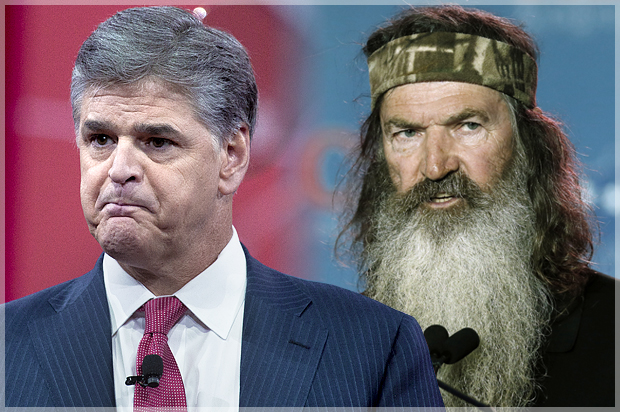
Dear White America: Your toxic masculinity is killing youSean Hannity, Phil Robertson (Credit: Jeff Malet, maletphoto.com/AP/Bill Haber/Salon)
Dear White America,
I am your friend. I have written several letters of this type to you before. It pains me to have to do so again. What I am going to share in this letter may be commonsense for many white brothers and sisters. Other White Americans may be surprised. Because our society is so segregated, people of color often do not have many opportunities to talk with white people in a direct way regarding our sincere worries about the problems in your community. I hope that this open letter can be part of a broader conversation in that regard.
When a person suffers from chronic pain they often find ways to compensate for it. Some people self-medicate with drugs or alcohol. Others develop the mental discipline necessary to compartmentalize their physical suffering. Others cocoon themselves in a bubble of denial. Because I am your friend, I am going to be honest with you. White America is suffering from a type of cancer. It is hurting you; it is killing your children; it is damaging families; it hurls shrapnel in many directions, maiming and otherwise bringing an end to the lives of those people who are unfortunate enough to be in its blast radius. If you want the truth, this is it: toxic white masculinity, and the backward right-wing politics which nurture and protect it, are hurting millions of you every year.
I know that is hard to digest. But, because I care about you White America, I am obligated to tell you the truth, even at the risk of your discomfort.
For many of you, the very idea that there is such a thing as toxic white masculinity is both surprising and enraging. Denial and anger are a very normal reaction when an uncomfortable truth is called to account. But it is the truth. Toxic white masculinity is a fear of the world changing to the disadvantage of white men, and where what too many white men take as natural rights are actually going to be exposed as unfair advantages, advantages which were gifted by a lottery of genetics and fortune of birth, as opposed to earned merit.
Toxic white masculinity defaults to violence as a means of maintaining social and political control. It clings to guns as a symbol of “real” male identity. It fears women as equals; it lashes out at non-whites who are somehow “stealing” white men’s jobs and power. Toxic white masculinity sees “liberals,” “progressives,” “social justice,” and “feminism” as enemies — out of a fear that “white masculinity” will somehow be made obsolete or extinct. The dream worlds and paranoid fantasies of angry white men are distractions that look to some type of Other as the preeminent threat to America’s safety and security. The reality is of course, very different.
In reality, right-wing domestic terrorists and mass shooters are the number one threat to America’s safety and security since September 11, 2001.
White men are approximately 31 percent of the United States population. And yet, white men are nearly 63 percent of those people who commit mass shootings. Such behavior, among any other group, would be considered pathological and a public health crisis.
Dylann Roof turned his toxic white racist masculinity on a black church in Charleston. And John Houser — a white, right-wing, conservative, Christian fundamentalist, an anti-feminist, woman-hating Nazi sympathizer — directed his rage towards a movie theater in Lafayette last month, where he killed three people and wounded eight others.
Because I am your friend White America, I will share another truth with you: While the mainstream news media will run away from subjects that make you uncomfortable, it is no coincidence that “Trainwreck,” a movie written by a white Jewish feminist comedian, was the target of John Houser’s lethal actions. It was not“mental illness” which made John Houser shoot those people in Lafayette, although such a claim is a common deflection that prevents a serious discussion of white masculinity and mass shootings. One can be “mentally ill” separate and apart from their violent impulses. No, it was extreme right-wing politics and toxic white masculinity that drove Houser to kill.
This is just the tip of the iceberg. The killing and abuse of women by men in the United States — the vast majority of it committed within the same “racial” group — is so common that it is rarely deemed to be newsworthy by the mainstream news media. This is a disgusting national embarrassment.
Toxic white masculinity is a complex problem. And you cannot fix it unless you also confront how toxic white masculinity is nurtured and encouraged by your news media and political representatives. While I do not think that you are a victim of your news media and political parties, you have nonetheless been done a disservice by them.
Fox News is your mouthpiece: 92 percent of its prime time viewing audience is white. Fox is the most popular cable news network in the United States. Millions of people watch it on a daily basis. Fox News is part of a propaganda machine that consists of the Internet, radio, and social media. This has created an alternate reality for many White Americans where down is up and up is down, so to speak. Researchers have shown that the right-wing media actually makes its public less knowledgeable about empirical reality and current events than those people who do not watch or listen to it.
The white identity politics, grievance mongering, conspiracies, paranoid thinking, eliminationist rhetoric about liberals and progressives, hostility to women, rage against immigrants, anxiety about those who are not “Christian”, and mainstreaming of white supremacy and white racial resentment, are the fuel for toxic white masculinity. The right-wing media gins up and encourages such sentiments because it is dependent on them for viewers and ad revenue.
The Republican Party, meanwhile, is America’s most prominent white identity organization. Since the end of the civil rights movement, the modern GOP has fused together conservatism and racism as its name brand. In the Age of Obama, the Republican Party has found itself increasingly dysfunctional as its politics are seemingly unable to evolve beyond “hate the black guy in the White House and anything that he proposes,” however reasonable. In many ways — the fetishistic embrace of guns, hostility to women’s rights, Islamophobia, symbolic and overt racism against black people — the policies and talking points of the contemporary Republican Party are toxic white masculinity as a campaign platform. Together with the alternate reality created by the right-wing media, the Republican Party has become so radicalized, breaking many of the standing norms of consensus politics in modern American politics, that it no longer functions as a responsible political organization.
White America, you have been confused, misled, and lied to by your primary political party and media. This is hurting you in many ways.
The American economy is broken. Wealth and income inequality are severe. The psychological wages of being White in America may still exist, but they are not translating into the material wealth they once did in the not so recent past. For example, there are more White Americans on welfare and other types of public aid than any other group. White Americans also receive a disproportionate percentageof public assistance dollars. As Robert Putnam details in his new book “Our Kids: The American Dream in Crisis,” the life opportunities and upward mobility of White America are increasingly imperiled. The abuse of prescription drugs, as well as illegal narcotics such as heroine and methamphetamines, is a severe problem for White America. The sum total of these and other troubles have left white folks — white men especially — less hopeful and feeling more insecure and angry about their future.
It is en vogue as of late to talk about the concept known as “white privilege.” I believe that such language often does more to distract than it reveals. I will not use it here. Given the many problems you are facing in these times of trouble, tumult, and economic peril, you are likely not feeling very privileged at all. I still have great hope for the possibilities that folks can come together to find shared and common concerns across barriers of race and class. But as much as I find inspiration in such dreams — and the examples history has provided us of such alliances in the United States and elsewhere — I will restrain myself.
Instead, I will appeal to your most basic self-interest.
White America, your media and political leadership have created a broken politics and economy that have left you less secure, less safe, and less upwardly mobile than generations past. But hostility and anxiety towards people who may have a different skin color than you is fool’s gold. White America’s leaders, and the plutocrats to whom they owe their allegiance, have been using that fake money to hustle and manipulate you for centuries.
White America, toxic white masculinity has provided a type of succor and protective blanket for many of your men. But this toxic white masculinity is killing your women and children — and even hurting and killing your men as well, both in the literal physical sense, and the figurative one, damaging their capacity to live full and emotionally healthy and satisfying lives.
White America, I end this open letter as I began it. I am your friend. I care deeply about your health and well-being. You can make a better way. But first, you must choose to do so.
Chauncey DeVega is editor and founder of the blog We Are Respectable Negroes, whose work has been featured by the NY Times, Alternet, the BBC, the New York Daily News, the Utne Reader, the Week, and The Atlantic Monthly. Chauncey DeVega is also a regular guest on Ring of Fire Radio and TV. He can be followed on Twitter and Facebook.

Saturday, May 16, 2015

The Myth of American Exceptionalism


FP


Voice

The Myth of American Exceptionalism


The idea that the United States is uniquely virtuous may be comforting to Americans. Too bad it's not true.


The Myth of American Exceptionalism


Over the last two centuries, prominent Americans have described the United States as an "empire of liberty," a "shining city on a hill," the "last best hope of Earth," the "leader of the free world," and the "indispensable nation." These enduring tropes explain why all presidential candidates feel compelled to offer ritualistic paeans to America’s greatness and why President Barack Obama landed in hot water — most recently, from Mitt Romney — for saying that while he believed in "American exceptionalism," it was no different from "British exceptionalism," "Greek exceptionalism," or any other country’s brand of patriotic chest-thumping.


Most statements of "American exceptionalism" presume that America’s values, political system, and history are unique and worthy of universal admiration. They also imply that the United States is both destined and entitled to play a distinct and positive role on the world stage.

The only thing wrong with this self-congratulatory portrait of America’s global role is that it is mostly a myth. Although the United States possesses certain unique qualities — from high levels of religiosity to a political culture that privileges individual freedom — the conduct of U.S. foreign policy has been determined primarily by its relative power and by the inherently competitive nature of international politics. By focusing on their supposedly exceptional qualities, Americans blind themselves to the ways that they are a lot like everyone else.

This unchallenged faith in American exceptionalism makes it harder for Americans to understand why others are less enthusiastic about U.S. dominance, often alarmed by U.S. policies, and frequently irritated by what they see as U.S. hypocrisy, whether the subject is possession of nuclear weapons, conformity with international law, or America’s tendency to condemn the conduct of others while ignoring its own failings. Ironically, U.S. foreign policy would probably be more effective if Americans were less convinced of their own unique virtues and less eager to proclaim them.

What we need, in short, is a more realistic and critical assessment of America’s true character and contributions. In that spirit, I offer here the Top 5 Myths about American Exceptionalism.


Myth 1

There Is Something Exceptional About American Exceptionalism.

 
Whenever American leaders refer to the "unique" responsibilities of the United States, they are saying that it is different from other powers and that these differences require them to take on special burdens.

Yet there is nothing unusual about such lofty declarations; indeed, those who make them are treading a well-worn path. Most great powers have considered themselves superior to their rivals and have believed that they were advancing some greater good when they imposed their preferences on others. The British thought they were bearing the "white man’s burden," while French colonialists invoked la mission civilisatrice to justify their empire. Portugal, whose imperial activities were hardly distinguished, believed it was promoting a certain missão civilizadora. Even many of the officials of the former Soviet Union genuinely believed they were leading the world toward a socialist utopia despite the many cruelties that communist rule inflicted. Of course, the United States has by far the better claim to virtue than Stalin or his successors, but Obama was right to remind us that all countries prize their own particular qualities.

So when Americans proclaim they are exceptional and indispensable, they are simply the latest nation to sing a familiar old song. Among great powers, thinking you’re special is the norm, not the exception.


Myth 2

The United States Behaves Better Than Other Nations Do.

 
Declarations of American exceptionalism rest on the belief that the United States is a uniquely virtuous nation, one that loves peace, nurtures liberty, respects human rights, and embraces the rule of law. Americans like to think their country behaves much better than other states do, and certainly better than other great powers.

If only it were true. The United States may not have been as brutal as the worst states in world history, but a dispassionate look at the historical record belies most claims about America’s moral superiority.

For starters, the United States has been one of the most expansionist powers in modern history. It began as 13 small colonies clinging to the Eastern Seaboard, but eventually expanded across North America, seizing Texas, Arizona, New Mexico, and California from Mexico in 1846. Along the way, it eliminated most of the native population and confined the survivors to impoverished reservations. By the mid-19th century, it had pushed Britain out of the Pacific Northwest and consolidated its hegemony over the Western Hemisphere.

The United States has fought numerous wars since then — starting several of them — and its wartime conduct has hardly been a model of restraint. The 1899-1902 conquest of the Philippines killed some 200,000 to 400,000 Filipinos, most of them civilians, and the United States and its allies did not hesitate to dispatch some 305,000 German and 330,000 Japanese civilians through aerial bombing during World War II, mostly through deliberate campaigns against enemy cities. No wonder Gen. Curtis LeMay, who directed the bombing campaign against Japan, told an aide, "If the U.S. lost the war, we would be prosecuted as war criminals." The United States dropped more than 6 million tons of bombs during the Indochina war, including tons of napalm and lethal defoliants like Agent Orange, and it is directly responsible for the deaths of many of the roughly 1 million civilians who died in that war.

More recently, the U.S.-backed Contra war in Nicaragua killed some 30,000 Nicaraguans, a percentage of their population equivalent to 2 million dead Americans. U.S. military action has led directly or indirectly to the deaths of 250,000 Muslims over the past three decades (and that’s a low-end estimate, not counting the deaths resulting from the sanctions against Iraq in the 1990s), including the more than 100,000 people who died following the invasion and occupation of Iraq in 2003. U.S. drones and Special Forces are going after suspected terrorists in at least five countries at present and have killed an unknown number of innocent civilians in the process. Some of these actions may have been necessary to make Americans more prosperous and secure. But while Americans would undoubtedly regard such acts as indefensible if some foreign country were doing them to us, hardly any U.S. politicians have questioned these policies. Instead, Americans still wonder, "Why do they hate us?"

The United States talks a good game on human rights and international law, but it has refused to sign most human rights treaties, is not a party to the International Criminal Court, and has been all too willing to cozy up to dictators — remember our friend Hosni Mubarak? — with abysmal human rights records. If that were not enough, the abuses at Abu Ghraib and the George W. Bush administration’s reliance on waterboarding, extraordinary rendition, and preventive detention should shake America’s belief that it consistently acts in a morally superior fashion. Obama’s decision to retain many of these policies suggests they were not a temporary aberration.

The United States never conquered a vast overseas empire or caused millions to die through tyrannical blunders like China’s Great Leap Forward or Stalin’s forced collectivization. And given the vast power at its disposal for much of the past century, Washington could certainly have done much worse. But the record is clear: U.S. leaders have done what they thought they had to do when confronted by external dangers, and they paid scant attention to moral principles along the way. The idea that the United States is uniquely virtuous may be comforting to Americans; too bad it’s not true. 


Myth 3

America’s Success Is Due to Its Special Genius.

 
The United States has enjoyed remarkable success, and Americans tend to portray their rise to world power as a direct result of the political foresight of the Founding Fathers, the virtues of the U.S. Constitution, the priority placed on individual liberty, and the creativity and hard work of the American people. In this narrative, the United States enjoys an exceptional global position today because it is, well, exceptional.

There is more than a grain of truth to this version of American history. It’s not an accident that immigrants came to America in droves in search of economic opportunity, and the "melting pot" myth facilitated the assimilation of each wave of new Americans. America’s scientific and technological achievements are fully deserving of praise and owe something to the openness and vitality of the American political order.

But America’s past success is due as much to good luck as to any uniquely American virtues. The new nation was lucky that the continent was lavishly endowed with natural resources and traversed by navigable rivers. It was lucky to have been founded far from the other great powers and even luckier that the native population was less advanced and highly susceptible to European diseases. Americans were fortunate that the European great powers were at war for much of the republic’s early history, which greatly facilitated its expansion across the continent, and its global primacy was ensured after the other great powers fought two devastating world wars. This account of America’s rise does not deny that the United States did many things right, but it also acknowledges that America’s present position owes as much to good fortune as to any special genius or "manifest destiny."


Myth 4

The United States Is Responsible for Most of the Good in the World.

 
Americans are fond of giving themselves credit for positive international developments. President Bill Clinton believed the United States was "indispensable to the forging of stable political relations," and the late Harvard University political scientist Samuel P. Huntington thought U.S. primacy was central "to the future of freedom, democracy, open economies, and international order in the world." Journalist Michael Hirsh has gone even further, writing in his book At War With Ourselves that America’s global role is "the greatest gift the world has received in many, many centuries, possibly all of recorded history." Scholarly works such as Tony Smith’s America’s Mission and G. John Ikenberry’s Liberal Leviathan emphasize America’s contribution to the spread of democracy and its promotion of a supposedly liberal world order. Given all the high-fives American leaders have given themselves, it is hardly surprising that most Americans see their country as an overwhelmingly positive force in world affairs.

Once again, there is something to this line of argument, just not enough to make it entirely accurate. The United States has made undeniable contributions to peace and stability in the world over the past century, including the Marshall Plan, the creation and management of the Bretton Woods system, its rhetorical support for the core principles of democracy and human rights, and its mostly stabilizing military presence in Europe and the Far East. But the belief that all good things flow from Washington’s wisdom overstates the U.S. contribution by a wide margin.

For starters, though Americans watching Saving Private Ryan or Patton may conclude that the United States played the central role in vanquishing Nazi Germany, most of the fighting was in Eastern Europe and the main burden of defeating Hitler’s war machine was borne by the Soviet Union. Similarly, though the Marshall Plan and NATO played important roles in Europe’s post-World War II success, Europeans deserve at least as much credit for rebuilding their economies, constructing a novel economic and political union, and moving beyond four centuries of sometimes bitter rivalry. Americans also tend to think they won the Cold War all by themselves, a view that ignores the contributions of other anti-Soviet adversaries and the courageous dissidents whose resistance to communist rule produced the "velvet revolutions" of 1989.

Moreover, as Godfrey Hodgson recently noted in his sympathetic but clear-eyed book, The Myth of American Exceptionalism, the spread of liberal ideals is a global phenomenon with roots in the Enlightenment, and European philosophers and political leaders did much to advance the democratic ideal. Similarly, the abolition of slavery and the long effort to improve the status of women owe more to Britain and other democracies than to the United States, where progress in both areas trailed many other countries. Nor can the United States claim a global leadership role today on gay rights, criminal justice, or economic equality — Europe’s got those areas covered.

Finally, any honest accounting of the past half-century must acknowledge the downside of American primacy. The United States has been the major producer of greenhouse gases for most of the last hundred years and thus a principal cause of the adverse changes that are altering the global environment. The United States stood on the wrong side of the long struggle against apartheid in South Africa and backed plenty of unsavory dictatorships — including Saddam Hussein’s — when short-term strategic interests dictated. Americans may be justly proud of their role in creating and defending Israel and in combating global anti-Semitism, but its one-sided policies have also prolonged Palestinian statelessness and sustained Israel’s brutal occupation.

Bottom line: Americans take too much credit for global progress and accept too little blame for areas where U.S. policy has in fact been counterproductive. Americans are blind to their weak spots, and in ways that have real-world consequences. Remember when Pentagon planners thought U.S. troops would be greeted in Baghdad with flowers and parades? They mostly got RPGs and IEDs instead.

Myth 5

God Is on Our Side.

 
A crucial component of American exceptionalism is the belief that the United States has a divinely ordained mission to lead the rest of the world. Ronald Reagan told audiences that there was "some divine plan" that had placed America here, and once quoted Pope Pius XII saying, "Into the hands of America God has placed the destinies of an afflicted mankind." Bush offered a similar view in 2004, saying, "We have a calling from beyond the stars to stand for freedom." The same idea was expressed, albeit less nobly, in Otto von Bismarck’s alleged quip that "God has a special providence for fools, drunks, and the United States."

Confidence is a valuable commodity for any country. But when a nation starts to think it enjoys the mandate of heaven and becomes convinced that it cannot fail or be led astray by scoundrels or incompetents, then reality is likely to deliver a swift rebuke. Ancient Athens, Napoleonic France, imperial Japan, and countless other countries have succumbed to this sort of hubris, and nearly always with catastrophic results.

Despite America’s many successes, the country is hardly immune from setbacks, follies, and boneheaded blunders. If you have any doubts about that, just reflect on how a decade of ill-advised tax cuts, two costly and unsuccessful wars, and a financial meltdown driven mostly by greed and corruption have managed to squander the privileged position the United States enjoyed at the end of the 20th century. Instead of assuming that God is on their side, perhaps Americans should heed Abraham Lincoln’s admonition that our greatest concern should be "whether we are on God’s side."

Given the many challenges Americans now face, from persistent unemployment to the burden of winding down two deadly wars, it’s unsurprising that they find the idea of their own exceptionalism comforting — and that their aspiring political leaders have been proclaiming it with increasing fervor. Such patriotism has its benefits, but not when it leads to a basic misunderstanding of America’s role in the world. This is exactly how bad decisions get made.

America has its own special qualities, as all countries do, but it is still a state embedded in a competitive global system. It is far stronger and richer than most, and its geopolitical position is remarkably favorable. These advantages give the United States a wider range of choice in its conduct of foreign affairs, but they don’t ensure that its choices will be good ones. Far from being a unique state whose behavior is radically different from that of other great powers, the United States has behaved like all the rest, pursuing its own self-interest first and foremost, seeking to improve its relative position over time, and devoting relatively little blood or treasure to purely idealistic pursuits. Yet, just like past great powers, it has convinced itself that it is different, and better, than everyone else. 

International politics is a contact sport, and even powerful states must compromise their political principles for the sake of security and prosperity. Nationalism is also a powerful force, and it inevitably highlights the country’s virtues and sugarcoats its less savory aspects. But if Americans want to be truly exceptional, they might start by viewing the whole idea of "American exceptionalism" with a much more skeptical eye.

Friday, May 15, 2015

American Exceptionalism Is No Shining City On a Hill: It Never Was.


US Empire

American Exceptionalism Is No Shining City On a Hill

by GILBERT MERCIER


The concept of American exceptionalism is as old as the United States, and it implies that the country has a qualitative difference from other nations. This notion of being special gives Americans the sense that playing a lead role in world affair is part of their natural historic calling. However there is nothing historically exceptional about this: the Roman empire also viewed itself as a system superior to other nations and, more recently, so did the British and the French empires.

On the topic of American exceptionalism, which he often called “Americanism”, Seymour Martin Lipset noted that “America’s ideology can be described in five words: liberty, egalitarism, individualism, populism and laissez-faire. The revolutionary ideology, which became American creed, is liberalism in its eighteenth and nineteenth-century meaning. It departed from conservatism Toryism, statist communitarianism, mercantilism and noblesse-oblige dominant in monarchical state-church formed cultures.” Naturally identifying America’s system as a unique ideology, just like calling its successful colonial war against Britain a revolution, is a fallacy. For one, America was never based on social equality, as rigid class distinctions always remained through US history.

In reality, the US has never broken from European social models. American exceptionalism implies a sense of superiority, just like in the case of the British empire, the French empire and the Roman empire. In such imperialist systems, class inequality was never challenged and, as matter of fact, served as cornerstone of the imperial structure. In American history, the only exception to this system based on social inequality was during the post World War II era of the economic “miracle”. The period from 1945 to the mid 1970s was characterized by major economic growth, an absence of big economic downturns, and a much higher level of social mobility on a massive scale. This time frame saw a tremendous expansion of higher education: from 2.5 million people to 12 million going to colleges and universities, and this education explosion, naturally, fostered this upward mobility where the American dream became possible for the middle class.

Regardless of  real domestic social progress made in the United States after the birth of the empire in 1945, for the proponents of American exceptionalism — this includes the entire political class — the myth of the US being defined as a “shining city on a hill” has always been a rationale to justify the pursuit of imperialism. For example, when President Barack Obama addressed the nation to justify the US military intervention in Libya, he said that “America is different”, as if the US has a special role in history as a force for good. In a speech on US foreign policy, at West Point on May 28, 2014, Obama bluntly stated: “In fact, by most measures, America has rarely been stronger relative to the rest of the world. Those who argue otherwise — who suggest that America is in decline or has seen its global leadership slip away are misreading history. Our military has no peer….  I believe in American exceptionalism with every fiber of my being.”

In his book, Democracy In America, Frenchman Alexis de Tocqueville was lyrical in his propaganda-like adulation of American exceptionalism, defining it almost as divine providence. “When the earth was given to men by the Creator, the earth was inexhaustible. But men were weak and ignorant, and when they had learned to take advantage of the treasures which it contained, they already covered its surface and were soon obliged to earn by the sword an asylum for repose and freedom. Just then North America was discovered, as if it had been kept in reserve by the Deity and had risen from beneath the waters of the deluge”, wrote de Tocqueville.

This notion, originated by the French author, and amplified ever since, which defined the US as the “divine gift” of a moral and virtuous land, is a cruel fairy tale. It is mainly convenient to ease up America’s profound guilt. After all, the brutal birth of this nation took place under the curse of two cardinal sins: the theft of Native American lands after committing a genocide of their population; and the hideous crime of slavery, with slaves building an immense wealth for the few, in a new feudal system, with their sweat, tears and blood.


Gilbert Mercier is the Editor in Chief of News Junkie Post.

Sunday, May 3, 2015

Institutional Racism and Poverty


Meryl Mohan


Institutional Racism and Poverty


Social Inequality and Public Policy - Professor Isaac Martin - March 2009

Institutional racism is a form of racism that exists subtly and beneath the conspicuous actions and policies of structures and institutions. For the purposes of this paper, “institution” refers to an establishment or governing body that creates or sets rules, policies, or standards in society. These institutions produce a societal order and hierarchy, impacting human behavior with its power to overshadow individuals’ own potential and intentions. “Racism” refers to the belief, and acts in conjunction with this belief, that particular races are innately different and inferior to others. Yet, beyond this compound definition, this research paper regards institutional racism as not only the deliberate actions of institutions, but also the ignorant and apathetic actions of institutions in perpetuating racism.


In this paper, I plan to discuss this particular form of racism, debating its contributions to the issue of poverty. I argue the way in which institutions can keep people in poverty or even force people into poverty in the United States. I believe this research is important, as institutional racism often goes under the radar. Often, only field research or investigation reveals the subversive tactics of institutional racism. In addition, it normatively goes unrecognized by the public and even those who are directly affected by it. As a result, this form of discrimination, whether deliberate or incognizant, is more difficult to curtail. These methods are safeguarded by the institutions themselves, falling under an umbrella of legitimate policies and actions. With relation to poverty, institutional racism can keep certain races in a perpetual condition of poverty, denying them the opportunities and capabilities to rise above their poor status.

This research is potentially important for policy makers, as information on this topic can provide greater resources and different angles for policy makers to approach the issue of poverty. Even as race itself is a “taboo” subject, conclusive research has the potential to present evidence pointing to institutional racism and the prevalence of poverty among those races. As policy makers have the possibility to influence, curb, or promote the institutional decisions regarding access to jobs, education, or a good quality of life, this research will be potentially important for them. With more strict policies regarding institutions and racism, policy makers can begin to tackle an issue that is still prevalent in society today.

One can examine this issue in a variety of methods, yet I intend to address institutional racism through particular categories of structures and their adverse effect on poverty. Specifically, I will focus on the institutions within the sectors of criminal justice, education, and urban planning. The structures of criminal justice include the prisons and courts of the criminal justice system. Within education, the school boards and test-maker organizations both execute institutionally racist practices. Finally, in the field of urban planning, the city government further maintains and increases poverty among minorities. All of these three spheres connect along the overarching importance of geographic mismatch. The spatial relations of the prisons, the inner city schools, and the industrial urban centers all reflect the setbacks and opportunities minorities face in the United States.

In the sphere of criminal justice, the institutions of prisons and courts create a system that purports racism and contributes to poverty in the United States. In this system, institutional racism takes root in the factors that generate the overwhelming majority of minorities in prison. In Katherine Pettus’s book Felony Disenfranchisement in America, she argues that the institution of prisons and the criminal justice system are a product of the racist roots upon which America was built (Pettus 151). She discusses the United States’s criminal justice policy as one that accentuates and breeds groups of domination and subordination. The same laws broken by white people are not handled through the criminal justice system, affirming that the law and the prisons were not created for white people in mind, but for minorities (151). In conjunction with this structure and composition of prisons, the geographic location of the prison creates and sustains disparate groups that institutionalize segregation. In society, prisons “perform a kind of social, economic, and political ‘magic’ by ‘disappearing’ large number of poor and minority people” (Rhodes 67). Statistics of the racial makeup in prisons further confirm these statements, as in the United States, more than 50 percent of the prisoners are African American, and 75 percent of the prisoners are people of color (67). Prisons remain on the periphery of white counties, isolated from the metropolis but still set in stark contrast to white suburbia and the cosmopolitan lifestyle (Pettus 20). The disenfranchised felons and ex-felons remain on the periphery of society, isolated from the opportunities within the metropolis.

Institutionally, the courts implement additional racist practices that contribute to this pervading disparity in prison demographic. The jury selection process, for example, results in primarily white juries. Customarily, this process relies on the exclusion of those with minimal educational credentials, hourly wage earners, and low-income individuals (Feagin and Feagin 141). As the courts themselves provide poor compensation, many low-income minorities cannot afford to leave their jobs to attend jury duty (142). Due to this condition, juries remain disproportionately white. Consequently, there exists an unequal representation of race and class in the courtroom, potentially increasing the number of minorities institutionalized in prisons.

The institution of prisons and the practices of courts harbor an environment in which the criminal justice system fails to provide a smooth re-integration of ex-felons into society. The lack of white populations in the prisons aid the legislation of restrictive laws that keep minorities barred from social integration after prison (Behrens et al. 599). Specifically, racial differences in punishment reflect restrictions on voting rights that “dilute the voting strength of minority groups” (599). Considering the racial makeup of prisons, its locality, and the lack of attention paid to minority disadvantages, disenfranchisement severely handicaps ex-felons and their re-entry into society. The stamp of a criminal record already hinders employment opportunities and earnings potential. With ex-felons representing about eight percent of the working-age population (Pager 938), the restrictions ex-felons face in obtaining housing or government benefits perpetuate poverty in society (Manza and Uggens 502). Denying them voting rights “undermines their capacity to connect with the political system, and [thereby] increase[s] their risk of recidivism” (Manza and Uggens 502). These factors continue a cycle in which minorities face greater risk of entering prison and greater difficulty in transitioning back into society once released. 

Institutional racism within the criminal justice sphere fosters the likelihood of minorities entering prison. Moreover, it further cultivates lingering effects upon ex-felons, making it atypical for them to rise above their peripheral status in society.

In addition to the institutional racism prevalent in the criminal justice system, education institutions like the school board and test-maker organizations also establish racist policies that perpetuate poverty in society. Through modes of cultural and linguistic ignorance, institutions pay inadequate attention to the respective needs of minorities in the education system. This mode continues from basic to college education, as institutions continue to tailor their best educational resources and opportunities to those of the white middle class. In “Institutionalized Racism and the Education of Blacks,” Spears discusses the educational performance of black students. He argues that the poor academic achievement by black students is partially due to educational systems’ ignorance of their various linguistic and cultural differences (Spears 128). Spears states that the same criteria and practices applied to white students cannot simply be applied to black students. For each individual, one must take into consideration the background and manner in which they are best suited to learn and grasp material. The decision makers of school curriculums in the inner city do not understand the ways in which discrimination and deprivation alter how students learn and mature. Black students are victimized by the institutions that disregard their educational needs, and comparing their performance to white students who lack this victimization by institutionalized racism is a false evaluation. Specifically in regard to African Americans, this racism denies the same opportunities and services by which they can achieve a good life.

Test-maker organizations also perpetuate racism by ignoring the cultural differences of low-income and minority students. These organizations create tests that do not take into consideration the cultural, linguistic, geographic, social, and economic differences of black students, for example. The inferior education provided in these inner city schools creates difficulties in passing written or standardized tests for minority students (Knowles and Prewitt 61). In continuing education, university admission offices provide entrance to students who score high on a test that is geared towards white middle class high schools, not the inner city schools in which minority population is high (5). Even if these universities do not purposely implement racist practices, they unwittingly grant the white, middle, and affluent classes a higher education and a more financially secure future. The structures of education fail to prepare all students through methods of racial and class segregation, and minorities themselves lack the power to make these structural changes.

In the education system, school boards also exhibit forms of institutional racism by placing students in academic tracks based on ability. In “Tracking: From Theory to Practice,” Maureen T. Hallinan discusses the negative effects of placing children in these different tracks. She argues that this process fosters segregation, and the schools and school boards fail to take action to instate measures that prevent this segregation based on race, social status, and class (Hallinan 84). The racism prevalent in these tracking systems is evident through the overrepresentation of African Americans and Latinos in the lower tracks. Many schools in predominantly poor and minority neighborhoods offer a fewer percentage of higher track classes, in comparison to those in affluent white and Asian populated areas (Oakes 229). In addition, higher tracks vary across racial and economic lines. In schools with more minority and lower-income populations, evidence shows a disparity in the quality of resources and opportunities offered. For example, an Algebra 2 class in a minority-rich neighborhood might be taught by a less qualified teacher with a less rigorous curriculum than the same class in a predominantly white, prosperous neighborhood (229). Teachers themselves gravitate towards the white, affluent communities that offer higher pay and esteem, leaving the less wealthy communities with less-qualified teachers. Furthermore, high competition in the wealthier schools results in minority students having greater chances of college-track enrollment at all-minority schools. As a consequence, minority students receive an inferior quality of education in comparison, hindering the acquisition of human capital with which to compete in the labor market.  

Repeatedly, spatial and geographic orientation is seen to either harm or foster a good quality of life, whether it concerns prisons and their peripheral location, or the inferior education prevalent in the inner city schools. Institutions within the urban planning sector, such as the city government, also influence the geographic location of individuals, defining zones and setting ordinances. 

Proximity to certain areas impacts one’s capability to obtain a job and remain in healthy living and working conditions. Primarily, the lack of consideration and recognition of the effects of zoning and urban planning reflects in the continuing poverty of minorities. The polarization of jobs and housing, for example, negatively affects the minorities who live in the metropolitan centers. According to Knowles and Prewitt in Institutional Racism in America, the “ghetto resident is left without the means to reach most jobs,” as city governments fail to provide low-cost, adequate transportation to the outlying areas where income potential is higher (Knowles and Prewitt 21). The majority of well-paying jobs follow the white middle class into the areas in which they live. This geographic mismatch leaves them outside the “major web of recruitment,” which occurs in the suburban spheres of economic development (Feagin and Feagin 47). As a result, those in the inner city are left with the low paying jobs that cannot suffice for a good quality of life.

In addition to this, minority families are often susceptible, through projects like urban renewal, to the dangers of noise, pollution, and other ills that only perpetuate a status of poverty and deprivation. These plans look to eliminate slum housing and replace it with private businesses that expand profit, forcing minorities in these locations out of their homes (Feagin and Feagin 107). With projects like highway construction to connect white suburbs, minority families are further displaced. White middle-class individuals can leave these locations with ease, whereas “the black people [evicted] by the bulldozers” find it extremely difficult (Knowles and Prewitt 28). Institutional racism lives within the city governments of the United States whose inaction and lack of recognition reproduces the adverse effects of decisions like urban renewal.

In addition to urban renewal, the city government also practices institutional racism as it relates to environmental racism. Specifically, environmental racism addresses environmental hazards and demographics, arguing the existence of “white privilege.” White privilege in this instance refers to the way in which white society has utilized their race to engender environmental racism, allowing people of color to inherit the hazards of urban development (Pulido 12). In many cities, whites have managed to move away from the industrial centers through suburbanization. In Los Angeles, however, many nonwhites have started moving into the suburbs neighboring the industrial core. As a result, these suburbs have now become an extension of the inner city, and central Los Angeles remains a largely nonwhite area (12). Yet, these same areas are also where the concentration of environmental hazards exists. Minorities are forced into the hazardous city center, and the city government allows these people to live in dangerous health zones. The government controls land uses and ordinances, and permits noxious land uses around areas such as central Los Angeles. This heightens poverty, creating an undesirable environment in which businesses cannot grow, job opportunities diminish, health conditions worsen, and the quality of life disintegrates.

Institutional racism rests within the structures of America’s society. Through the seemingly legitimate actions of these institutions, the effects of this form of racism continue to act as a pervading cause of poverty. Spatial relations, one of the most significant criteria in the status of poverty among individuals, often determines the wealth of opportunities and resources available to people. Whether this locality relates to one’s job, housing, or other aspects, geographic mismatch decidedly contributes to the perpetuation of poverty. In the sectors of criminal justice, education, and urban planning, the location of the prisons, the inner city schools, and the layout of homes and jobs create a web of disparity between minorities and the white, affluent class. The overt, subtle, and even ignorant actions of institutions in these sectors further reproduce poverty along racial lines, establishing conditions in which minorities are set at a considerable disadvantage in society.

Works Cited
  1. Behrens, Angela, and Christopher Uggen and Jeff Manza. “Ballot Manipulation and the ‘Menace of Negro Domination’: Racial Threat and Felon Disenfranchisement in the United States.” The American Journal of Sociology. 109.3 (2003): 559-6065. JSTOR. 2 March 2009. <http://links.jstor.org/search>.
  2. Feagin, Joe R. and Clairece Booher Feagin. Discrimination American Style. Englewood Cliffs: Prentice-Hall, Inc., 1978.
  3. Frymer, Paul. “Courts, Labor Law, and the Institutional Construction of Racial Animus.” The American Political Science Review. 99.3 (2005): 373-387. JSTOR. 9 Feb. 2009. <http://links.jstor.org/search>.
  4. Hallinan, Maureen T. “Tracking: From Theory to Practice.” Sociology of Education. 67.2 (1994): 79-84. JSTOR. 2 March 2009. <http://links.jstor.org/search>.
  5. Knowles, Louis L. and Kenneth Prewitt. Institutional Racism in America. Englewood Cliffs: Prentice-Hall, Inc., 1969.
  6. Manza, Jeff and Christopher Uggen. “Punishment and Democracy: Disenfranchisement of Nonincarcerated Felons in the United States.” Perspectives on Politics. 2.3 (2004): 491-505.  JSTOR. 18 March 2009. <http://links.jstor.org/search>.
  7. Oakes, Jeannie. Keeping Track: How Schools Structure Inequality. New Haven: Yale University Press, 1985.
  8. Pager, Devah. “The Mark of a Criminal Record.” The American Journal of Sociology. 108.5 (2003): 937-975. JSTOR. 17 March 2009. <http://links.jstor.org/search>.
  9. Pettus, Katherine Irene. Felony Disenfranchisement in America. New York: LFB Scholarly Publishing LLC, 2005.
  10. Pulido, Laura. “Rethinking Environmental Racism: White Privilege and Urban Development in Southern California.” Annals of the Association of American Geographers. 90.1 (2000): 12-40. JSTOR. 9 Feb. 2009. <http://links.jstor.org/search>.
  11. Rhodes, Lorna A. “Toward an Anthropology of Prisons.” Annual Review of Anthropology. 30 (2001): 65-83. JSTOR. 17 March 2009. <http://links.jstor.org/search>.
  12. Spears, Arthur K. “Institutionalized Racism and the Education of Blacks.” Anthropology & Education Quarterly. 90.2 (1978): 127-136. JSTOR. 9 Feb. 2009. <http://links.jstor.org/search>.